1. Right side (10) is positive → two cases.
2. Case 1: 2x - 4 = 10 → 2x = 14 → x = 7
3. Case 2: 2x - 4 = -10 → 2x = -6 → x = -3
4. Check: |2(7)-4| = 10 | 2(-3)-4| = |-10| = 10
x = 7 and x = -3 (both verified)

|
Preparing for the SAT? Claim Your Personalized Math Plan →
|
The absolute value of a number is its distance from zero on a number line — always zero or positive, never negative. Written as |x|, it equals x when x is positive and −x when x is negative. To solve an absolute value equation like |x| = 5, set up two cases: x = 5 and x = −5. Absolute value appears on the SAT Math section in both equations and inequalities.
The absolute value of a number is its distance from zero on a number line — always zero or positive, never negative. Written |x|, it equals x when x ≥ 0 and −x when x < 0. To solve |x| = 5, set up two cases: x = 5 and x = −5. Tested on the SAT in both equations and inequalities.
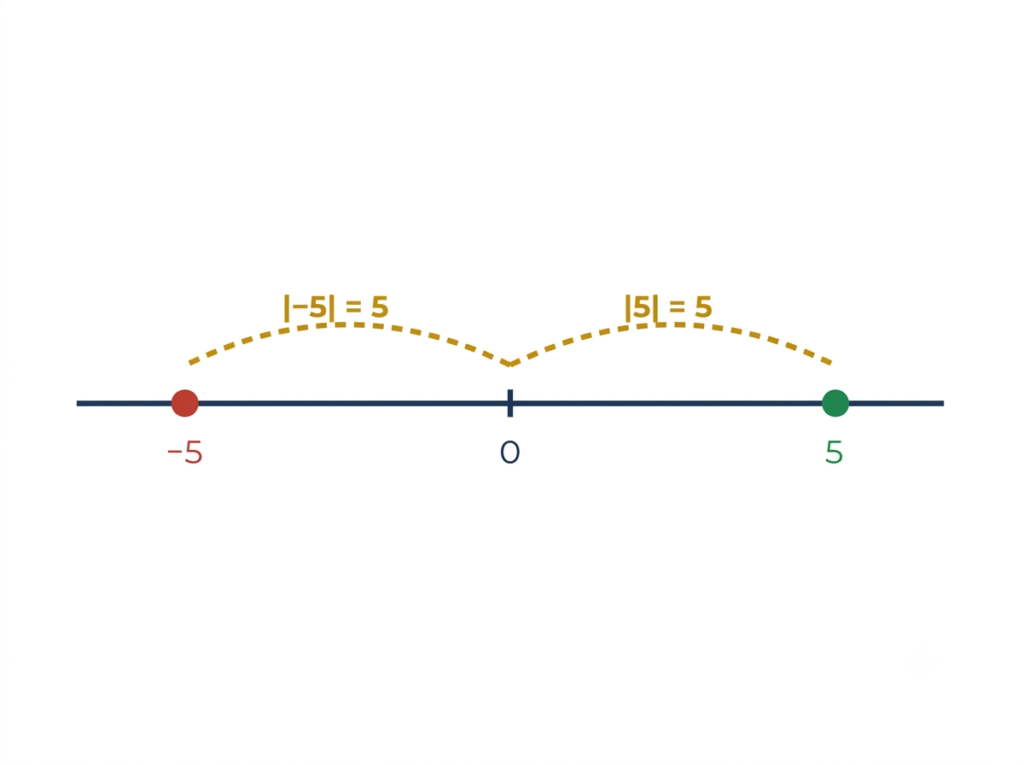
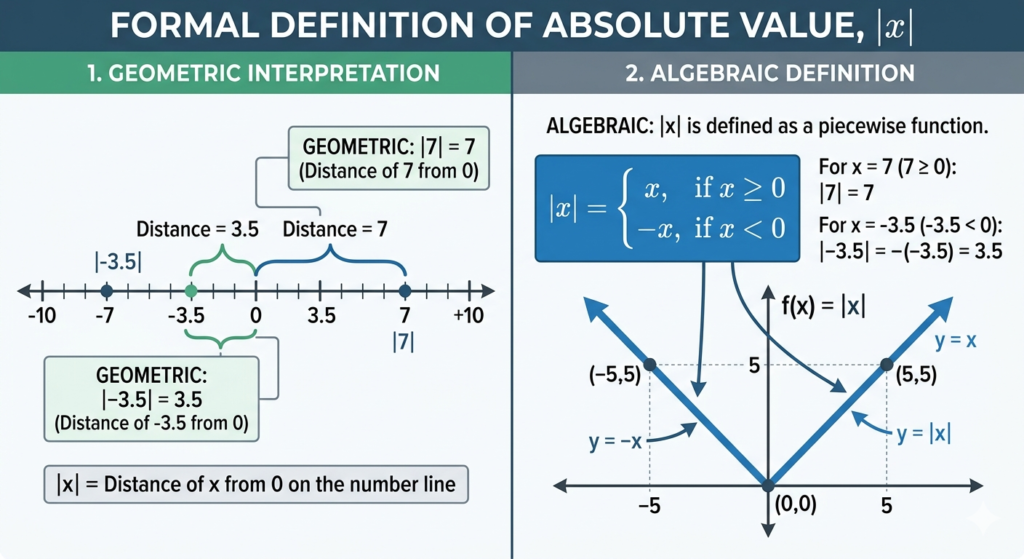
The absolute value of a real number x, written |x|, is its distance from zero on the number line — so it’s always zero or positive, regardless of sign. Both 5 and −5 sit a distance of 5 from zero, so |5| = |−5| = 5. Examples: |7| = 7, |−3.5| = 3.5, |0| = 0.
Every absolute value problem is one of three types. Identify it first (= vs. < vs. >), then apply its rule.
Formal definition: The absolute value of a real number x, written |x|, is the non-negative value of x without regard to its sign. Geometrically, |x| is x’s distance from zero on a number line. Algebraically, it is defined as a piecewise function:
Where you’ll see it: Absolute value appears throughout algebra (grades 8–11), Florida FSA and EOC assessments, SAT Math (linear equations and inequalities section), ACT Mathematics, and Florida MAFS.912.A-REI standards for solving equations and inequalities.
Absolute value problems fall into two types: equations (|expression| = number) and inequalities (|expression| < or > number). Each type requires a specific case-split procedure. Learn the rule for each type and you can solve any absolute value problem on the SAT Math section.
Absolute value is tested in the SAT Math section under the “Linear Equations, Linear Inequalities, and Linear Functions” domain — one of the four highest-weighted algebra content areas. Every SAT Math section contains at least one absolute value problem; most contain two. The most common types: solving a two-case equation, identifying whether an equation has no solution, and solving an absolute value inequality.
| SAT QUESTION TYPE | WHAT IT TESTS | FREQUENCY |
|---|---|---|
| Equation — Two Cases | Solve |ax + b| = c for both positive and negative cases. Most commonly appears with one extraneous solution that must be eliminated. | 1–2× per test |
| No Solution Trap | |expression| = negative number → no solution. Students must recognize this before attempting algebra. Common SAT multiple-choice trap. | ~1× per test |
| Inequality — AND | |ax + b| < c → compound inequality. Solved as -c < ax + b < c. Answer reported as interval or inequality notation. | ~1× per test |
| Graph Interpretation | Identify the graph of y = |x - h| + k (vertex at (h, k)) or match an absolute value function to its equation from a V-shaped graph. | ~1× per test |
Rule: If the number is positive, split into two cases. If the number is zero, solve one equation. If the number is negative, write “no solution” immediately — do not attempt algebra.
Memory device: “Positive = split. Zero = one. Negative = none.”
MAFS connection: MAFS.912.A-REI.1 (solving equations in one variable) — absolute value equations are tested as a subset of linear equation solving.
Rule: Rewrite as a compound AND inequality: −number < expression < number. Solve the compound inequality. Graph as a bounded segment (between two points) on the number line.
Memory device: “Less than = Between.” The absolute value is less than a distance — so x must be between the two bounds. Closed interval [ ] if ≤; open interval ( ) if <.
Common trap: Forgetting to write the AND compound — writing two separate inequalities that both go in the same direction (x < 5 and x < −5) instead of converging toward zero (−5 < x < 5).
Rule: Rewrite as two separate OR inequalities: expression > number OR expression < −number. Graph as two rays pointing away from the center on the number line.
Memory device: “Greater than = Apart.” The absolute value exceeds a distance — so x must be far from zero in either direction. This is the “OR” type.
Critical sign flip: In the negative case (expression < −number), the inequality direction stays the same — you are not dividing by a negative. The flip only happens if you divide both sides by a negative coefficient after the split.
❌ Solving an absolute value equation when the right side is negative. |2x + 3| = −5 has no solution — but students split into two cases and produce x = −4 and x = −1, then choose one. The absolute value symbol guarantees a non-negative result. If the right side is negative, stop immediately. Fix: Before writing any algebra, check the right side. Negative = no solution. Write “no solution” and move on.
❌ Using the wrong inequality direction for the negative case. In |x + 3| > 5, the two cases are x + 3 > 5 OR x + 3 < −5. Students write x + 3 < 5 (same direction as the positive case) instead of x + 3 < −5 (direction flips AND becomes negative). Fix: The negative case always uses the opposite inequality direction AND negates the right side. “Greater than = Apart” — the negative case points away from zero, not toward it. InLighten’s certified math tutors in Orlando catch this specific error in the first diagnostic session.
❌ Forgetting to isolate the absolute value before case-splitting. In 2|x − 1| + 4 = 14, students split into two cases before isolating: they write 2(x − 1) + 4 = 14 and 2(x − 1) + 4 = −14 instead of first simplifying to |x − 1| = 5. The case split only applies to the absolute value expression, not the surrounding terms. Fix: Before any case split, get |expression| = number alone on the left and a positive number on the right. Then split.
❌ Not verifying solutions after solving. Absolute value equations can produce extraneous solutions — values that satisfy the equation after the case split but do not satisfy the original equation when substituted. This happens most often when additional operations (squaring, multiplying by expressions) are involved. Fix: Always substitute both case solutions back into the original equation |ax + b| = c. If a value produces a true statement, it is a valid solution. If it produces a false statement, discard it.
Case 1: x + 5 = 9 → x = 4. Case 2: x + 5 = −9 → x = −14. Verify: |4 + 5| = 9 ✓ · |−14 + 5| = |−9| = 9 ✓. Answer: x = 4 and x = −14
AND type (≤). Rewrite: −16 ≤ 4x − 8 ≤ 16. Add 8: −8 ≤ 4x ≤ 24. Divide by 4: −2 ≤ x ≤ 6. Answer: [−2, 6] — all x between −2 and 6 inclusive.
OR type (>). Case 1: 2x + 1 > 7 → 2x > 6 → x > 3. Case 2: 2x + 1 < −7 → 2x < −8 → x < −4. Answer: x > 3 OR x < −4. Interval: (−∞, −4) ∪ (3, ∞)
Step 1: Isolate the absolute value → 3|x − 2| = −6 → |x − 2| = −2. Step 2: The right side is negative. Absolute value cannot equal a negative number. Answer: No solution.
The absolute value of a number is its distance from zero on a number line — always zero or positive, never negative. Written as |x|, it equals x when x is positive or zero, and −x when x is negative (so that the result is always non-negative). For example, |−7| = 7 and |7| = 7. Absolute value is defined in Florida MAFS.912.A-REI standards and appears on the SAT Math section in equations and inequalities.
To solve an absolute value equation like |ax + b| = c: (1) Check if c is positive. If c is negative, the answer is no solution. If c = 0, solve ax + b = 0 for one solution. (2) If c is positive, set up two cases: Case 1: ax + b = c (positive) and Case 2: ax + b = −c (negative). (3) Solve each case separately. (4) Substitute both solutions back into the original equation to eliminate any extraneous solutions.
Absolute value equations (|x| = a) produce point solutions and are solved by splitting into two cases. Absolute value inequalities use < or > and produce ranges of solutions. “Less than” inequalities (|x| < a) produce AND (compound) inequalities — meaning x falls between two bounds. “Greater than” inequalities (|x| > a) produce OR inequalities — meaning x falls outside two bounds. The memory device: “< = Between (AND)” and “> = Apart (OR).”
Absolute value appears on every SAT Math section under Linear Equations and Inequalities — typically 2–4 questions per test. Common types: solving a two-case equation (with a potential no-solution trap), solving a less-than inequality as a compound AND statement, and identifying the graph of y = |x − h| + k. The most frequent SAT trap: a student attempts algebra on |expression| = −number without recognizing the right side is negative, wasting time on an unsolvable equation.
Yes. InLighten’s certified math tutors in Orlando specialize in algebra including absolute value — covering equations, inequalities, the no-solution trap, and the graphical form y = |x − h| + k that appears in SAT Math calculator sections. We use diagnostic assessments to identify which specific case type is causing errors before designing a targeted session plan. Students preparing for Florida FSA algebra assessments or the SAT Math section benefit from our personalized approach. Book a free algebra assessment to start.
Understanding the definition of absolute value is straightforward — but solving equations with extraneous solutions, choosing the right inequality direction, and catching the “no solution” trap under time pressure on the SAT Math section is a different skill. InLighten’s certified math tutors in Orlando diagnose exactly which absolute value case type is causing errors — whether it’s the negative right-side trap, the inequality direction confusion, or isolating before splitting — then build targeted sessions around those specific gaps. Most algebra students see measurable improvement within 2–3 sessions.