
|
Preparing for the SAT? Claim Your Personalized Math Plan →
|
A box plot (also called a box-and-whisker plot) is a graph that displays the distribution of a data set using five values: the minimum, Q1 (first quartile), median (Q2), Q3 (third quartile), and maximum. The box spans from Q1 to Q3, and the line inside the box marks the median. The IQR = Q3 − Q1 measures the spread of the middle 50% of the data. Box plots appear on Florida FSA statistics standards (MAFS.912.S-ID) and the SAT Math “Problem Solving & Data Analysis” section.
A box plot (box-and-whisker plot) displays a data set’s distribution using five values, minimum, Q1, median, Q3, and maximum. The box spans Q1 to Q3 with the median marked inside; the IQR (Q3 − Q1) measures the spread of the middle 50%.
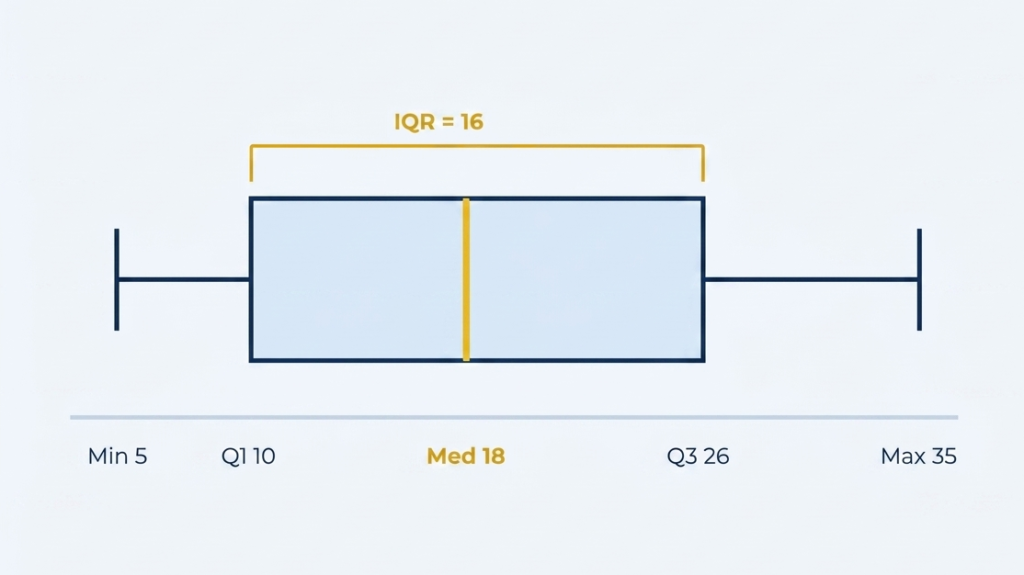
Every box plot is built from five values. This one uses the data set {5, 10, 18, 26, 35}.
| Component | What It Is | In The Diagram | SAT / FSA Use |
|---|---|---|---|
| Minimum | Smallest value (excluding outliers) | Left whisker = 5 | Range = Max - Min |
| Q1 (First Quartile) | Median of the lower half | 25% falls below | Left edge of box = 10 | IQR, outlier detection |
| Median (Q2) | Middle value | 50% below, 50% above | Line inside box = 18 | Center comparison |
| Q3 (Third Quartile) | Median of the upper half | 75% falls below | Right edge of box = 26 | IQR, outlier detection |
| Maximum | Largest value (excluding outliers) | Right whisker = 35 | Range = 35 - 5 = 30 |
| IQR | Q3 - Q1 = box width = middle-50% spread | 26 - 10 = 16 | Spread, outlier detection |
Every box plot problem uses one or more of these. The summary builds the plot; the IQR measures spread; the 1.5×IQR rule finds outliers.
Minimum
0%ile
1st Quartile
25th %ile
Median
50th %ile
3rd Quartile
75th %ile
Maximum
100%ile
The width of the box | the spread of the middle 50%. Large IQR → high variability; small IQR → clustered data. IQR ≠ range (range = Max - Min, all data).
Lower fence = Q1 - 1.5×IQR; upper fence = Q3 + 1.5×IQR. Points beyond a fence are outliers, plotted as dots. NOT on the SAT reference sheet | memorize it.
In order. Skipping Step 1 (ordering the data) makes every quartile that follows wrong.
Sort from least to greatest | every later step depends on it.
The endpoints of the whiskers (unless outliers are present).
Odd count → middle value; even count → average of the two middle values.
The median of the values strictly below Q2.
The median of the values strictly above Q2.
Number line → mark all five → box Q1 to Q3 → line at median → whiskers to Min and Max.
Reading a box plot. Min = 12, Q1 = 20, Median = 28, Q3 = 35, Max = 50. Find (a) IQR, (b) range, (c) the % of data between Q1 and Q3.
Comparing two box plots (SAT). Class A: Q1 = 60, Median = 72, Q3 = 85. Class B: Q1 = 55, Median = 68, Q3 = 80. Greater variability? Better overall?
Box plots sit in “Problem Solving & Data Analysis”, about 17 of 58 SAT Math questions. They’re 1–2 per test at Medium–Hard, because comparing two plots and finding outliers under time pressure trips up students who can already calculate IQR.
| Question Type | Frequency | Difficulty |
|---|---|---|
| Read five number summary from a plot | 1 per test | Easy Freebie |
| Calculate IQR from a given plot | 1 per test | Medium |
| Compare median or IQR of two plots | 1 per test | Medium Hard |
| Determine if a value is an outlier (1.5 × IQR) | 1 per 2 tests | Hard |
| Interpret skewness (left vs. right) | 1 per 2 tests | Hard |
Work each one, then reveal the answer to check yourself.
The median (Q2) is the middle value of the sorted data — not the average. A box plot tells you nothing about the mean.
Fix: read "median" as "middle value," never "average." The mean needs the actual data, not the plot.
Whisker length shows the range of that quarter, not how many points are in it. Each quarter holds exactly 25% of the data regardless of length.
Fix: "box plots show WHERE data is spread, not HOW MANY points are in each section."
That's the range. IQR = Q3 - Q1 (the middle 50%).
Fix: IQR = "box width"; range = "whisker tip to whisker tip." The box plot diagram above distinguishes them instantly.
The median is excluded from both halves when finding the quartiles.
Fix: physically cross out Q2 before splitting into halves. For even counts, cross out both middle values.
A box-and-whisker plot summarizes a data set with five values: minimum, Q1, median (Q2), Q3, and maximum. The box spans Q1 to Q3 with a line at the median; whiskers reach the min and max (excluding outliers). It lets you compare center (median), spread (IQR), and shape across data sets. In Florida MAFS.912.S-ID standards and SAT "Problem Solving & Data Analysis."
Sort the data least to greatest. Min = smallest, Max = largest. Median (Q2) = middle value. Q1 = median of the lower half (below Q2); Q3 = median of the upper half (above Q2) excluding Q2 from both halves. IQR = Q3 − Q1.
IQR = Q3 − Q1 (the box width, the middle-50% spread). For outliers, apply the 1.5×IQR rule: lower fence = Q1 − 1.5×IQR, upper fence = Q3 + 1.5×IQR. Any point beyond a fence is an outlier, plotted as a dot. This rule isn't on the SAT reference sheet memorize it for Hard data-analysis questions.
1–2 times per SAT Math test in "Problem Solving & Data Analysis" (~17 of 58 questions). Typically Medium–Hard, since they need data interpretation, not formula recall. Common types: read the five-number summary, calculate IQR, compare two plots, and apply the 1.5×IQR outlier rule.
Yes box plots, five-number summaries, IQR, outlier detection, and plot comparison, at the level of the Florida FSA Statistics assessment and SAT "Problem Solving & Data Analysis." We diagnose which data-analysis skills are missing before building a targeted plan. Book a free math assessment to start.
Book a free math assessment and get a personalized Digital SAT plan built around your gaps.