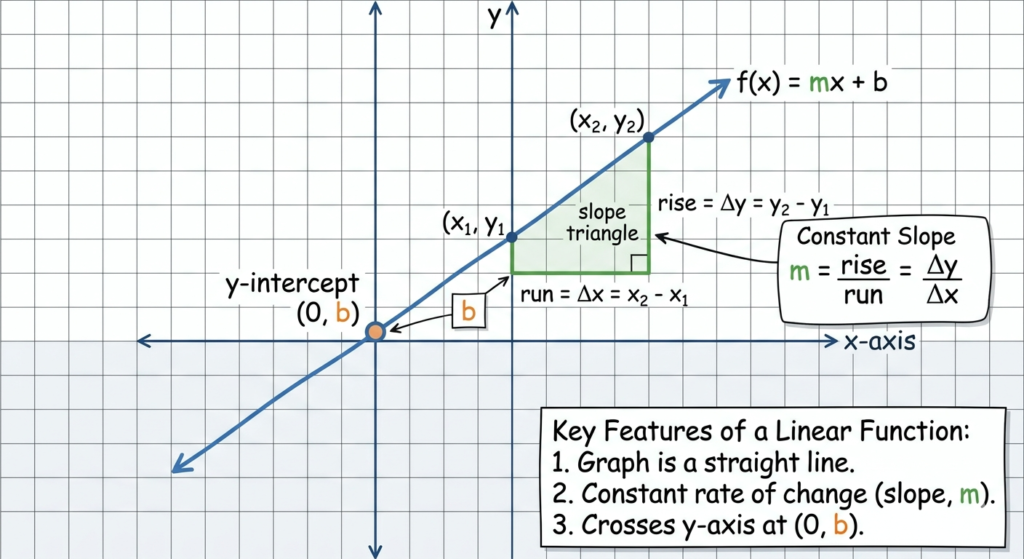
A linear function is a mathematical relationship where the output changes at a constant rate as the input increases. It is written as f(x) = mx + b, where m is the slope (rate of change) and b is the y-intercept (starting value). Its graph is always a straight line. Linear functions appear throughout Florida MAFS algebra standards and account for 4–6 questions on the SAT Math section.

"Linear Functions" Explained

y = mx+b.
m = slope.
b = y-intercept

Linear Functions — Definition, Equation & How to Graph Them

Formal definition: A linear function is a function whose graph is a straight line — meaning the rate of change between any two points is constant. It is written in function notation as f(x) = mx + b, where m represents the slope (rate of change) and b represents the y-intercept (where the line crosses the y-axis). Every linear function produces a straight-line graph on a coordinate plane.
f(x) vs. y — the same thing: f(x) = mx + b is identical to y = mx + b. The notation f(x) simply emphasizes that y is a function of x — meaning for every x value, there is exactly one y value. Students transitioning from pre-algebra to Algebra I often encounter f(x) for the first time in the context of linear functions.
Where you’ll see it: Linear functions appear in Florida MAFS algebra standards (grades 7–11), FSA and EOC assessments, SAT Math (Heart of Algebra — linear equations account for 4–6 questions per test), ACT Mathematics, and as the foundational concept for systems of equations, inequalities, and calculus.

Linear Function Equations — Every Form You Need to Know

Linear functions appear in four related equation forms in algebra — each useful in different situations. Slope-intercept form is the most common for graphing; standard form is used in standardized tests; point-slope form writes a line when you have a point and slope but not the y-intercept; and function notation f(x) = mx + b is used when defining the function formally.

📈 SLOPE-INTERCEPT FORM

f(x) = mx + b  |  y = mx + b

m = slope (rate of change)  •  b = y-intercept

Most common form. Use for graphing and identifying slope and y-intercept directly.

Example: f(x) = 3x - 2 → slope is 3, y-intercept is -2. Start at (0, -2), go up 3 and right 1 for each additional point.

⬈ STANDARD FORM

Ax + By = C

A, B, C are integers  •  A ≥ 0

Common on standardized tests. Convert to slope-intercept: solve for y → y = (-A/B)x + C/B, so slope m = -A/B.

Example: 2x + 4y = 8 → y = -½x + 2 → slope = -½, y-intercept = 2.

📝 POINT-SLOPE FORM

y - y₁ = m(x - x₁)

Use when: you know slope m and one point (x₁, y₁) but not the y-intercept.

Write the linear function equation when given: slope = 2 and point (3, 5): y - 5 = 2(x - 3) → y = 2x - 1 → f(x) = 2x - 1.

⚡ SAT / EOC EFFICIENCY RULE

Identify form → extract m and b immediately

  • Slope-intercept f(x) = mx + b: m is the x-coefficient, b is the constant.
  • Standard Ax + By = C: slope = -A/B.
  • Two points given: use slope formula m = (y₂-y₁)/(x₂-x₁), then substitute into y = mx + b.

On SAT Math, linear function problems are answered in under 60 seconds using these patterns.

Linear Function Examples — Worked Step-by-Step

Example 1 Easy

Write the equation of a linear function with slope = 4 and y-intercept = -3.

Step 1: Use slope-intercept form → f(x) = mx + b
Step 2: Substitute m = 4 and b = -3
Step 3: f(x) = 4x + (-3) = 4x - 3
f(x) = 4x - 3
Example 2 Medium

Find the linear function equation that passes through (2, 7) and (5, 13).

Step 1: Find slope → m = (13 - 7) / (5 - 2) = 6/3 = 2
Step 2: Use point-slope form with point (2, 7) → y - 7 = 2(x - 2)
Step 3: Simplify → y - 7 = 2x - 4 → y = 2x + 3
Step 4: Write as linear function → f(x) = 2x + 3
f(x) = 2x + 3 Check: f(2) = 4 + 3 = 7 ✓ · f(5) = 10 + 3 = 13 ✓
Example 3 Hard - SAT Level

The linear function f is defined by f(x) = kx - 4 where k is a constant. If f(3) = 8, what is the value of f(-1)?

Step 1: Use f(3) = 8 → substitute → k(3) - 4 = 8
Step 2: Solve for k → 3k = 12 → k = 4
Step 3: Rewrite function → f(x) = 4x - 4
Step 4: Find f(-1) → f(-1) = 4(-1) - 4 = -4 - 4 = -8
f(-1) = -8 SAT trap: Students often stop at k = 4 without completing the f(-1) evaluation.

How Linear Functions Appear on the SAT Math Section

Linear functions are the single most tested topic in the SAT Math “Heart of Algebra” category — accounting for 4–6 questions per exam across writing linear equations, interpreting slope and y-intercept in context, evaluating f(x) for a given input, and identifying linear functions from tables or graphs. The SAT-level example in Block 03 (the “k constant” question) is one of the most commonly missed linear function question types on the exam. InLighten’s certified SAT Math tutors in Orlando target these exact question types in every linear algebra session.

SAT Math Blueprint Breakdown
High-Frequency Topic
SAT Math Category How Linear Functions Appear Frequency
Heart of Algebra Write linear function from two points; identify slope and y-intercept from f(x) = mx + b 2–3 per test
Word Problems Interpret slope as rate of change; interpret b as initial value; evaluate f(x) for a given x 1–2 per test
Data Analysis Identify a linear function from a table (constant rate of change); line of best fit 1–2 per test
Linear Systems Solve where two linear functions intersect; number of solutions based on slope comparison 1 per test

Types of Linear Functions — Classified by Slope and Intercept

Increasing Linear Function

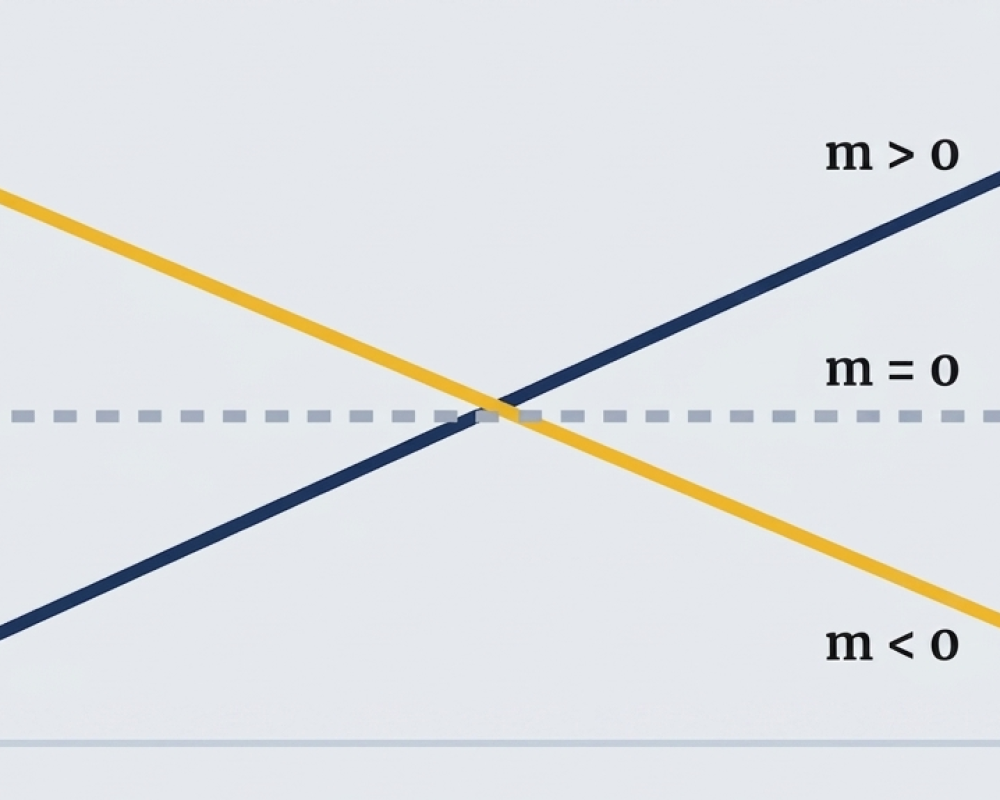
A linear function is increasing when its slope m > 0 — the line rises from left to right. Example: f(x) = 3x + 1 increases as x increases. In real-world contexts, increasing linear functions model growth: earnings over time, distance traveled at a constant speed, or savings accumulating at a fixed rate.

Decreasing Linear Function

A linear function is decreasing when its slope m < 0 — the line falls from left to right. Example: f(x) = −2x + 5 decreases as x increases. On the SAT, decreasing linear functions appear in word problems about depreciation, temperature drop, or remaining balance.

Constant Function

A constant function has slope m = 0 — the line is perfectly horizontal. It is written f(x) = b (a constant). The output is the same regardless of input. Example: f(x) = 4 is a horizontal line at y = 4 for all values of x. On the SAT, a constant function always has slope = 0.

Linear Function vs. Non-Linear

A function is linear only if the rate of change between any two points is constant. Test: if a table of values has equal differences in y for equal differences in x, the function is linear. If y-differences vary, the function is non-linear (quadratic, exponential, etc.). This distinction appears directly on SAT data analysis questions.

4 Common Linear Function Mistakes — and How to Fix Them

Mistake 1: Confusing m and b in f(x) = mx + b
Students frequently read f(x) = 3x + 5 and say “the slope is 5 and the y-intercept is 3.” The coefficient of x is always the slope (m = 3); the constant term is always the y-intercept (b = 5). Fix: circle the x-coefficient and label it m before reading the equation. InLighten’s certified math tutors in Orlando identify this in the first diagnostic session.
Mistake 2: Assuming f(x) and y are different things
Students in the transition from pre-algebra to Algebra I often treat f(x) as a new concept separate from y. They are identical: f(x) = mx + b is the same equation as y = mx + b. The notation f(x) only emphasizes that y depends on x. Fix: rewrite f(x) as y on every problem until the equivalence is automatic.
Mistake 3: Treating the rate of change as constant without verifying linearity first
On SAT data analysis questions, students assume a function is linear and apply f(x) = mx + b when the data is actually quadratic or exponential. Fix: always check that y-differences are constant for equal x-differences in a table before applying the linear function formula. A non-constant rate of change means the function is not linear.
Mistake 4: Sign errors when substituting into point-slope form
Given point (3, −2) and slope m = 5, students write y − (−2) = 5(x − 3) and then simplify incorrectly: y + 2 = 5x − 15, so y = 5x − 17. The most common error: writing y − 2 instead of y + 2 (missing the double-negative). Fix: always write the full substitution y − y₁ = m(x − x₁) with parentheses before simplifying.

4 Common Linear Function Mistakes — and How to Fix Them

To graph a linear function f(x) = mx + b on a coordinate plane, follow these five steps:
  1. Identify the y-intercept (b). This is where the line crosses the y-axis. Plot the point (0, b) on the coordinate plane. For f(x) = 2x + 3, plot (0, 3).
  2. Identify the slope (m). The slope is the coefficient of x. Write it as a fraction: m = rise/run. For f(x) = 2x + 3, slope m = 2 = 2/1 (rise 2, run 1).
  3. Plot a second point using slope. From the y-intercept, move up (or down if m < 0) by the rise and right by the run. For m = 2/1: from (0, 3), go up 2 and right 1 → plot (1, 5).
  4. Plot a third point to verify. Repeat the slope movement: from (1, 5), go up 2 and right 1 → plot (2, 7). If all three points are collinear, your slope is correct.
  5. Draw a straight line through all points. Extend the line in both directions with arrows — a linear function extends infinitely. Label the line f(x) = 2x + 3.
Graphing from standard form (Ax + By = C): First convert to slope-intercept form by solving for y, then follow steps 1–5. Example: 3x + y = 6 → y = −3x + 6 → f(x) = −3x + 6.

Frequently Asked Questions — Linear Functions

A linear function is a function of the form f(x) = mx + b, where m is the slope (rate of change) and b is the y-intercept. Its graph is always a straight line on a coordinate plane. Linear functions are defined by a constant rate of change — for every equal increase in x, y increases by the same amount. They appear throughout Florida MAFS algebra standards, specifically MAFS.8.F.A.3, which requires students to identify linear functions from equations and tables.

f(x) and y are identical in a linear function. Writing f(x) = mx + b is mathematically equivalent to y = mx + b. The notation f(x) (read “f of x”) simply emphasizes that y is a function of x — that every x input produces exactly one y output. The f(x) notation becomes essential in higher math when multiple functions (g(x), h(x)) are used simultaneously, but for linear functions in Algebra I, they are interchangeable.

A function is linear from a table if the rate of change between any two rows is constant. Specifically: calculate the change in y (Δy) and the change in x (Δx) between consecutive rows. If Δy/Δx is the same for every pair of rows, the function is linear and the slope m = Δy/Δx. If the ratios differ, the function is non-linear. This table test appears directly on SAT data analysis questions — see the SAT Math section breakdown for frequency.

Slope is a component of every linear function — m in f(x) = mx + b IS the slope. Understanding linear functions requires understanding slope first. Systems of equations are two linear functions graphed simultaneously — their intersection point is the solution. If two linear functions have the same slope but different y-intercepts, they are parallel (no solution). If they are the same function, they have infinite solutions. See our slope guide for the full slope definition and formula.

Yes. InLighten’s certified math tutors in Orlando cover all linear function concepts — f(x) = mx + b, graphing from slope-intercept and standard form, writing linear equations from two points or a point and slope, identifying linear vs. non-linear functions from tables, and the specific SAT Math question types students miss most. Our diagnostic-first approach identifies exactly which linear function problems are costing your student points before building a targeted session plan. Book a free math assessment to start.

Still Struggling with Linear Functions? Work with a Certified Math Tutor in Orlando.

Understanding f(x) = mx + b is one thing — applying it to SAT word problems, graphing from standard form, or identifying which form to use when given a point and slope is another. InLighten’s certified math tutors in Orlando diagnose exactly which linear function problems are costing your student points — whether it’s confusing m and b, sign errors in point-slope form, or missing the linearity check on a table — then build targeted sessions around those specific gaps. Most students see grade improvement within 3 sessions. Bright Futures and NCAA eligibility requirements depend on Algebra performance in exactly these areas.