
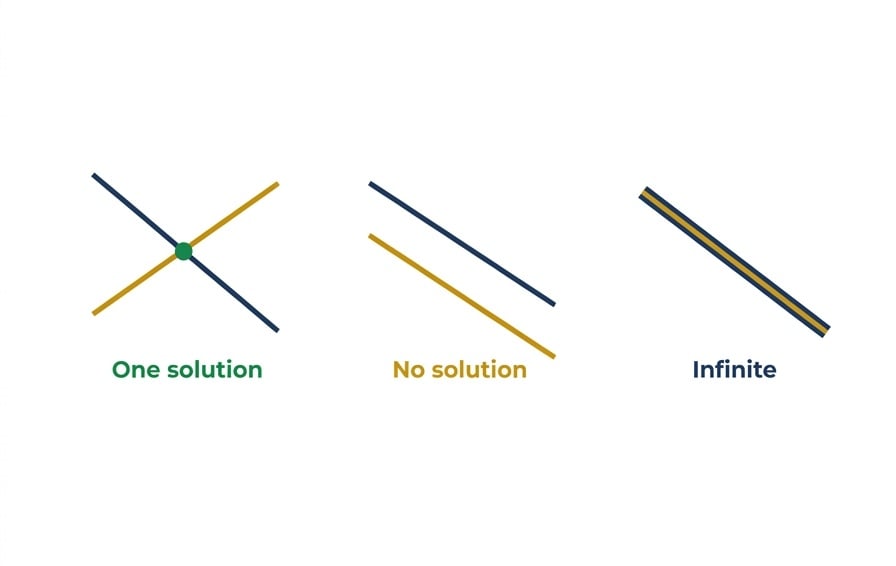
linear system of equations is a set of two or more equations in which every term is degree 1 (no x², no xy), written in standard form Ax + By = C. Graphed on a coordinate plane, each equation is a straight line — the solution is the point where the lines intersect. Lines that intersect at one point have one solution; parallel lines have no solution; identical lines have infinite solutions. Linear systems appear on the SAT Math “Heart of Algebra” section.

Linear Systems: Forms, Graphing, and Solution Types

Linear Systems: Forms, Graphing & Solution Types

A linear system is a set of two or more equations where every term is degree 1 (no x², no xy), each graphing as a straight line. The solution is where the lines intersect: different slopes → one solution; parallel → no solution; identical → infinite solutions. The most-tested topic in SAT “Heart of Algebra.”
TWO FORMS, ONE GRAPH

Linear System Forms & Graphing Rules

Every linear system can be written in standard form (to identify it) or slope-intercept form (to graph it). Converting between them is the first step before graphing.
📐

Standard Form

Ax + By = C
A, B, C are integers; A ≥ 0; A and B not both zero. e.g. 2x + 3y = 12 and x − y = 1. Each graphs as a line; the solution is the intersection.
📈

Slope-Intercept

y = mx + b
m = slope, b = y-intercept. Convert from Ax + By = C: subtract Ax, divide by B → y = (−A/B)x + (C/B). Required for graphing.
✏️

Graphing Steps

  1. Convert each equation to y = mx + b
  2. Plot the y-intercept (0, b)
  3. Use slope (rise/run) for a 2nd point
  4. Draw each line
  5. Intersection = the solution (x, y)
Solution-type shortcut: compare slopes before solving. Different slopes → 1 solution. Same slope, different b → no solution (parallel). Same slope, same b → infinite solutions (same line). This answers SAT "for what value of k" questions in seconds without solving the system.

ONE · NONE · INFINITE

The Three Solution Types

A linear system has exactly one of three outcomes, set entirely by the slopes and y-intercepts.
Linear Systems
ONE SOLUTION NO SOLUTION INFINITE
Slopes Different (m1 ≠ m2) Same (m1 = m2) Same (m1 = m2)
Y-intercepts Any Different (b1 ≠ b2) Same (b1 = b2)
Graph Lines cross at one point Parallel, never touch One line (proportional)
Algebra One (x, y) pair False statement (0 = 5) True statement (0 = 0)
Std-form test A1/A2 ≠ B1/B2 A1/A2 = B1/B2 ≠ C1/C2 A1/A2 = B1/B2 = C1/C2

STEP BY STEP

Worked Example — Word Problem

A theater charges $12 for adult tickets and $7 for student tickets. A sold-out show with 150 seats brought in $1,325. Write the system in standard form and find each ticket count.
  • 1. Define variables: a = adult tickets, s = student tickets
  • 2. System in standard form: a + s = 150 (seats) and 12a + 7s = 1,325 (revenue)
  • 3. Eliminate: multiply Eq. 1 by 7 → 7a + 7s = 1,050 ; subtract from Eq. 2 → 5a = 275 → a = 55
  • 4. Back-substitute: 55 + s = 150 → s = 95
55 adult tickets, 95 student tickets

HEART OF ALGEBRA

How Linear Systems Appear on the SAT

Linear systems are the single most-tested topic in “Heart of Algebra”, 3–5 times per test. Most students solve them algebraically but lose points on graphical-interpretation questions, the most-missed type.
SAT QUESTION TYPE WHAT IT TESTS KEY SKILL
Graph Identification "Which graph shows a system with no solution?" Recognize parallel lines (same slope, different b)
Intersection in Context "The graphs meet at (3, 5). What does 3 represent?" Connect a coordinate to a real-world variable
Parametric k-Value "For what k does the system have no solution?" Set slopes equal, compare intercepts, don't solve
Standard Form → Graph "3x + 2y = 12 is graphed. Which else is shown?" Convert to y = mx + b, match m and b to the graph

AVOID THESE

4 Common Linear-System Mistakes

Comparing Only Slopes for "No Solution"

Seeing equal slopes and writing "no solution" without checking the y-intercepts. Equal slopes + equal b = infinite, not none.
Fix: check both. Same slope + same b = infinite; same slope + different b = no solution.

Graphing Straight from Standard Form

Treating A as the slope and C as the y-intercept in Ax + By = C, neither is correct.
Fix: convert to y = mx + b first. Slope = -A/B, y-intercept = C/B.

Misreading the Intersection as (y, x)

Reading the point off a graph but writing the coordinates reversed.
Fix: always read horizontal (x) first, then vertical (y). The solution is (x, y).

Proportional Equations = "No Solution"

Multiplying one equation gives the other exactly, and the student picks "no solution" because there's no unique answer.
Fix: 0 = 0 (true) → infinite solutions; 0 = 5 (false) → no solution. The constant decides.

TRY THESE

Practice Problems

Work each one, then reveal the answer to check yourself.
Convert
Convert 4x + 2y = 10 to slope-intercept form and identify the slope and y-intercept.
2y = −4x + 10 → y = −2x + 5. Slope = −2, y-intercept = 5.
Classify
Without solving, determine whether 2x + 4y = 8 and x + 2y = 5 has one, no, or infinite solutions.
Both have slope −½. Intercepts: 8/4 = 2 vs 5/2 = 2.5, different. Same slope, different b → no solution (parallel).
Intersection
Line 1 passes through (0, 3) and (6, 0). Line 2 through (0, −1) and (3, 5). Where do they intersect?
L1: y = −½x + 3. L2: y = 2x − 1. Set equal: −½x + 3 = 2x − 1 → 4 = 2.5x → x = 1.6. Then y = 2(1.6) − 1 = 2.2. Intersection ≈ (1.6, 2.2).
Parametric (SAT)
For what value of k does 3x − ky = 12 and x − 2y = 4 have infinite solutions?
Infinite → proportional equations. Multiplying Eq. 2 by 3: 3x − 6y = 12. Matching to Eq. 1 (3x − ky = 12): k = 6.

FREQUENTLY ASKED

Linear Systems — FAQ

Work each one, then reveal the answer to check yourself.

What is a linear system of equations?

A set of two or more equations where every variable term is degree 1, no x², no xy, no radicals. Each graphs as a straight line, and the solution is the point satisfying all equations at once (the intersection). Written in standard form (Ax + By = C) or slope-intercept form (y = mx + b). Florida MAFS.912.A-REI.6.

What is the standard form of a linear equation?

Ax + By = C, where A, B, C are integers, A is non-negative, and A and B are not both zero. It groups variable terms on one side and the constant on the other. To graph, convert to slope-intercept form, subtract Ax, divide by B, giving y = (−A/B)x + (C/B).

How do you find the number of solutions without solving?

Convert both equations to y = mx + b and compare. Different slopes (m₁ ≠ m₂) means one solution. Same slope, different y-intercepts (m₁ = m₂, b₁ ≠ b₂) means no solution (parallel). Same slope and same y-intercept means infinite solutions (same line). This slope-comparison method is the fastest approach on SAT and FSA parametric k-value questions.

How do linear systems appear on the SAT "Heart of Algebra"?

Two forms: algebraic (solve for x and y by substitution or elimination) and graphical (interpret the intersection, identify which graph matches a system, or find a parameter that yields no or infinite solutions). Graphical-interpretation questions are the most-missed type, since students prepare for algebraic solving but overlook the geometry. The SAT also tests converting between standard and slope-intercept form.

Can InLighten's Orlando tutors help with linear systems?

Yes, standard form, slope-intercept conversion, graphing, and the solution-type framework, for both Florida FSA/EOC and SAT/ACT Math. We diagnose the exact skill gap causing point loss before building a plan, graphical interpretation is the most common gap for students who "already know how to solve systems." Book a free math assessment to start.

KEEP EXPLORING

Related Algebra Concepts

SAT Heart of Algebra Giving You Trouble?

Book a free math assessment and get a personalized Digital SAT plan built around your gaps.