
|
Preparing for the SAT? Claim Your Personalized Math Plan →
|
A quadratic system of equations is a system containing at least one quadratic equation (with an x² term) paired with a linear equation. Unlike linear systems, quadratic systems are solved using substitution only — not elimination. Substitute the linear equation into the quadratic, simplify to standard form, then solve using factoring, the quadratic formula, or completing the square. Quadratic systems appear in the SAT Math Advanced Math domain.
A quadratic system pairs at least one quadratic equation (with an x² term) with a linear equation. Unlike linear systems, they’re solved by substitution only, never elimination. The solutions are the points where the parabola and the line intersect. A staple of the SAT “Advanced Math” domain.
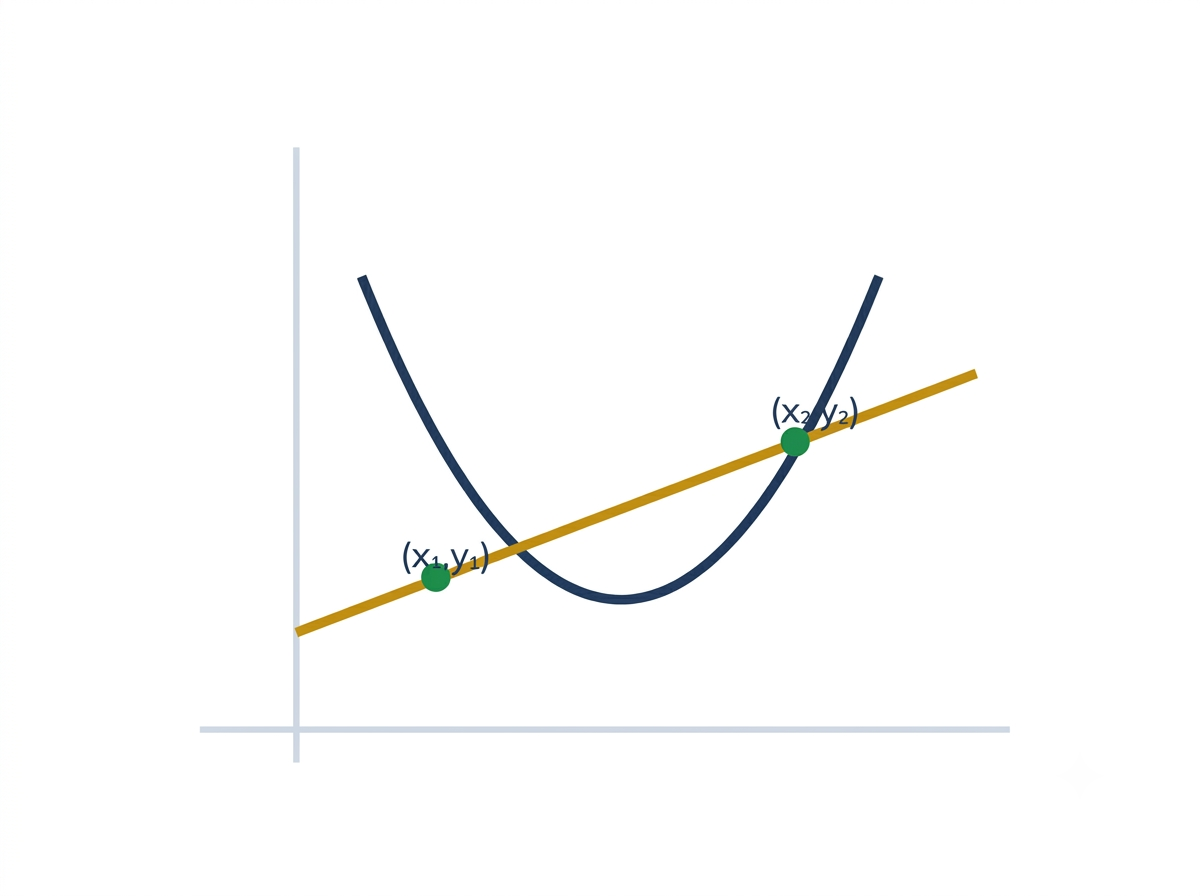
A system in which at least one equation is quadratic (contains an x² term) and at least one is linear. The solution is the set of coordinate pairs (x, y) satisfying both equations at once, the points where the parabola and the line intersect on the coordinate plane. A quadratic system can have 0, 1, or 2 real solutions.
Why substitution, not elimination: adding a linear equation to a quadratic one still leaves an x² term nothing is eliminated. Substitution is the only method that isolates a variable and reduces the system to a single solvable equation. (The discriminant b² - 4ac then tells you how many solutions exist.)
Every quadratic system reduces to a single quadratic equation in one variable. Follow the steps in order, the back-substitution step is where most time is saved or lost.
Rearrange so y is alone. If it's already solved for y, go straight to Step 2. Don't isolate y in the quadratic it creates a harder expression.
Replace y in the quadratic with the linear expression. Expand and collect all terms on one side → standard form ax² + bx + c = 0.
Factor if it factors cleanly; quadratic formula if not; completing the square when instructed. You may get 0, 1, or 2 values of x.
Put each x into the linear equation (not the quadratic) and write each solution as an ordered pair (x, y).
⚡ SAT rule: back-substitute into the linear equation it's always simpler. The quadratic wastes 60–90 seconds and adds error risk.
1–2 questions per test in “Advanced Math”, not the most frequent topic, but among the most point-differentiating. Misapplying elimination loses 2–3 questions that can move a score from 620 to 680.
| SAT QUESTION TYPE | HOW THEY APPEAR | FREQUENCY |
|---|---|---|
| Solve for intersection points | Find the (x, y) pairs where a parabola and line meet full substitution | 1 per test |
| Number of solutions | "How many solutions?" discriminant analysis | 1 per test |
| Parameter value (discriminant trap) | "For what k does it have exactly one / no solution?" | Occasional |
| Graphical interpretation | "Which graph shows no solution?" recognizing no intersection | Occasional |
How many times the line meets the parabola, set by the discriminant of the quadratic you get after substituting.
The line crosses the parabola at two distinct points. The quadratic factors into two real roots.
The line is tangent it touches the parabola at exactly one point. The discriminant-trap questions live here.
The line misses the parabola entirely. No real intersection the quadratic has no real roots.
Adding or subtracting a quadratic and a linear equation never cancels the x² term it just makes another quadratic.
Fix: when one equation has x², always substitute. Elimination can't reduce a quadratic to a linear equation.
Trying to factor before moving all terms to one side. Factoring and the formula only work on ax² + bx + c = 0.
Fix: after substituting, immediately set the equation equal to zero and write standard form explicitly.
Putting x back into the quadratic to find y a much harder calculation with more error risk.
Fix: always back-substitute into the linear equation. Same y, one step instead of three, 45–60 seconds saved.
Finding the first x, writing one pair, and stopping missing the second intersection.
Fix: count your x values first. Two roots → back-substitute both → write both ordered pairs.
Work each one, then reveal the answer to check yourself.
Solve: y = x² − 1 and y = x + 1.
x + 1 = x² − 1 → x² − x − 2 = 0 → (x−2)(x+1) = 0 → x = 2 or −1. Into y = x+1: (2, 3) and (−1, 0).
Solve: y = x² + 2x − 8 and y = x − 2.
x − 2 = x² + 2x − 8 → x² + x − 6 = 0 → (x+3)(x−2) = 0 → x = −3 or 2. Into y = x−2: (2, 0) and (−3, −5).
y = x² + 3 and y = x − 1. How many solutions does this system have?
x − 1 = x² + 3 → x² − x + 4 = 0. Discriminant = (−1)² − 4(1)(4) = 1 − 16 = −15 < 0 → zero real solutions.
y = x² − 6x + 9 and y = kx − 5. For what value of k does this system have exactly one solution?
kx − 5 = x² − 6x + 9 → x² − (6+k)x + 14 = 0. One solution → (6+k)² − 4(14) = 0 → (6+k)² = 56 → k = −6 ± √56 = −6 ± 2√14. (Two k-values give tangency.)
A system where at least one equation is quadratic (has an x² term) and at least one is linear. The solutions are the coordinate pairs (x, y) satisfying both at once, where the parabola and line intersect. It can have 0, 1, or 2 real solutions, unlike a linear system (0, 1, or infinitely many). Tested in Florida Algebra 2 (MAFS.912.A-REI.7) and the SAT Advanced Math domain.
By substitution, not elimination. Four steps: (1) isolate y in the linear equation; (2) substitute that into the quadratic; (3) rearrange to standard form (ax² + bx + c = 0) and solve by factoring, the quadratic formula, or completing the square; (4) back-substitute each x into the linear equation for the y values. Write each solution as (x, y).
Elimination works on linear systems because combining two linear equations yields another linear equation. Adding a quadratic and a linear equation leaves the x² term; nothing is eliminated. Substitution is the only method that reduces the system to a single solvable equation. It's the key procedural distinction between linear and quadratic systems.
0, 1, or 2 real solutions. Two means the line crosses the parabola twice (discriminant > 0); one means it's tangent (discriminant = 0); zero means it misses entirely (discriminant < 0). The discriminant b² − 4ac of the post-substitution quadratic decides. SAT questions often ask for parameter values that produce a specific count, testing deliberate discriminant use.
Yes, for Algebra 2 and SAT Advanced Math, including the substitution method, discriminant analysis, and the parameter-value trap questions on the digital SAT. We diagnose where errors happen (method confusion, standard-form setup, back-substitution), then target it, aligned to Florida MAFS and the digital SAT. Book a free math assessment to start.
Book a free math assessment and get a personalized Digital SAT plan built around your gaps.