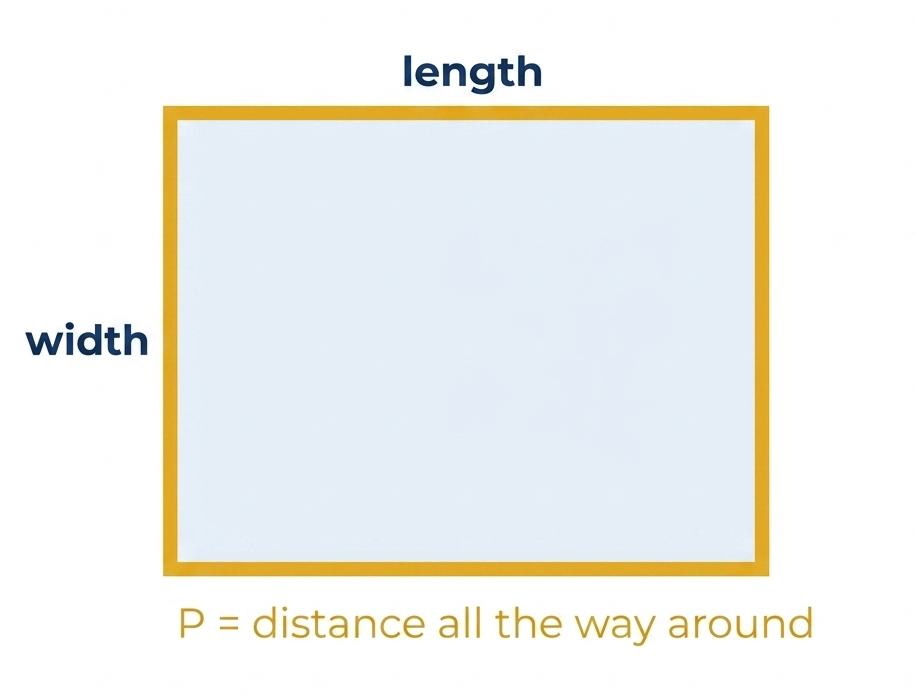
The perimeter of a shape is the total distance around its outside edge — the sum of all its side lengths. The perimeter formula is P = sum of all sides. For a rectangle: P = 2l + 2w. For a square: P = 4s. For any polygon, add all side lengths. Perimeter is tested on the Florida FSA, Florida Geometry EOC, and the SAT Math section.

"Perimeter" Explained

All the side lengths added up. “Peri” means outside. “Meter” means measure.

Perimeter in Math — Definition, Formulas & How to Find It

Formal definition: Perimeter is the total length of the boundary of a two-dimensional shape — the distance you would travel if you walked all the way around its outer edge. It is calculated by adding together the lengths of all sides of the polygon. Perimeter is always measured in linear units (cm, m, inches, feet) — never square units, which are for area.

Perimeter
How perimeter differs from area: Perimeter measures distance around the outside of a shape (one-dimensional, linear units). Area measures the space inside a shape (two-dimensional, square units). A 3 cm × 4 cm rectangle has a perimeter of 14 cm (distance around) and an area of 12 cm² (space inside). Students who confuse these two concepts lose points on every Florida geometry assessment — this distinction is covered in depth in the “Perimeter vs. Area” section below.
Where you’ll see it: Perimeter is tested across Florida’s math curriculum from grade 4 through grade 11 — on the Florida FSA, the Florida Algebra 1 EOC (algebraic perimeter problems), the Florida Geometry EOC, and in the SAT Math “Heart of Algebra” and “Additional Topics in Math” domains.

Perimeter Formulas — The Universal Rule and Shape-Specific Shortcuts

Every perimeter calculation uses the same universal rule: add all the side lengths together. For regular shapes (all sides equal) or shapes with predictable side relationships (like rectangles), there are shortcut formulas. Learning both the universal rule and the shortcuts lets you solve any perimeter problem — whether the shape is labeled or described only by its dimensions.
📐 UNIVERSAL PERIMETER RULE – WORKS FOR ANY POLYGON
P = s₁ + s₂ + s₃ + ... + sₙ (add ALL side lengths)
The perimeter of any polygon is the sum of every side length. No shape is excluded – if you know all the sides, just add them up. For shapes with missing sides (composites), find the missing sides first, then add all sides together.
Units: always linear (cm, m, ft, in) – never squared. If your answer ends in cm², you calculated area, not perimeter.
▭ RECTANGLE PERIMETER
P = 2l + 2w  or  P = 2(l + w)
l = length • w = width
Because a rectangle has two pairs of equal opposite sides, you can also add length + width and multiply by 2.
Example: l = 9, w = 4 → P = 2(9) + 2(4) = 18 + 8 = 26 units
Most common perimeter formula on the Florida FSA and SAT Math.
▲ TRIANGLE PERIMETER
P = a + b + c
a, b, c = the three side lengths
For an equilateral triangle (all sides equal): P = 3s
For an isosceles triangle (two equal sides): P = 2s + b
Example: sides 5, 7, 9 → P = 5 + 7 + 9 = 21 units
Triangular perimeter may require the Pythagorean Theorem when a side is missing – see /vocab/pythagorean/.
■ SQUARE & REGULAR POLYGONS
Square: P = 4s  •  Regular n-gon: P = ns
s = side length • n = number of sides
A square has 4 equal sides → P = 4s
A regular pentagon (5 sides): P = 5s
A regular hexagon (6 sides): P = 6s
For any regular polygon: multiply the side length by the number of sides. SAT often presents hexagon or pentagon perimeter problems using this rule.
⚡ SAT ALGEBRAIC PERIMETER
P = (2x + 3) + (x + 1) + ... → solve for x
On the SAT, sides are often given as algebraic expressions (2x + 3, x − 1) instead of numbers. The process: (1) Write P = sum of all side expressions. (2) Combine like terms. (3) If a total perimeter is given, set equal and solve for x.
SAT Rule: always distribute and simplify fully before setting equal to the given perimeter value.

How to Find Perimeter — 3 Worked Examples

EXAMPLE 1 — RECTANGLE PERIMETER EASY

Find the perimeter of a rectangle with length 12 cm and width 7 cm.

Step 1: Write the formula → P = 2l + 2w
Step 2: Substitute → P = 2(12) + 2(7)
Step 3: Calculate → P = 24 + 14
Step 4: Units check → perimeter is in linear units (cm), not cm²
EXAMPLE 2 — COMPOSITE SHAPE (MISSING SIDE) MEDIUM

An L-shaped figure is made from two rectangles. The outer dimensions are 10 cm wide and 8 cm tall. A rectangular notch 4 cm wide and 3 cm tall is cut from the top-right corner. Find the perimeter of the L-shape.

Step 1: Sketch the shape and label known sides from the outer dimensions and the notch size
Step 2: Identify the 6 sides of the L-shape using the outer dimensions: bottom = 10, right outer = 5 (8-3), notch top = 4, notch drop = 3, inner step = 6 (10-4), left side = 8
Step 3: Verify the missing sides: inner horizontal = 10 − 4 = 6; inner vertical = 8 − 3 = 5
Step 4: Add all 6 sides → P = 10 + 5 + 4 + 3 + 6 + 8 = 36
Florida FSA Tip: composite shape perimeter problems always require finding ALL side lengths – including the sides of the notch that are not directly labeled in the diagram. Draw and label every side before summing.
EXAMPLE 3 — SAT LEVEL (ALGEBRAIC PERIMETER) HARD – SAT LEVEL

A rectangle has a length of (3x + 2) and a width of (x − 1). The perimeter is 42. Find the value of x and the dimensions of the rectangle.

Step 1: Write the perimeter formula → P = 2l + 2w = 42
Step 2: Substitute expressions → 2(3x + 2) + 2(x − 1) = 42
Step 3: Distribute → 6x + 4 + 2x − 2 = 42
Step 4: Combine like terms → 8x + 2 = 42
Step 5: Solve for x → 8x = 40 → x = 5
Step 6: Find dimensions → length = 3(5) + 2 = 17; width = 5 − 1 = 4
Step 7: Verify → P = 2(17) + 2(4) = 34 + 8 = 42 ✓

How Perimeter Appears on the SAT Math Section

Perimeter problems appear in two distinct SAT Math domains — making perimeter one of the most cross-domain math skills on the exam. In “Heart of Algebra,” perimeter appears disguised as an algebraic equation where sides are given as expressions (Example 3). In “Additional Topics in Math,” perimeter appears as straightforward shape-measurement questions. Students who have mastered both forms answer 2–3 more SAT Math questions correctly — directly impacting their score in the range where Bright Futures scholarship eligibility thresholds fall.
InLighten’s certified math tutors in Orlando cover both types of SAT perimeter problems — from the pure algebraic form to the composite shape variant — in targeted SAT Math prep sessions. Students who lose points on these problems are typically not struggling with math; they are struggling with recognizing the perimeter setup inside an algebraic word problem.
SAT DOMAIN HOW PERIMETER APPEARS DIFFICULTY
Heart of Algebra Sides given as expressions (2x + 3, x − 1) — write perimeter equation, solve for x, find dimensions Medium
Additional Topics Standard shape perimeter — rectangle, triangle, or composite shape measurement Easy-Medium
Word Problem Setup "A fence encloses a rectangular yard..." — translate to perimeter equation and solve Medium
Missing Dimension Perimeter given, one dimension missing — rearrange P = 2l + 2w and solve for the unknown side Medium

Perimeter vs. Area — What's the Difference?

Perimeter and area are the two most frequently confused measurement concepts in geometry. They measure completely different things and use different formulas, different units, and different calculation processes. Understanding the distinction is required for every Florida geometry assessment from grade 6 through the Geometry EOC.
CONCEPT WHAT IT MEASURES UNITS FORMULA (RECTANGLE) EXAMPLE (4×3 RECT)
Perimeter Distance around the outside edge — the boundary Linear (cm, m, ft) P = 2l + 2w P = 2(4)+2(3) = 14 cm
Area Space inside the shape — the region covered Square (cm², m², ft²) A = l × w A = 4 × 3 = 12 cm²

4 Common Perimeter Mistakes (and How to Fix Them)

Calculating area instead of perimeter — the #1 geometry mistake across all grade levels. Students multiply length × width (getting 12 cm²) when asked for perimeter (the answer should be 22 cm). This error happens when students rely on muscle memory instead of reading which measurement is requested. On Florida FSA and Geometry EOC, both the perimeter and the area are typically included among the answer choices as deliberate distractors. Fix: before writing any formula, circle the word “perimeter” or “area” in the problem. The two formulas use different operations — perimeter adds, area multiplies. Write the formula before substituting any numbers.
Forgetting to include all sides of a composite shape — missing the unlabeled sides. For L-shapes, recessed figures, or notched rectangles, students add only the labeled sides and omit the step sides that are unlabeled in the diagram. The perimeter of a composite shape includes every side — including sides created by the cutout. Fix: trace your finger around the entire outside boundary of the shape before writing any values. Count the number of sides and write that number above the figure — if your addition has fewer terms than that count, you missed a side. Example 2 on this page demonstrates the full process for an L-shaped composite figure.
Using squared units (cm²) for perimeter answers. Perimeter is a linear measurement — it has the same units as the side lengths (cm, m, ft). Students who have recently calculated area carry the “squared” unit habit into perimeter problems. On multiple-choice assessments, “38 cm²” and “38 cm” may both appear as options. Fix: perimeter = linear units (cm, m, ft). Area = squared units (cm², m², ft²). After any calculation, ask: am I measuring distance around (linear) or space inside (squared)? Perimeter is always the “distance around” answer — linear units, no exponent.
Not distributing correctly when sides are algebraic expressions. For SAT-level algebraic perimeter problems, students write P = 2(3x + 2) + 2(x − 1) and then forget to distribute the 2 correctly — writing 6x + 2 instead of 6x + 4 for the first term. This sign/distribution error produces an incorrect x value. Fix: distribute every coefficient explicitly — do not skip the middle step. Write 2(3x + 2) = 6x + 4 as a separate line before combining terms. After solving for x, always substitute back into the original expressions to verify the perimeter equals the given value. InLighten’s math tutors in Orlando cover this algebraic perimeter procedure in every SAT Heart of Algebra session.

Practice Problems — Perimeter in Math

What is perimeter in math?

Perimeter in math is the total distance around the outside edge of a two-dimensional shape — calculated by adding together all of its side lengths. It is a linear measurement, expressed in units like centimeters, meters, or feet (never squared units, which are for area). The general perimeter formula is P = sum of all sides. For a rectangle: P = 2l + 2w. For a square: P = 4s. For a triangle: P = a + b + c. Perimeter is tested across Florida’s math curriculum from grade 4 through the Florida Geometry EOC and the SAT Math section.

The universal perimeter formula is P = sum of all side lengths. For specific shapes: Rectangle: P = 2l + 2w (or 2(l + w)). Square: P = 4s. Triangle: P = a + b + c. Regular polygon with n sides: P = ns. The formula always adds — never multiplies — because perimeter measures distance around the outside edge, not the space inside. On the SAT Math section, sides are sometimes given as algebraic expressions (like 2x + 3), and the perimeter formula is set equal to a given value to solve for x.

Perimeter measures the distance around the outside edge of a shape (a linear measurement in cm, m, ft). Area measures the space inside a shape (a square measurement in cm², m², ft²). For a rectangle: perimeter = 2l + 2w (add the sides); area = l × w (multiply the sides). A quick way to remember: perimeter = “fence” (you put it around the outside); area = “carpet” (you lay it inside). This distinction is one of the most frequently tested concepts on the Florida FSA and Florida Geometry EOC — and one of the most common sources of wrong answers when students use the wrong formula.

Perimeter appears on the SAT Math section in two domains. In “Heart of Algebra,” perimeter problems give side lengths as algebraic expressions (like 2x + 3 and x − 1) and ask for the value of x given the total perimeter — requiring setting up and solving a linear equation. In “Additional Topics in Math,” perimeter appears as shape-measurement problems requiring knowledge of rectangle, triangle, and composite shape perimeter formulas. Students who understand both forms answer 2–4 more SAT Math questions correctly — impacting scores in the range where Florida’s Bright Futures scholarship thresholds apply.

Yes. InLighten’s certified math tutors in Orlando cover perimeter across the full curriculum range — from Florida FSA composite shape perimeter problems at the middle school level to SAT Math algebraic perimeter problems at the high school level. We identify exactly whether your student is struggling with the perimeter/area distinction, missing unlabeled sides on composite shapes, or setting up algebraic expressions — then target those specific gaps. We align every session with Florida MAFS standards and Florida EOC assessment formats. Book a free math assessment to start.

Losing Points on Perimeter Problems? Work with a Certified Math Tutor in Orlando.

Whether your student is preparing for the Florida FSA, the Florida Geometry EOC, or the SAT Math section, perimeter problems appear on every exam — and the mistakes that cost points are almost always the same ones: using the area formula instead of the perimeter formula, missing unlabeled sides on composite shapes, or not setting up the algebraic equation correctly when sides are expressions. InLighten’s certified math tutors in Orlando diagnose exactly which error pattern your student has and build targeted sessions around that specific gap. We align every session with Florida MAFS standards. Most students show measurable improvement within 2–3 sessions.