
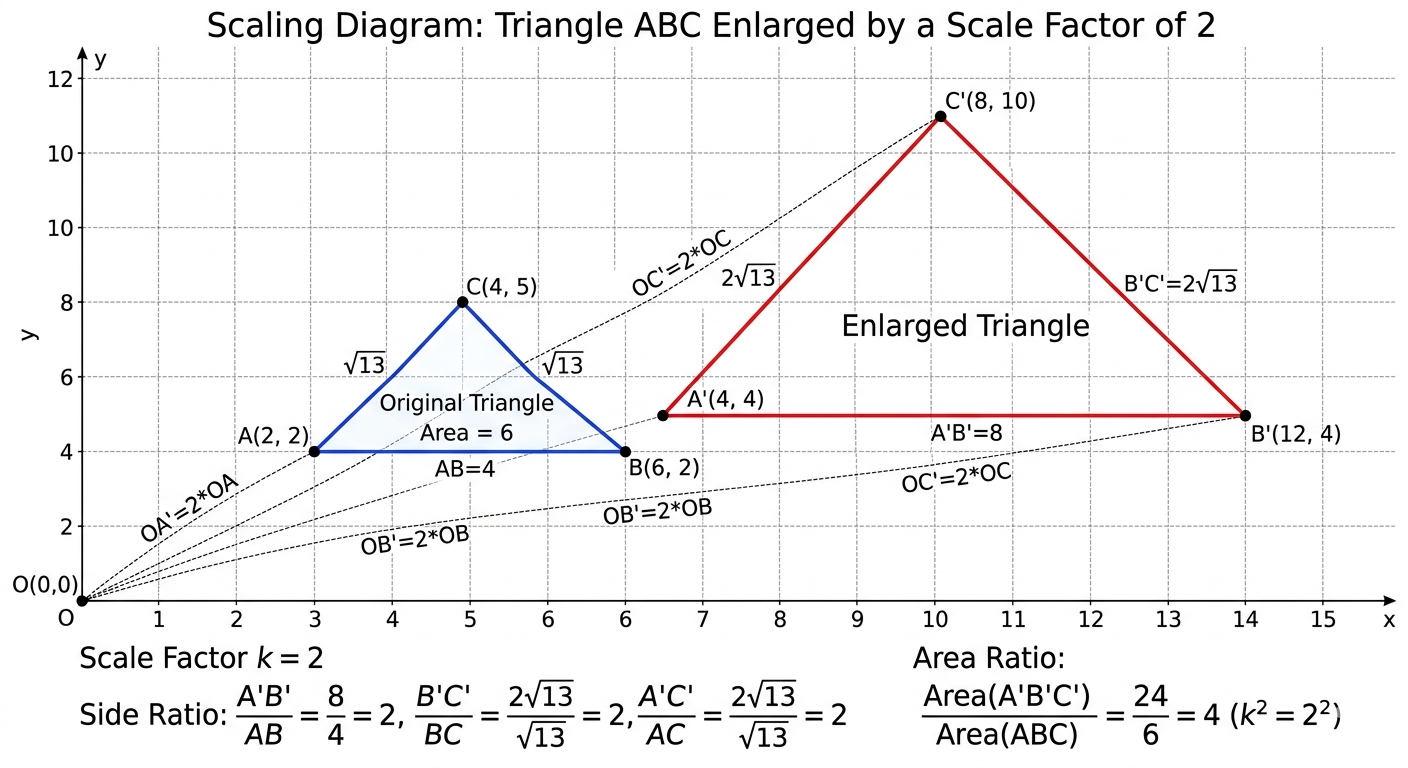
In mathematics, scaling means multiplying a figure’s dimensions by a constant called the scale factor (k) to produce an enlarged or reduced version that maintains the original’s shape and proportions. When a figure is scaled by k, its side lengths multiply by k, its area multiplies by k², and its volume multiplies by k³. Scaling is a core concept in geometry, similar figures, and the SAT Math section.
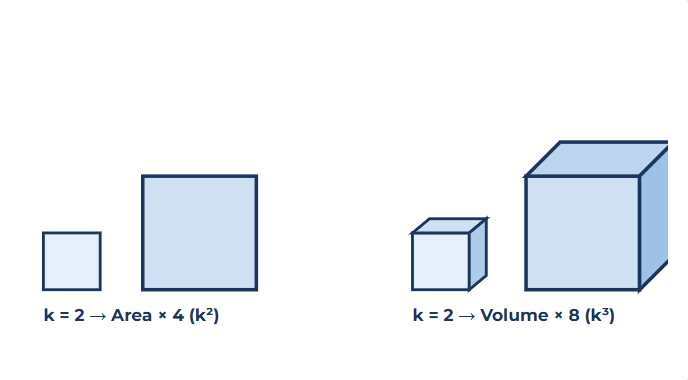
"Scaling Area" Explained

When scaling area, the scale factor is multiplied twice or squared.

Math Vocabulary → Geometry → Scaling

Scaling in Math — Definition, Scale Factor & How It Works

Formal definition: Scaling is a geometric transformation that changes the size of a figure by multiplying each of its dimensions by a constant ratio called the scale factor. A scale factor greater than 1 enlarges the figure; a scale factor between 0 and 1 reduces it. The transformed figure is always similar to the original — same shape, different size.
Where you’ll see it: Scaling appears in geometry courses (grades 8–10), Florida FSA math assessments, SAT Math problem-solving sections, and ACT Mathematics. It is closely related to dilation, similar figures, and proportional reasoning.
Scaling diagram showing a triangle enlarged by a scale factor of 2 in geometry

The Scale Factor Formula — How to Find and Use It

The scale factor (k) is the ratio of any length in the scaled figure to the corresponding length in the original. Once you know k, it determines how every measurement changes:

Scaling Formula Infographic
📐 CORE FORMULA

Scale Factor (k) = New Length ÷ Original Length

If a triangle has a side of 4 cm, and the scaled version has that side at 10 cm, then k = 10 ÷ 4 = 2.5

🏷️ SIDE LENGTHS

New Length = k × Original Length

Multiply every side by k. k > 1 enlarges; 0 < k < 1 reduces.

AREA (2D)

New Area = k2 × Original Area

Area scales by the square of k. Double the sides (k=2) → area × 4.

📦 VOLUME (3D)

New Volume = k3 × Original Volume

Volume scales by the cube of k. Triple the sides (k=3) → volume × 27.

ANGLES

Angles are UNCHANGED by scaling

Scaling preserves shape. All corresponding angles stay equal — this is why scaled figures are similar.

Scaling in Math — 3 Worked Examples

Scaling Example
Example 1 Easy

A rectangle is 5 cm wide and 8 cm long. It is scaled by a factor of k = 3. Find the new dimensions and new area.

Step 1:
Apply scale factor to side lengths → New width: 5 × 3 = 15 cm · New length: 8 × 3 = 24 cm
Step 2:
Calculate new area → New area = 15 × 24 = 360 cm²
Step 3:
Verify with area scaling rule → Original area = 5 × 8 = 40 cm² · 40 × k² = 40 × 9 = 360 cm²
Answer: New dimensions = 15 cm × 24 cm · New area = 360 cm²
Reference Image
Scaling Example 2
Example 2 Medium

Triangle ABC has sides 6, 8, and 10. Triangle DEF is similar to ABC with a corresponding side of 15. Find the scale factor and all remaining sides of DEF.

Step 1:
Identify corresponding sides → Side 10 in ABC corresponds to side 15 in DEF
Step 2:
Find scale factor → k = 15 ÷ 10 = 1.5
Step 3:
Scale all sides → DEF side 1: 6 × 1.5 = 9 · DEF side 2: 8 × 1.5 = 12 · DEF side 3: 10 × 1.5 = 15
Answer: k = 1.5 · Triangle DEF has sides 9, 12, and 15
Reference Material
Scaling Example 3
Example 3 Hard – SAT Level

A sphere has a volume of 36π cm³. A second sphere has a radius that is 3 times larger. What is the volume of the second sphere?

Step 1:
Identify the scale factor → k = 3 (radius is 3× larger)
Step 2:
Apply volume scaling rule → New volume = k3 × original volume = 33 × 36π = 27 × 36π
Step 3:
Calculate → 27 × 36π = 972π cm³
SAT trap: many students multiply by k (3) instead of k3 (27) → they get 108π and choose the wrong answer.
Answer: 972π cm³ · SAT-level insight: volume always scales by k3, not k
Reference Material

How Scaling Appears on the SAT Math Section

Scaling and scale factor questions appear in every SAT Math section — in both the no-calculator and calculator portions. The k³ volume rule (Example 3 above) is one of the highest-difficulty SAT questions students miss because they apply k instead of k³. InLighten’s SAT Math tutors in Orlando specifically target these conceptual traps.

SAT Math Scaling Table - 1140px
Scaling Table Header
SAT Math Category How Scaling Appears Difficulty
Problem-Solving Similar figure side-length ratios; map scale problems Moderate
Advanced Math Function transformations that scale graphs vertically Hard
Geometry Area and volume scaling with k² and k³ rules Hard
Data Analysis Proportional reasoning in scaled data sets Moderate

Types of Scaling in Mathematics

Uniform Scaling

All dimensions are multiplied by the same scale factor k. The figure changes size but keeps its exact shape and proportions. Used in similar figures and most geometry scaling problems.

Non-Uniform Scaling

Different scale factors apply to different dimensions (e.g., the x-axis scales by 2 while the y-axis scales by 3). The figure changes shape as well as size. Appears in coordinate geometry transformations.

Dilation

Scaling from a fixed center point. Each point moves away from (enlargement) or toward (reduction) the center by the scale factor. The formal geometry term for scaling. Appears in the MAFS.912.G-SRT Florida standards.

Volume Scaling (k³)

When a 3D figure is scaled by k, its volume changes by k³. This is the most frequently missed concept on SAT Math scaling problems. A cube with side 2 has volume 8; scaled by k=3, side becomes 6 and volume becomes 216 (= 8 × 27).

4 Common Mistakes Students Make with Scaling

Using k for volume instead of k³. The most common and most costly SAT mistake. If a solid is scaled by k=4, students write new volume = 4 × old volume — the correct answer is 4³ = 64 × old volume. Fix: always check whether the question asks for length (×k), area (×k²), or volume (×k³).

Scaling the perimeter with k² instead of k. Perimeter is a sum of lengths — it scales linearly with k, not k². A square with perimeter 20 scaled by k=3 has new perimeter 60, not 180. Fix: perimeter = length × k. Only area uses k².

Confusing enlargement and reduction direction. k = 0.5 means the figure is reduced to half the size — not "scaled by negative 0.5." Students often think fractional k values mean negative scaling. Fix: any k between 0 and 1 = reduction. k > 1 = enlargement. k cannot be negative in standard scaling.

Assuming scaled figures are congruent. Scaling produces similar figures — same angles, different side lengths. Congruence requires both same shape AND same size (k = 1). Fix: after scaling (k ≠ 1), figures are similar but NOT congruent.

Practice Problems — Scaling in Math

New area = k² × original = 16 × 25 = 400 cm²

Radius ×2, height ×1 → V = πr²h. New V = π(2r)²h = 4πr²h = 4 × 50π = 200π

Actual distance = 4.5 × 50 = 225 km · Scale factor k = 50 km/cm

Frequently Asked Questions About Scaling in Math

Scaling in math means multiplying a figure’s dimensions by a constant called the scale factor (k) to produce a larger or smaller version that keeps the original’s shape. When a figure is scaled by k, side lengths multiply by k, area multiplies by k², and volume multiplies by k³. Scaling preserves angles — so scaled figures are always similar to the original.

Scale factor (k) = New Length ÷ Original Length. You can use any pair of corresponding lengths from the original and scaled figures to find k. Once you have k, all other dimensions of the scaled figure equal k × the original dimension.

When a figure is scaled by k: its area multiplies by k² (the square of the scale factor), and its volume multiplies by k³ (the cube of the scale factor). Side lengths and perimeters scale linearly by k. Angles do not change when scaling. This is why a solid scaled by k = 2 has 4× the surface area but 8× the volume.

Dilation is scaling from a fixed center point — every point moves away from (or toward) the center by the scale factor. General scaling resizes a figure without necessarily specifying a center. In most high school geometry contexts (including Florida MAFS standards and SAT Math), dilation and scaling are used interchangeably for the transformation that changes size while preserving shape.

SAT Math tests scaling in similar figures (finding missing side lengths using scale factors), area and volume scaling with k² and k³ rules, and real-world proportional reasoning problems (map scale, recipe scaling). The k³ volume rule is one of the most commonly missed SAT Math concepts — students apply k instead of k³ and select the wrong answer choice.

Still Struggling with Scaling or Geometry? Work with a Certified Math Tutor in Orlando.

Understanding the definition is one thing — applying scaling correctly under test pressure is another. InLighten’s certified math tutors in Orlando diagnose exactly where your student loses points on scaling, similar figures, and volume problems, then build targeted sessions around those specific gaps. Most students see grade improvement within 3 sessions.