
|
Preparing for the SAT? Claim Your Personalized Math Plan →
|
In mathematics, the slope of a line measures its steepness and direction — calculated as rise over run, or the change in y divided by the change in x between any two points on the line. The slope formula is m = (y₂ − y₁) / (x₂ − x₁). A positive slope rises from left to right; a negative slope falls; a zero slope is horizontal; an undefined slope is vertical. Slope is one of the most frequently tested concepts on the SAT Math section.
The slope of a line measures its steepness and direction , rise over run, the change in y divided by the change in x between any two points. The formula is m = (y₂ − y₁) / (x₂ − x₁). Positive slope rises, negative falls, zero is horizontal, undefined is vertical.
We're building a short video breaking down arc length and central angles step by step. Check back soon, or keep working through the examples above in the meantime.
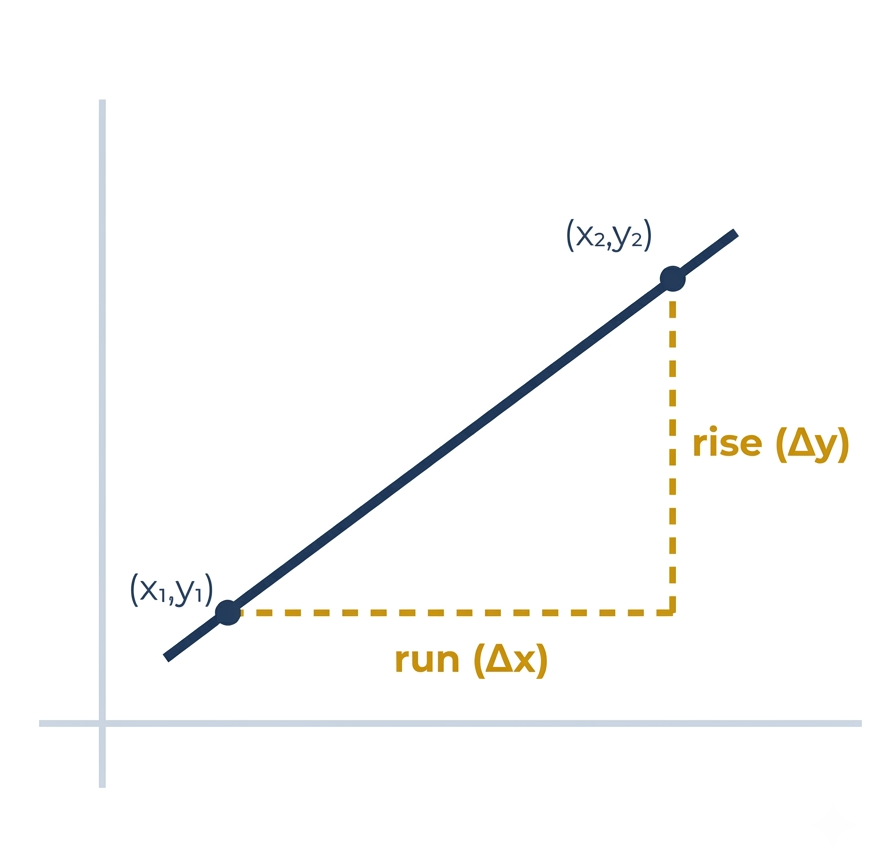
A number describing both the steepness and direction of a line on the coordinate plane, the ratio of vertical change (rise) to horizontal change (run) between any two points. Slope is written as m in both the slope formula and slope-intercept form (y = mx + b). It’s the foundation for linear functions, systems of equations, and later, calculus derivatives.
Memory aid: "Rise to your whY, run from your eX" rise is the change in y (vertical), run is the change in x (horizontal).
Slope appears in three interrelated equation forms, each useful in a different situation, plus one efficiency rule for the SAT.
Also rise/run = Δy/Δx. Use when given two points. Keep the subtraction order consistent in numerator and denominator.
m = slope, b = y-intercept. Use when graphing or reading slope from an equation. In y = 3x + 5, m = 3 (the x-coefficient).
Use when you know the slope and one point but not the y-intercept. Common SAT setup for writing a line's equation.
Slope-intercept: m = x-coefficient. Standard form Ax + By = C: m = -A/B. Two points: use the formula, don't graph. Most slope questions take under 60 seconds.
Slope from two points. Find the slope of the line through (2, 3) and (6, 11).
Write the equation. A line passes through (0, 4) with slope -3. Write it in slope-intercept form, then find y when x = 5.
Perpendicular line (SAT). Line ℓ passes through (1, 2) and (4, 8). Line k is perpendicular to ℓ and passes through (4, 8). Find k's equation.
Slope is the most-tested single concept in “Heart of Algebra”, 4–7 times per exam. The perpendicular-slope trap is among the most commonly missed questions in the category.
| SAT MATH CATEGORY | HOW SLOPE APPEARS | FREQUENCY |
|---|---|---|
| Heart of Algebra | Find slope from two points; identify slope from y = mx + b | 2 to 3 per test |
| Linear Equations | Parallel (equal slopes); perpendicular (negative reciprocals) | 1 to 2 per test |
| Data Analysis | Slope of a line of best fit; rate of change from a table | 1 to 2 per test |
| Advanced Math | Slope as derivative (intro); slope of a tangent line | Rare (≤1) |
InLighten's certified SAT Math tutors in Orlando target these exact question types.
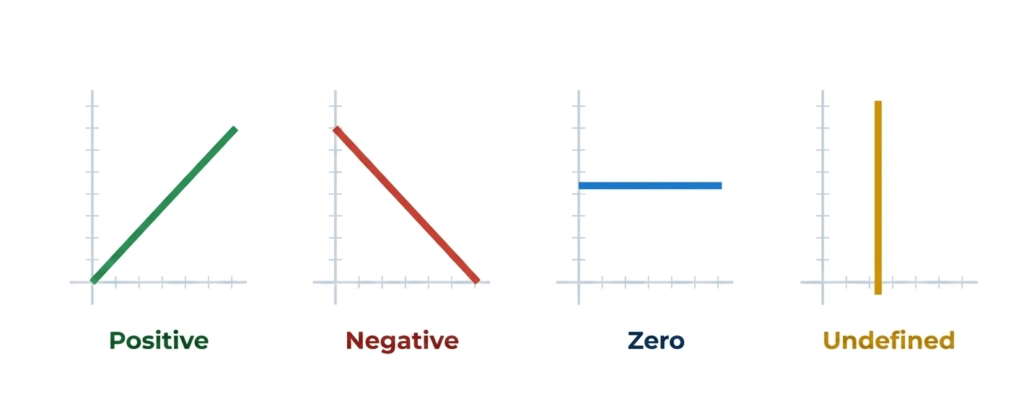
The line rises left to right; larger m = steeper. m = 3 rises 3 units for every 1 unit right. Most real-world linear functions have positive slopes.
The line falls left to right. m = -2 drops 2 units per 1 unit right. In SAT word problems, usually a decreasing quantity (cost or height over time).
A perfectly horizontal line, y = c. Rise is 0, so 0/run = 0. On the SAT, a horizontal line always has slope 0, never undefined.
A vertical line, x = c, where run = 0, division by zero is undefined. The most-focused type: "slope of x = 4?" → undefined, not zero.
Writing (y₂ - y₁)/(x₁ - x₂) where y is in one order and x is reversed flips the sign.
Fix: subscripts must match. Pick one point as "point 1" and stay consistent in both.
Confusing horizontal (slope 0) with vertical (undefined).
Fix: horizontal → y doesn't change → 0. Vertical → x doesn't change → undefined. "x = 4" undefined; "y = 4" zero.
Using slope 3 for a line perpendicular to a slope-3 line, instead of -1/3.
Fix: perpendicular slope = -1/m. Negate AND flip. Check: m₁ × m₂ = -1.
Estimating points between gridlines on a graph yields a close-but-wrong fractional slope.
Fix: use exact grid-intersection points only; if none are visible, find two exact points from the equation.
Work each one, then reveal the answer to check yourself.
Find the slope of the line through (-1, 4) and (3, -4).
What is the slope of the line 3x + 4y = 12?
Line ℓ has slope 5/2. Find the slope of a line parallel to ℓ, and one perpendicular to ℓ.
A table shows x = 0, y = 7 and x = 4, y = -1. Find the slope and the equation of the line.
Slope measures how steep a line is and which direction it goes: how much y changes for every 1 unit of change in x. It's rise over run, (y₂ − y₁)/(x₂ − x₁), using any two points. Positive rises, negative falls, zero is horizontal, undefined is vertical. Written as m in y = mx + b and y − y₁ = m(x − x₁).
m = (y₂ − y₁)/(x₂ − x₁), also written rise/run or Δy/Δx. Subtract the y-coordinates and divide by the difference of the x-coordinates, in the same order. In slope-intercept form (y = mx + b), m is the x-coefficient. In standard form (Ax + By = C), slope = −A/B.
Zero slope is a horizontal line (y = constant), rise/run = 0/run = 0. Undefined slope is a vertical line (x = constant), run = 0, and dividing by zero is undefined. On the SAT, "x = 5" always has undefined slope; "y = 5" always has zero slope.
Parallel lines have equal slopes. Perpendicular lines have slopes that are negative reciprocals: if ℓ has slope 3, a perpendicular line has slope −1/3. The product of perpendicular slopes always equals −1 (m₁ × m₂ = −1). A commonly missed SAT trap.
Yes. InLighten's certified math tutors in Orlando cover all slope concepts: the slope formula, slope-intercept and point-slope forms, parallel and perpendicular slopes, and slope from tables and graphs, including the SAT question types most students miss. Our diagnostic-first approach finds exactly where points are being lost before building a targeted plan. Book a free math assessment to start.
Book a free math assessment and get a personalized Digital SAT plan built around your gaps.