
|
Preparing for the SAT? Claim Your Personalized Math Plan →
|
An intercept is the point where a graphed line or curve crosses an axis. The x-intercept is where it crosses the horizontal axis (y = 0), also called a zero or root. The y-intercept is where it crosses the vertical axis (x = 0). Finding zeros of a function means finding its x-intercepts.
An intercept is the coordinate point where a graphed line or curve crosses an axis on the Cartesian plane. The x-intercept is where the graph crosses the horizontal axis, where y = 0. The y-intercept is where it crosses the vertical axis, where x = 0.
Key equivalence: finding the "zeros" or "roots" of a function is exactly the same as finding its x-intercepts, the x-values that make the output y equal to zero. The SAT uses all three words interchangeably.
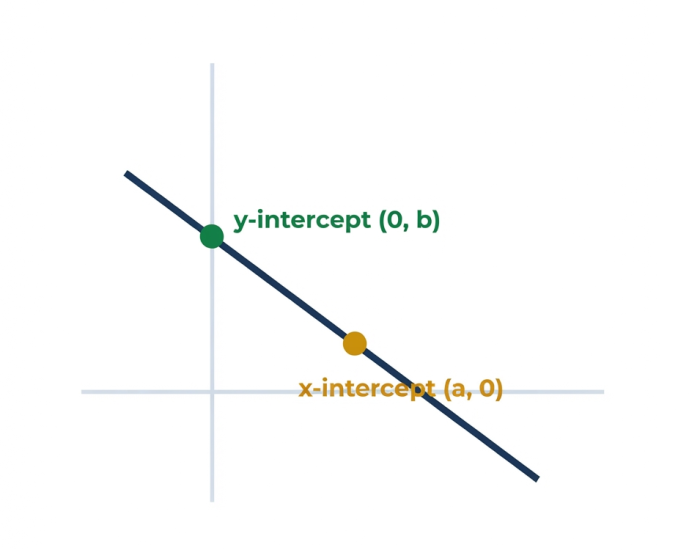
Two algebraic methods and one graphical, the same logic works for lines and parabolas.
Substitute 0 for x and simplify.
y = 2x + 4 → y = 2(0) + 4 = 4 → (0, 4)
Set the function equal to zero and solve.
5x - 10 = 0 → 5x = 10 → x = 2 → (2, 0)
In y = mx + b, the constant b is the y-intercept. A parabola's roots are its x-intercepts.
Read the axis crossings directly.
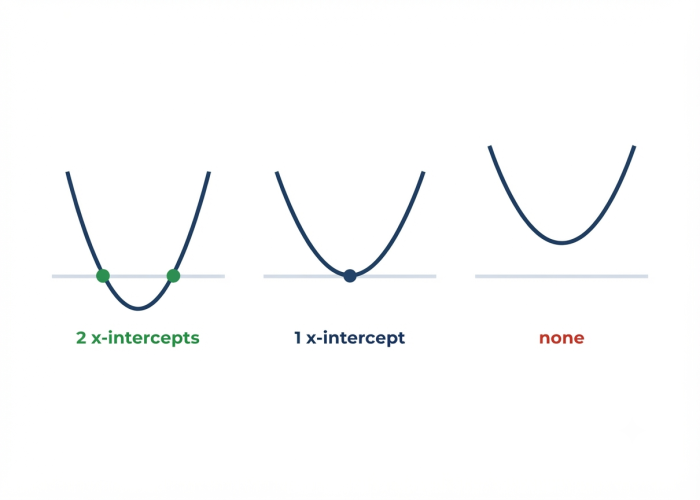
For a quadratic, the number of x-intercepts is the number of real roots and you can see it in the graph.
The SAT rarely says “intercept.” It uses “zero,” “root,” or “initial value”, all of which map directly to an intercept. Recognizing the synonyms is half the battle.
| SAT TERM | WHAT IT MEANS | HOW TO FIND IT |
|---|---|---|
| Zero / Root | An x-intercept, an x-value where y = 0 | Set the function = 0 and solve |
| Initial Value | The y-intercept, the output when x = 0 | Substitute x = 0 (or read b in y = mx + b) |
| Solution of f(x) = 0 | The x-intercept(s) of the graph | Factor, use the quadratic formula, or graph |
| Where the graph crosses the y-axis | The y-intercept (0, b) | The constant term when solved for y |
Setting x = 0 to find the x-intercept (it gives the y-intercept instead).
Fix: x-intercept → set y = 0. Y-intercept → set x = 0. Zero the variable you're NOT solving for.
Answering "the y-intercept is 4" instead of the point (0, 4). SAT grid-ins often want the coordinate.
Fix: an intercept is a point. Y-intercept = (0, b); x-intercept = (a, 0).
A parabola usually has two x-intercepts; students find one root and stop.
Fix: a quadratic can have two roots. Factor fully or use ± in the quadratic formula to catch both.
Work each one, then reveal the answer to check yourself.
Book a free math assessment and get a personalized Digital SAT plan built around your gaps.