|
Preparing for the SAT? Claim Your Personalized Math Plan →
|
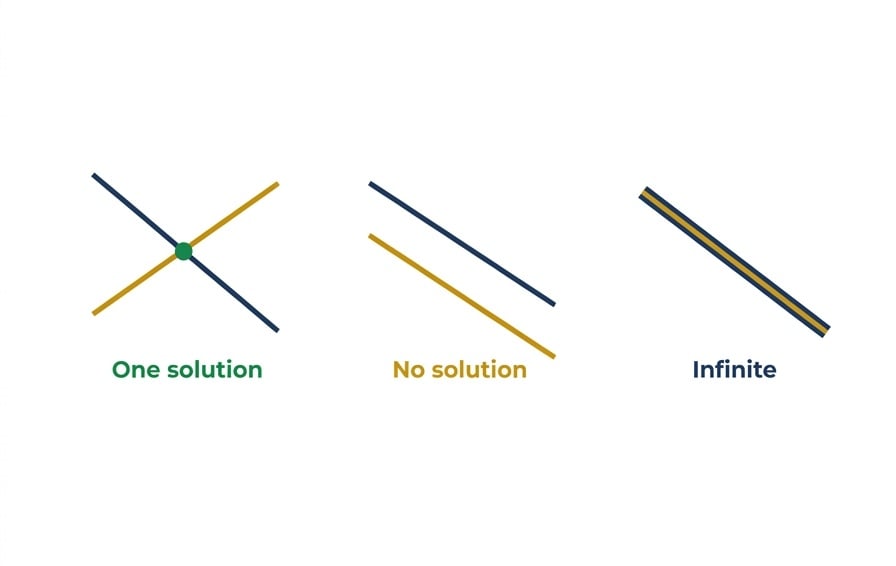
A linear system of equations is a set of two or more equations in which every term is degree 1 (no x², no xy), written in standard form Ax + By = C. Graphed on a coordinate plane, each equation is a straight line — the solution is the point where the lines intersect. Lines that intersect at one point have one solution; parallel lines have no solution; identical lines have infinite solutions. Linear systems appear on the SAT Math “Heart of Algebra” section.
Different slopes. One intersection.
Formal definition: A linear system of equations is a collection of two or more linear equations — equations in which all variable terms are degree 1 (no exponents, no variable multiplication like xy). In two variables, a linear system typically takes standard form: Ax + By = C, where A, B, and C are constants. Every linear equation in two variables graphs as a straight line on the coordinate plane. The solution to a linear system is the point (or points) where all the lines in the system intersect simultaneously.
A, B, C are integers · $A \ge 0$ · A and B are not both zero.
A linear system in standard form:
$2x + 3y = 12$
$x - y = 1$
Each equation graphs as a straight line. The solution is the intersection point.
$m$ = slope · $b$ = y-intercept
Convert from $Ax + By = C$:
$\rightarrow y = (-A/B)x + (C/B)$
Required for graphing each line in the system.
Before graphing or solving: compare the slopes of both lines. Same slope but different y-intercepts means parallel lines – they never intersect (no solution). Same slope AND same y-intercept means the same line (infinite solutions). Different slopes always produce exactly one intersection point (one solution). This rule lets you answer SAT "for what value of k" problems in seconds without solving the system.
| SAT QUESTION TYPE | WHAT IT TESTS | KEY SKILL |
|---|---|---|
| Graph identification | "Which graph shows a system with no solution?" | Recognize parallel lines (same slope, different y-intercept) |
| Intersection in context | "The graphs intersect at point (3, 5). What does 3 represent?" | Connect coordinate value to real-world variable meaning |
| Parametric k-value | "For what value of k does the system have no solution?" | Set slopes equal, compare y-intercepts — use slope rule, not solving |
| Standard form → graph | "The equation $3x + 2y = 12$ is graphed. Which of the following is also graphed?" | Convert to slope-intercept, identify m and b, match to graph |
| ONE SOLUTION | NO SOLUTION | INFINITE SOLUTIONS | |
|---|---|---|---|
| Slopes | Different slopes ($m_1 \neq m_2$) | Same slope ($m_1 = m_2$) | Same slope ($m_1 = m_2$) |
| Y-intercepts | Any | Different ($b_1 \neq b_2$) | Same ($b_1 = b_2$) |
| Graph appearance | Two lines crossing at one point | Two parallel lines — never touch | One line (equations are proportional) |
| Algebraic signature | Solving gives one (x, y) pair | Solving gives false statement (e.g., 0 = 5) | Solving gives true statement (e.g., 0 = 0) |
| Standard form test | $A_1/A_2 \neq B_1/B_2$ | $A_1/A_2 = B_1/B_2 \neq C_1/C_2$ | $A_1/A_2 = B_1/B_2 = C_1/C_2$ |
Subtract 4x: 2y = −4x + 10. Divide by 2: y = −2x + 5. Slope m = −2 · Y-intercept b = 5 · Intersection point with y-axis: (0, 5).
Convert Eq. 1: y = −(1/2)x + 2 (slope = −1/2, b = 2). Convert Eq. 2: y = −(1/2)x + 5/2 (slope = −1/2, b = 5/2). Same slope, different y-intercepts → No solution (parallel lines).
Line 1: slope = (0−3)/(6−0) = −1/2 · y = −(1/2)x + 3. Line 2: slope = (5−(−1))/(3−0) = 6/3 = 2 · y = 2x − 1. Set equal: −(1/2)x + 3 = 2x − 1 → 4 = (5/2)x → x = 8/5 = 1.6. y = 2(1.6) − 1 = 2.2. Answer: (1.6, 2.2)
Convert Eq. 2: x = 2y + 4 → not helpful. Use ratio test: For infinite solutions, coefficients must be proportional: 3/1 = −k/−2 = 6/4. Check: 3/1 = 3 and 6/4 = 1.5 — these are not equal, so the system cannot have infinite solutions for any k using this coefficient approach. Simpler: multiply Eq. 2 by 3 → 3x − 6y = 12. Compare with Eq. 1: 3x − ky = 6. For proportionality: −k = −6 → k = 6, but 6 ≠ 12. No value of k produces infinite solutions — this system has no solution when k = 6 (parallel lines). SAT note: always verify the constant ratio, not just the variable coefficients.
A linear system of equations is a set of two or more equations in which every variable term is degree 1 — no x², no xy, no radical terms. Each equation in a linear system graphs as a straight line on the coordinate plane. A linear system in two variables is typically written in standard form (Ax + By = C) or slope-intercept form (y = mx + b). The solution to a linear system is the point (or set of points) that satisfies all equations simultaneously, which geometrically corresponds to the intersection of the lines. Linear systems fall under Florida’s MAFS.912.A-REI.6 standard.
The standard form of a linear equation is Ax + By = C, where A, B, and C are integers, A is non-negative, and A and B are not both zero. Standard form is the most common way to write a linear system because it groups the variable terms on one side and the constant on the other. To graph a line in standard form, convert it to slope-intercept form (y = mx + b) by isolating y: subtract Ax from both sides, then divide by B, giving y = (−A/B)x + (C/B).
Convert both equations to slope-intercept form (y = mx + b) and compare slopes and y-intercepts. If the slopes are different (m₁ ≠ m₂), the lines cross at one point — exactly one solution. If the slopes are the same and the y-intercepts are different (m₁ = m₂, b₁ ≠ b₂), the lines are parallel — no solution. If the slopes and y-intercepts are both the same (m₁ = m₂ and b₁ = b₂), the equations represent the same line — infinite solutions. This slope-comparison method is the fastest approach on the SAT and Florida FSA when a parametric k-value question appears.
Linear systems appear on the SAT Math “Heart of Algebra” section in two forms: algebraic (solve for x and y using substitution or elimination) and graphical (interpret what the intersection point means, identify which graph represents a given system, or determine what value of a parameter causes no solution or infinite solutions). Graphical interpretation questions are the most frequently missed type because students prepare for algebraic solving but overlook the geometry. The SAT also tests converting between standard form and slope-intercept form to match an equation to its graph. See the SAT Math content specification on College Board for the full “Heart of Algebra” breakdown.
Yes. InLighten’s certified math tutors in Orlando specialize in linear systems for both Florida FSA/EOC assessments and SAT/ACT Math preparation — covering standard form, slope-intercept conversion, graphing, and the solution-type identification framework. For student-athletes pursuing NCAA academic eligibility or Florida Bright Futures Scholarship score requirements, we align sessions around the specific question formats on each exam. We diagnose exactly which skill gap is causing point loss before building a targeted session plan — graphical interpretation is the most common skill gap for students who “already know how to solve systems.”
Understanding standard form and graphing rules is one thing — applying the solution-type framework under test pressure and reading a coordinate plane quickly on the SAT are skills that require targeted practice. InLighten’s certified math tutors in Orlando diagnose exactly where your student is losing points on linear systems — whether it’s the standard-form conversion, graphing accuracy, or the parametric k-value question type — and build sessions around those gaps. Student-athletes pursuing Florida Bright Futures Scholarship score requirements or NCAA academic eligibility receive priority scheduling.