
|
Preparing for the SAT? Claim Your Personalized Math Plan →
|
The perimeter of a shape is the total distance around its outside edge — the sum of all its side lengths. The perimeter formula is P = sum of all sides. For a rectangle: P = 2l + 2w. For a square: P = 4s. For any polygon, add all side lengths. Perimeter is tested on the Florida FSA, Florida Geometry EOC, and the SAT Math section.
The perimeter of a shape is the total distance around its outside edge, the sum of all its side lengths. The universal rule is P = sum of all sides; for a rectangle, P = 2l + 2w; for a square, P = 4s. Always in linear units, never squared.
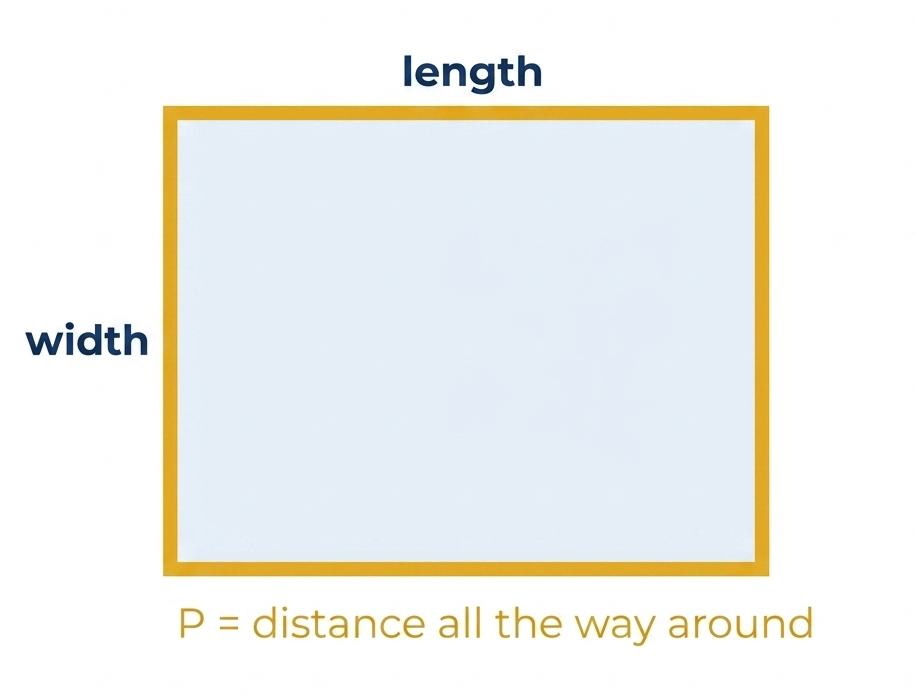
The total length of the boundary of a two-dimensional shape, the distance you’d travel walking all the way around its outer edge. It’s found by adding the lengths of all sides. Perimeter is always measured in linear units (cm, m, inches, feet), never square units, which are for area.
Where the word comes from: "Peri" means around and "meter" means measure perimeter literally is the measure around a shape. A handy reminder that it's the outside boundary, not the inside space.
Every perimeter uses the same universal rule, add all the sides. For regular shapes and rectangles, there are faster shortcuts.
Add every side length no shape excluded. For composites with missing sides, find them first.
Always linear units never squared.
Two pairs of equal opposite sides.
l = 9, w = 4 → 2(9) + 2(4) = 26.
Equilateral: P = 3s · Isosceles: P = 2s + b.
Sides 5, 7, 9 → 21. (Use Pythagorean if a side is missing.)
Multiply side length by number of sides.
Pentagon P = 5s · Hexagon P = 6s.
Sides given as expressions. Sum them, combine like terms, set equal to the given P, solve for x.
Distribute fully before setting equal.
Perimeter is cross-domain, it shows up both as straight measurement and as disguised algebra. Students who master both forms pick up 2–3 more questions.
| SAT DOMAIN | HOW PERIMETER APPEARS | DIFFICULTY |
|---|---|---|
| Heart of Algebra | Sides given as expressions (2x + 3, x - 1) : write the equation, solve for x, find dimensions | Medium |
| Additional Topics | Standard shape perimeter : rectangle, triangle, or composite measurement | Easy-Medium |
| Word Problem Setup | "A fence encloses a rectangular yard..." : translate to a perimeter equation | Medium |
| Missing Dimension | Perimeter given, one side missing : rearrange P = 2l + 2w and solve | Medium |
The two most-confused measurement concepts, different things, units, and formulas.
| CONCEPT | WHAT IT MEASURES | UNITS | FORMULA (RECT.) |
4×3 RECTANGLE |
|---|---|---|---|---|
| Perimeter | Distance around the outside edge : the boundary | Linear (cm, m, ft) | P = 2l + 2w | 2(4) + 2(3) = 14 cm |
| Area | Space inside the shape : the region covered | Square (cm², m², ft²) | A = l × w | 4 × 3 = 12 cm² |
Quick test: Perimeter = "fence" (you walk around the outside). Area = "carpet" (you cover the inside). Border around something → perimeter. Filling something in → area. Florida FSA answer choices deliberately include both values as distractors, so picking the wrong formula means the wrong answer even with perfect arithmetic.
The #1 geometry mistake : multiplying l × w (12 cm²) when perimeter (22 cm) was asked. Both appear as answer choices.
Fix: circle "perimeter" or "area" first. Perimeter adds; area multiplies.
On L-shapes and notched figures, students add only the labeled sides and skip the unlabeled step sides.
Fix: trace the whole boundary, count the sides, and check your sum has that many terms.
Writing "38 cm²" for a perimeter : carrying the area habit. Both "38 cm" and "38 cm²" may be options.
Fix: perimeter = linear units, no exponent. Distance around, not space inside.
Writing 2(3x + 2) = 6x + 2 instead of 6x + 4 : a distribution slip that throws off x.
Fix: distribute every coefficient on its own line, then verify by substituting x back.
Work each one, then reveal the answer to check yourself.
Find the perimeter of a triangle with sides 8 cm, 11 cm, and 6 cm.
P = 8 + 11 + 6 = 25 cm.
A square has a perimeter of 52 inches. What is the length of one side?
P = 4s : s = 52 ÷ 4 = 13 in.
A rectangle has a perimeter of 44 ft and a length of 14 ft. What is the width?
2(14) + 2w = 44 : 28 + 2w = 44 : 2w = 16 : w = 8 ft.
A rectangle has sides (2x + 4) and (x + 2). Its perimeter is 48. Find x and both dimensions.
2(2x+4) + 2(x+2) = 48 : 6x + 12 = 48 : 6x = 36 : x = 6. Sides: 2(6)+4 = 16 and 6+2 = 8 (check: 2(16)+2(8) = 48 ✓).
The total distance around the outside edge of a 2D shape : found by adding all side lengths. It's a linear measurement (cm, m, ft), never squared. The universal formula is P = sum of all sides; rectangle P = 2l + 2w; square P = 4s; triangle P = a + b + c. Tested from grade 4 through the Florida Geometry EOC and SAT Math.
P = sum of all side lengths. Rectangle: 2l + 2w (or 2(l + w)); square: 4s; triangle: a + b + c; regular n-gon: ns. The formula always adds, never multiplies : perimeter is distance around, not space inside. On the SAT, sides may be expressions (2x + 3) set equal to a given perimeter to solve for x.
Perimeter is the distance around the outside (linear units, cm/m/ft); area is the space inside (square units, cm²/m²/ft²). Rectangle: perimeter = 2l + 2w (add); area = l × w (multiply). Memory aid: perimeter = "fence," area = "carpet." One of the most-tested distinctions on the Florida FSA and Geometry EOC.
Two domains: in "Heart of Algebra," sides are algebraic expressions (2x + 3, x − 1) and you solve for x given the perimeter; in "Additional Topics," it's shape-measurement with rectangle, triangle, and composite formulas. Mastering both forms picks up 2–4 more questions.
Yes : from Florida FSA composite-shape problems in middle school to SAT algebraic perimeter in high school. We pinpoint whether the gap is the perimeter/area distinction, missing composite sides, or algebraic setup, then target it : aligned to Florida MAFS and EOC formats. Book a free math assessment to start.
Book a free math assessment and get a personalized Digital SAT plan built around your gaps.