
|
Preparing for the SAT? Claim Your Personalized Math Plan →
|
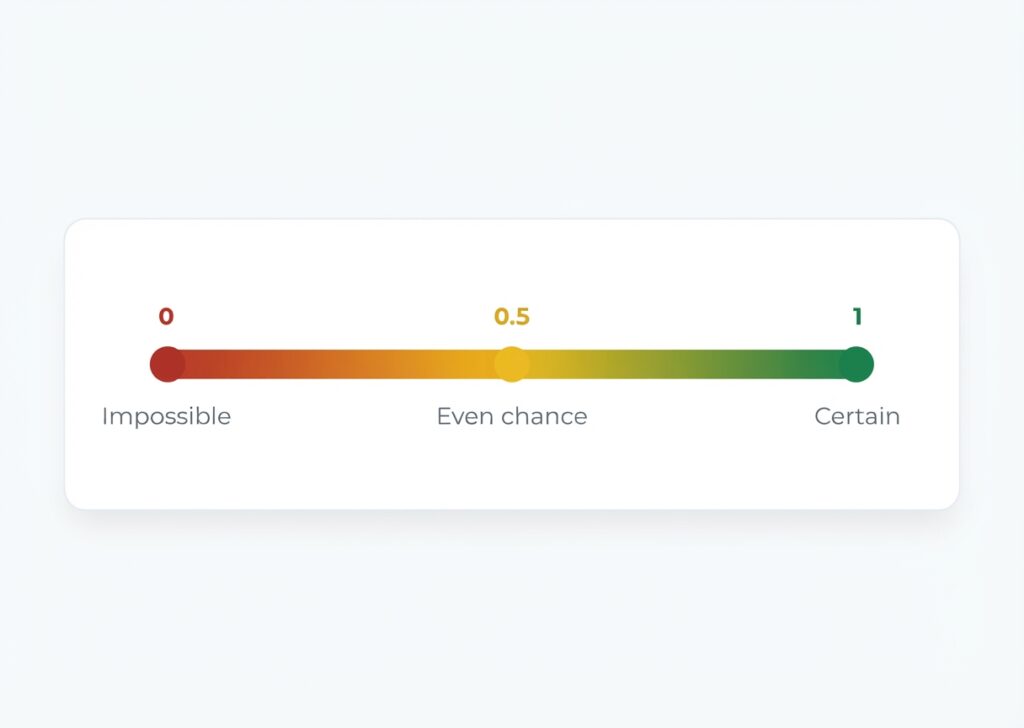
In mathematics, probability is a measure of how likely an event is to occur, expressed as a number between 0 (impossible) and 1 (certain). The basic probability formula is: P(A) = number of favorable outcomes ÷ total number of possible outcomes. To calculate probability, count how many outcomes satisfy your event, then divide by all possible outcomes. Probability appears on the SAT Math and ACT Math sections and in Florida’s MAFS.912.S-CP standards.
Number of target outcomes / number of total outcomes.
Formal definition: Probability is a branch of mathematics that quantifies the likelihood of an event occurring. It is expressed as a number between 0 and 1, where 0 means the event is impossible and 1 means the event is certain. An event with probability 0.5 is equally likely to occur or not occur. Probability is the foundation of statistics, data analysis, and decision-making under uncertainty.
Where you’ll see it: Probability appears throughout statistics courses (grades 7–12), Florida FSA assessments, EOC exams, SAT Math (data analysis section), ACT Mathematics, and the MAFS.912.S-CP standards for Florida high school students. The Florida Bright Futures Scholarship GPA and SAT score requirements make probability mastery directly relevant to scholarship eligibility.
Every probability problem uses one of four core formulas. The basic formula covers single-event problems. The compound formulas (AND / OR) cover multi-event problems. The conditional formula covers dependent-event problems. On the SAT Math section, knowing which formula to apply is the most commonly tested skill — not the calculation itself.
Use when: one event, equally likely outcomes (coins, dice, drawing cards).
Example: Rolling a 4 on a standard die → P(4) = 1 ÷ 6 ≈ 0.167
Result is always between 0 (impossible) and 1 (certain).
Use when: two events both need to happen AND events don't affect each other.
Example: Flipping heads AND rolling a 3 → P = (1/2) × (1/6) = 1/12
If dependent: P(A and B) = P(A) × P(B|A)
Use when: at least one of two events needs to happen. Subtract the overlap to avoid counting twice.
Mutually exclusive events (can't both happen): P(A or B) = P(A) + P(B)
Example: drawing a king OR a red card from a standard deck.
Use when: the probability of event B depends on event A already having happened. Read as "probability of B given A."
Example: Drawing a second ace given the first card drawn was an ace – the deck now has 51 cards, not 52.
| QUESTION TYPE | SAT FREQUENCY | ACT FREQUENCY | FORMULA REQUIRED |
|---|---|---|---|
| Basic probability from a table or graph | 1–2 per test | 2–3 per test | P(A) = favorable ÷ total |
| Compound probability (independent events) | 1 per test | 1–2 per test | P(A and B) = P(A) × P(B) |
| Conditional probability ("given that...") | 1 per test | 1 per test | P(B|A) = P(A and B) ÷ P(A) |
| Mutually exclusive / OR probability | Occasionally | 1 per test | P(A or B) = P(A) + P(B) – P(A∩B) |
| THEORETICAL PROBABILITY | EXPERIMENTAL PROBABILITY | |
|---|---|---|
| Definition | What should happen based on equally likely outcomes | What actually happened based on trials/data |
| Formula | P(A) = favorable outcomes ÷ total outcomes | P(A) = number of times A occurred ÷ total trials |
| Example | Flipping a fair coin: P(heads) = 1/2 = 0.5 | You flip a coin 100 times, get 53 heads: P(heads) ≈ 53/100 = 0.53 |
| When to use | Perfect, ideal conditions with equally likely outcomes | Real-world data, surveys, experiments, simulations |
| Florida FSA connection | Used in constructed probability problems (dice, cards, spinners) | Used in data analysis problems (tables, survey results, frequency charts) |
Total = 4+6+2 = 12. P(blue) = 6/12 = 1/2 = 0.5 = 50%
Numbers greater than 4: 5 and 6 → P(>4 on one roll) = 2/6 = 1/3. Events are independent → P(>4 AND >4) = (1/3) × (1/3) = 1/9 ≈ 0.111
P(sports) = 18/30, P(instrument) = 12/30, P(both) = 5/30. P(sports OR instrument) = 18/30 + 12/30 − 5/30 = 25/30 = 5/6 ≈ 0.833
After drawing one red: 2 red balls remain in a 7-ball bag. P(2nd red | 1st red) = 2/7 ≈ 0.286. SAT note: the “given” signals conditional probability — always update both numerator and denominator.
Probability in math is a measure of how likely an event is to happen, expressed as a number between 0 and 1. An event with probability 0 is impossible; an event with probability 1 is certain. The basic probability formula is P(A) = number of favorable outcomes ÷ total number of possible outcomes. Probability is used in statistics, data analysis, and decision-making, and is tested on the SAT Math and ACT Math sections under the Florida MAFS.912.S-CP standards.
The basic probability formula is P(A) = favorable outcomes ÷ total outcomes. For compound probability with independent events (AND): P(A and B) = P(A) × P(B). For OR events: P(A or B) = P(A) + P(B) − P(A and B). For conditional probability (given that): P(B|A) = P(A and B) ÷ P(A). On the SAT Math section, identifying which formula applies to the problem is the primary skill being tested — not the arithmetic.
Theoretical probability is calculated from equally likely outcomes without running an experiment — for example, P(heads) = 1/2 for a fair coin. Experimental probability is calculated from actual results of trials — if you flip a coin 100 times and get 47 heads, the experimental probability is 47/100. As trials increase, experimental probability approaches theoretical probability (Law of Large Numbers). Florida FSA data analysis questions typically provide survey or frequency table data and ask for experimental probability, not theoretical.
The SAT Math section includes 2–3 probability questions per test, all under the “Problem Solving and Data Analysis” content area, which accounts for approximately 17% of the total SAT Math score. Probability question types include: basic probability from a table or graph (most common), compound probability with independent events, and conditional probability (“given that” phrasing). Conditional probability is the most frequently missed type because students don’t update the sample space after each draw. See the SAT Math section on College Board for the full content specification.
Yes. InLighten’s certified math tutors in Orlando specialize in probability for both Florida FSA/EOC assessments and SAT/ACT Math preparation — covering all formula types (basic, compound AND/OR, conditional), the theoretical vs experimental distinction, and the specific question formats that appear on each exam. We diagnose exactly where your student is making errors before building a targeted session plan. Student-athletes working toward NCAA eligibility or Florida Bright Futures Scholarship score requirements receive priority alignment sessions.