
|
Preparing for the SAT? Claim Your Personalized Math Plan →
|
The Pythagorean Theorem states that in a right triangle, the square of the hypotenuse (the side opposite the right angle) equals the sum of the squares of the two legs: a² + b² = c². To use it, substitute the two known sides and solve for the unknown side by taking the square root. The Pythagorean Theorem is tested on the Florida Geometry EOC assessment and appears in the SAT Math “Additional Topics in Math” domain.
In a right triangle, the square of the hypotenuse (the side opposite the right angle) equals the sum of the squares of the two legs: a² + b² = c². Substitute the two known sides and solve for the unknown by taking the square root. Tested on the Florida Geometry EOC and SAT “Additional Topics in Math.”
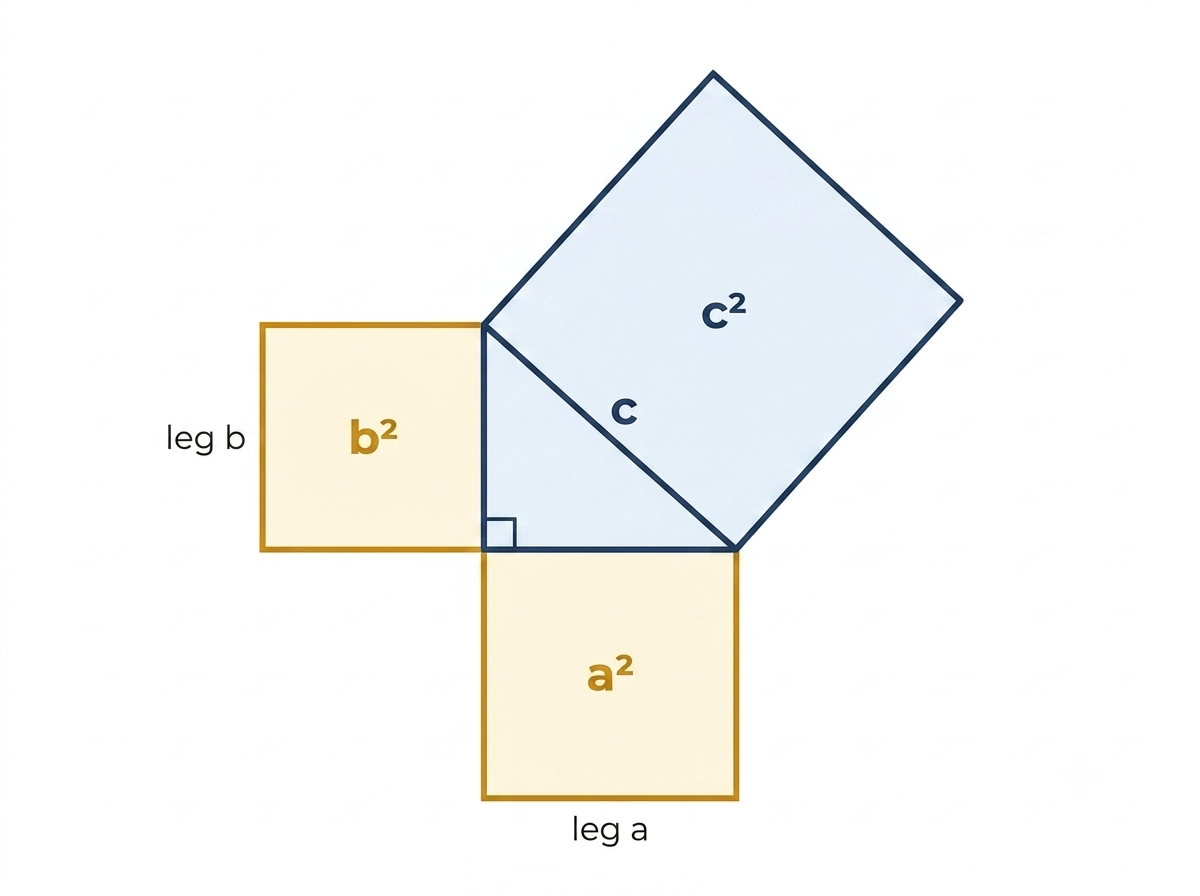
In any right triangle, the square of the hypotenuse (the longest side, opposite the right angle) equals the sum of the squares of the other two sides, the legs. Written a² + b² = c², where c is the hypotenuse and a and b are the legs. It applies to every right triangle, whatever its size or orientation.
Why it holds: draw a square on each side of a right triangle the square on the hypotenuse (c²) has exactly the same area as the two squares on the legs combined (a² + b²). A proof known since antiquity, still required in Florida Geometry courses.
a² + b² = c² rearranges to find any missing side, and the distance formula is the very same theorem on a coordinate plane.
Both legs known. Square both, add, square-root.
a=3, b=4 → √(9+16) = √25 = 5
Hypotenuse and one leg known. Square both, subtract, square-root.
c=13, b=5 → √(169-25) = √144 = 12
Symmetric to leg a the legs are interchangeable.
Label consistently to avoid confusion.
The distance formula IS the theorem on the coordinate plane: horizontal gap = a, vertical gap = b, distance = c.
Don't memorize two formulas recognize one.
It’s the most frequently tested single theorem on the SAT, 3–5 times per test, but rarely as a plain “find the missing side.” Recognizing its four disguises is what separates 650s from 750s in this domain.
| SAT QUESTION TYPE | PYTHAGOREAN DISGUISE | FREQUENCY |
|---|---|---|
| Distance between two points | The distance formula is a² + b² = c² on the plane the triangle is implicit | 1–2 per test |
| Right triangle missing side | Direct; may use triples (3-4-5, 5-12-13, 8-15-17) as fast answers | 1 per test |
| 45-45-90 triangle | Leg : Leg : Hyp = x : x : x√2 from a² + a² = c² | 1 per test |
| 30-60-90 triangle | Sides x : x√3 : 2x from the theorem with a 30° angle | 1 per test |
| 3D / space diagonal | Apply twice: once in the base, once using that diagonal as a new leg | Occasional |
Students who need to rebuild these fundamentals from the ground up often benefit from ongoing math tutoring alongside test-specific strategy.
The converse tests whether a triangle has a right angle from its three sides. Plug them in (c = longest); if the equation holds, it's a right triangle.
EOC example: sides 9, 12, 15 → 81 + 144 = 225 = 15² ✓ → yes, right triangle.
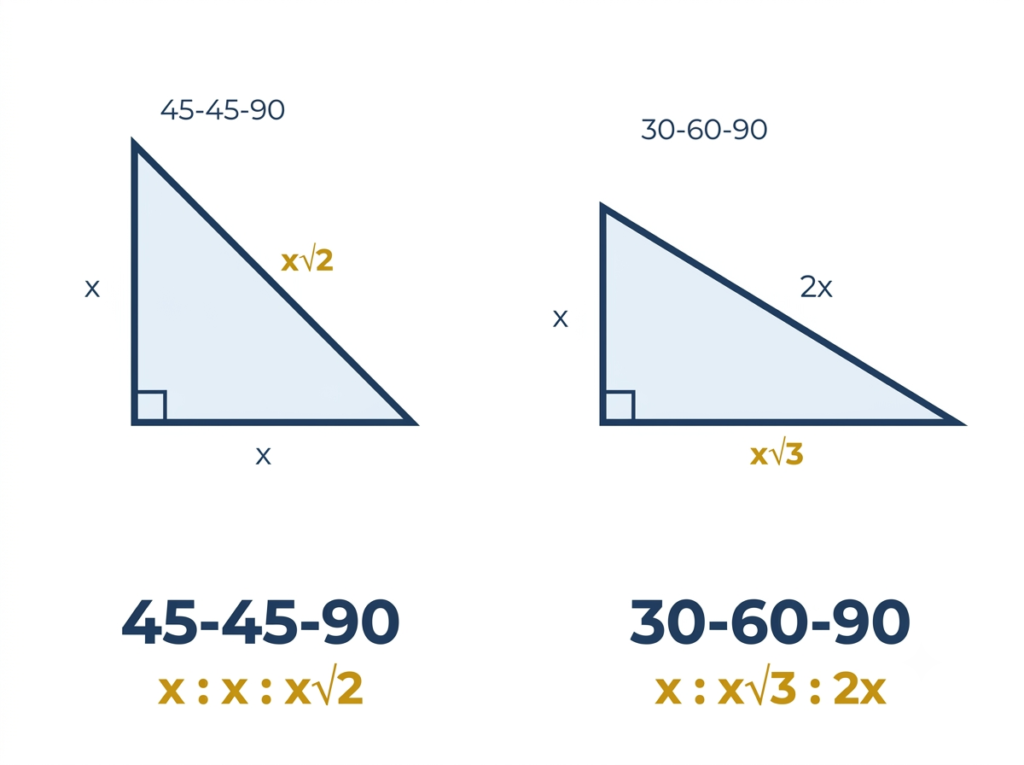
SAT shortcut: the two special-triangle ratios let you skip the Pythagorean calculation entirely memorize them to save 60+ seconds per problem. 45-45-90 comes from x² + x² = c² → c = x√2; 30-60-90 from x² + (x√3)² = (2x)².
Writing "a + b = c" instead of "a² + b² = c²" the single most common error.
Fix: always write the equation with exponents first, before substituting. Never skip squaring.
Writing a² = c² + b² when solving for a leg, because the hypotenuse wasn't identified.
Fix: label c (opposite the right angle, the longest side) first. It's always alone: a² + b² = c².
Reporting c² = 100 as "c = 100" instead of c = 10 database usually a rushed final step.
Fix: write the root explicitly: c = √100 = 10. Don't do it mentally under time pressure.
The theorem starts from a known right angle; the converse starts from sides to prove one.
Fix: ask "do I know it's a right triangle?" Yes → find a side. No → use the converse to test for a right angle.
Work each one, then reveal the answer to check yourself.
A right triangle has legs of 5 and 12. Find the hypotenuse.
A rectangular garden is 9 m wide and 40 m long. How long is the diagonal from corner to corner?
A triangle has sides 7, 24, and 25. Is it a right triangle?
Point P is at (-3, 1) and Point Q is at (5, 7). Find the length of segment PQ.
a² + b² = c², where c is the hypotenuse (opposite the right angle) and a and b are the legs. It rearranges to find any missing side: a = √(c² − b²) or b = √(c² − a²). It applies to any right triangle regardless of size or orientation, and is required by Florida MAFS.912.G-SRT, tested on the Geometry EOC and the SAT.
(1) Identify the hypotenuse (opposite the right angle, the longest side) and label it c. (2) Label the other two sides a and b. (3) Write a² + b² = c². (4) Substitute the two known values. (5) Solve for the unknown take the square root if solving for a side. (6) Verify the equation holds with all three values.
If a² + b² = c² holds for a triangle's three sides (c = longest), then the triangle is a right triangle. The theorem goes from a known right angle to a side; the converse goes from known sides to proving a right angle. Plug the three sides in if the equation is true, there's a right angle. Tested on Florida MAFS.912.G-SRT.4 and the Geometry EOC.
3–5 times per test the most frequently tested single theorem. In four forms: direct right-triangle sides, the distance formula on the coordinate plane, special right triangles (30-60-90 and 45-45-90), and 3D problems needing two applications. Recognizing all four disguises avoids wasting time on problems that look unfamiliar but are straightforward.
Yes the theorem, its converse, special right triangles, and the SAT "Additional Topics in Math" domain. We diagnose exactly where points are lost formula setup, the algebra, or recognizing the theorem inside distance and special-triangle problems then target it. Most students improve on geometry within three sessions. Book a free math assessment to start.
Book a free math assessment and get a personalized Digital SAT plan built around your gaps.