|
Preparing for the SAT? Claim Your Personalized Math Plan →
|
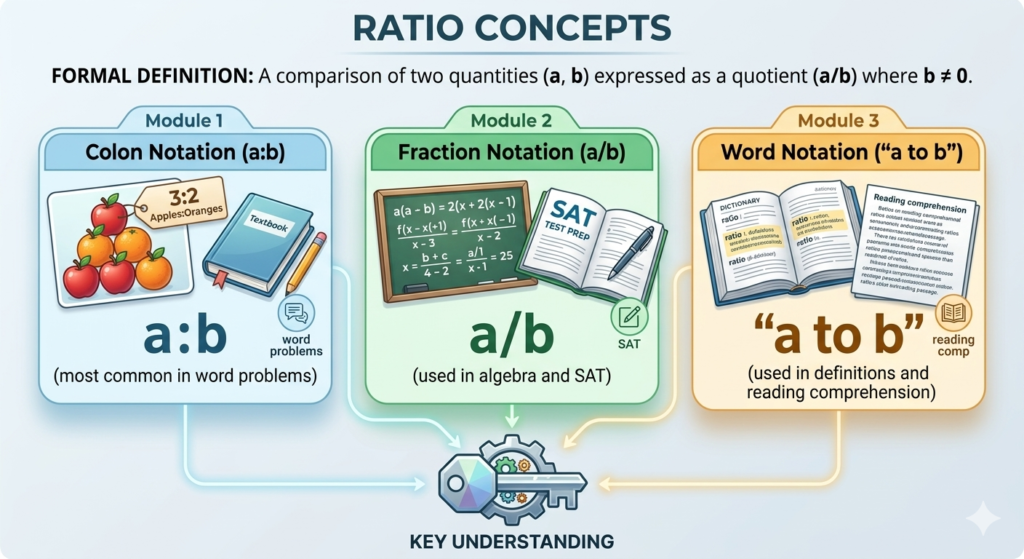
In high school math, a ratio is a comparison of two quantities using division, written as a:b, a/b, or “a to b.” Ratios can compare parts to parts (3:5) or parts to a whole (3:8). To simplify a ratio, divide both terms by their greatest common factor. Ratios and proportions — two equal ratios — appear on the SAT Math section in Problem Solving and Data Analysis questions.
“Per” and “Ratio” means something divided by something. Miles per gallon is miles divided by gallons.
Formal definition: A ratio is a comparison of two quantities expressed as a quotient. If the two quantities are a and b (where b ≠ 0), the ratio of a to b is written in three equivalent forms:
Key property: A ratio has no units — it compares like quantities. 3 apples to 5 apples = 3:5. (If the quantities have different units, it becomes a rate, not a ratio — covered in Block 05.)
Where you’ll see it: Ratios appear in pre-algebra and algebra (grades 6–10), Florida FSA math assessments, Florida MAFS.6.RP and MAFS.7.RP standards, SAT Math Problem Solving and Data Analysis domain, and ACT Mathematics proportional reasoning questions.
Every ratio problem on the SAT Math section uses one or more of these four methods. Learn each procedure and you can solve any ratio or proportion question — including the multi-step word problems that appear in the Problem Solving and Data Analysis domain.
To simplify a ratio to lowest terms:
To find equivalent ratios, multiply or divide both terms by the same non-zero number k.
When two ratios are equal (a proportion), cross-multiply to find a missing term:
A unit rate expresses a ratio with a denominator of 1 – the "per one" form.
On the SAT Math section, the most common ratio trap: a ratio of 3:5 does NOT mean 3/5 of the total. It means 3 parts out of 8 total (3+5). The ratio 3:5 → part:whole fractions are 3/8 and 5/8. Always add the ratio terms to find the total before setting up a fraction.
Time rule: write out "part, part, whole" before beginning any ratio word problem – 15 extra seconds prevents the most frequent lost point on SAT ratio questions.
Ratios and proportions appear in the SAT Math Problem Solving and Data Analysis domain — which accounts for approximately 29% of all SAT Math questions. Unlike algebra questions that test one concept at a time, ratio questions on the SAT almost always combine two skills: setting up the ratio correctly AND solving the proportion or finding the part:whole fraction. Students who master both steps consistently outperform those who only know how to cross-multiply.
| SAT QUESTION TYPE | WHAT IT TESTS | FREQUENCY |
|---|---|---|
|
Part:Part → Part:Whole |
Given a ratio like 3:5, find the fraction of the total. Requires adding ratio terms to find the whole before setting up the fraction. The most common lost-point ratio question on the SAT. | 2–3× per test |
| Proportion Word Problem | Set up a proportion from a word problem (miles/gallon, cost/item, etc.) and solve for the missing value using cross-multiplication. | 2–3× per test |
| Ratio Change Problem | A ratio changes when one quantity increases — find the new ratio. Requires setting up the original ratio, applying the change, and re-simplifying. | ~1× per test |
| Unit Rate / Density | Convert a ratio to a unit rate (per hour, per mile, per item) and use it to solve a larger problem. Appears in the Extended Thinking section. | ~1× per test |
Definition: A ratio compares two quantities of the same type. The units cancel, leaving a pure number comparison.
Example: 10 red marbles : 15 blue marbles = 2:3 (both are marbles — units cancel).
Key rule: A ratio is always unitless. If the units don’t cancel, it’s a rate, not a ratio.
Part:part vs. part:whole: 2:3 is a part:part ratio (red to blue). The part:whole ratios are 2:5 (red to total) and 3:5 (blue to total). Always identify which type the question is asking for — this is the most tested distinction on the SAT.
Definition: A rate compares two quantities with different units — the units do NOT cancel. Almost always expressed in “per unit” form (miles per hour, dollars per item, students per classroom).
Example: 180 miles ÷ 3 hours = 60 miles per hour (units: miles/hour — they don’t cancel).
Key rule: If you see the word “per” in the answer, it’s a rate, not a ratio. Unit rates are a special form of rate where the denominator is 1.
SAT connection: Rate problems in SAT Data Analysis include speed, price per unit, and population density — all use the ratio structure but with different units.
Definition: A proportion states that two ratios are equal: a/b = c/d. A proportion is not a single ratio — it is a relationship between two ratios.
Example: 3/4 = 15/20 (both simplify to 3:4 — this is a true proportion).
How to solve: Use cross-multiplication: a × d = b × c. Solve for the unknown variable.
Key rule: “Setting up a proportion” means writing two equivalent ratios and solving. Most SAT ratio word problems require you to set up a proportion — the ratio gives you the structure; the proportion gives you the equation to solve.
❌ Using the ratio directly as the part:whole fraction. A ratio of 3:5 does NOT mean 3/5. It means 3 parts to 5 parts, and the total is 3 + 5 = 8 parts. The part:whole fractions are 3/8 and 5/8. Students who write 3/5 directly from the ratio of 3:5 will choose the wrong answer on every part:whole ratio question on the SAT. Fix: Before writing any fraction from a ratio, add the ratio terms to find the total. Then write part/total — not part/other-part.
❌ Reversing the order of the ratio. “The ratio of dogs to cats is 4:7” means dogs:cats = 4:7 — not cats:dogs = 4:7. Students set up the proportion in the wrong order and solve for a different quantity than asked. This error is especially common in word problems where the ratio is stated in a sentence rather than shown numerically. Fix: Underline both nouns in the ratio statement, then write the ratio exactly in the order they appear. “Ratio of A to B” → A:B. Always label both terms before computing. InLighten’s certified math tutors in Orlando address ratio order errors in the first diagnostic session using labeled ratio tables.
❌ Cross-multiplying a ratio instead of a proportion. Cross-multiplication is valid only when two ratios are set equal (a/b = c/d). Students sometimes cross-multiply a single ratio (for example, 3/4 alone) without having a second ratio to set it equal to — producing meaningless results. Fix: Before cross-multiplying, confirm there are two equal ratios (a proportion). A single ratio cannot be cross-multiplied. Set up the proportion first: write the known ratio, then set it equal to the unknown ratio (with a variable), then cross-multiply.
❌ Not simplifying before solving — carrying large numbers unnecessarily. In 90:120 = x:40, students cross-multiply immediately: 90 × 40 = 120 × x → 3,600 = 120x → x = 30. This is correct but unnecessarily complex. Simplifying first: 90:120 = 3:4, then 3/4 = x/40 → 4x = 120 → x = 30. The simplified version uses smaller numbers with less arithmetic error risk. Fix: Always simplify the known ratio to lowest terms before setting up the proportion. Smaller numbers reduce arithmetic errors — especially in the no-calculator SAT section.
GCF(42, 56) = 14. 42 ÷ 14 = 3. 56 ÷ 14 = 4. Answer: 3:4
Set up proportion: 5/12.50 = 8/x. Cross-multiply: 5x = 8 × 12.50 = 100. x = 20. Answer: $20.00. Unit rate check: $12.50 ÷ 5 = $2.50 per notebook · $2.50 × 8 = $20 ✓
Set up proportion: 7/3 = 84/x. Cross-multiply: 7x = 252. x = 36. Answer: 36. Verify: 84/36 = 7/3 ✓
Part:part ratio 2:3 → total parts = 2 + 3 = 5. Value of one part = 40 ÷ 5 = 8. Red marbles = 2 × 8 = 16. Answer: 16 red marbles. (Fraction check: 2/5 of 40 = 16 ✓). Trap avoided: 2/3 × 40 = 26.7 — wrong because 2/3 is a part:part fraction, not part:whole.
A ratio is a comparison of two quantities using division, written as a:b, a/b, or “a to b.” In high school math, ratios are used to compare parts of a whole, set up proportions, and solve word problems. A ratio is always simplified to lowest terms by dividing both terms by their greatest common factor (GCF). Ratios appear in Florida MAFS.6.RP and MAFS.7.RP standards and on the SAT Math section in Problem Solving and Data Analysis questions.
A ratio is a comparison of two quantities (for example, 3:4). A proportion is a statement that two ratios are equal (for example, 3/4 = 6/8). A ratio is a single comparison; a proportion is a relationship between two ratios. To solve a proportion, cross-multiply: if a/b = c/d, then a × d = b × c. On the SAT Math section, most ratio word problems require you to set up a proportion using the given ratio, then solve for the unknown quantity using cross-multiplication.
A part:part ratio compares one part of a group to another part. A part:whole ratio compares one part to the entire group. For example, if there are 3 red and 5 blue marbles, the part:part ratio is 3:5 (red to blue) and the part:whole ratios are 3:8 (red to total) and 5:8 (blue to total). On the SAT Math section, the most common ratio trap is using the part:part ratio (3/5) as if it were the part:whole fraction — always add ratio terms to find the total first.
Ratios and proportions appear in the SAT Math Problem Solving and Data Analysis domain, which accounts for approximately 29% of all SAT Math questions. Common question types include: part:part → part:whole problems (2–3 per test), proportion word problems requiring cross-multiplication (2–3 per test), ratio change problems (1 per test), and unit rate or density problems (1 per test). The most frequent lost-point error is treating a part:part ratio directly as a fraction instead of adding terms to find the whole. This content is covered in InLighten’s SAT prep program in Orlando.
Yes. InLighten’s certified math tutors in Orlando specialize in math including ratios, rates, and proportions — covering all four methods (simplification, scaling, cross-multiplication, and unit rate), the part:part vs. part:whole distinction, and the SAT Math trap questions that appear in Problem Solving and Data Analysis. We use diagnostic assessments to identify which specific ratio concept is causing errors before designing targeted sessions. Students preparing for Florida FSA math assessments, SAT Math, or ACT Mathematics benefit from our algebra and pre-algebra tutoring. Book a free math assessment to start.
Understanding that a ratio of 3:5 means 3 out of 8 total — not 3 out of 5 — is the single insight that prevents the most common lost point on SAT Math ratio questions. But applying that insight consistently in a timed test, across word problems where the ratio is buried in a sentence, is a different skill. InLighten’s certified math tutors in Orlando diagnose exactly which ratio concept is causing errors — whether it’s the part:whole setup, the proportion structure, or the ratio-order confusion — then build targeted sessions around those specific gaps. Students preparing for Florida FSA math assessments or the SAT Math section routinely see improvement within 2–3 sessions of targeted ratio and proportion work.