Statistics in math is the study of collecting, organizing, and interpreting numerical data. In high-school math, descriptive statistics covers four key measures: mean (average: sum ÷ count), median (middle value when ordered), mode (most frequent value), and range (maximum − minimum). Standard deviation measures how spread out the data is from the mean. These statistics appear on Florida FSA assessments and the SAT Math “Problem Solving and Data Analysis” section.

"Statistics" Explained

Sum/number of items.

Statistics in Math — Mean, Median, Mode, Range & Standard Deviation

Formal definition: Statistics in mathematics is the discipline concerned with collecting, organizing, summarizing, and interpreting data. Statistical methods allow us to describe patterns in data, compare groups, and draw conclusions from numerical information. Statistics is divided into two main branches: descriptive statistics (summarizing the data you have) and inferential statistics (drawing conclusions about a larger population from a sample).

Statistics
What this page covers: This page focuses on descriptive statistics — the foundation of all statistical analysis and the sub-domain tested on Florida FSA, EOC assessments, SAT Math, and ACT Mathematics. Specifically: the measures of central tendency (mean, median, mode), measures of spread (range, interquartile range, standard deviation introduction), and data distributions (normal, skewed, and the effect of outliers).
Where you’ll see it: Descriptive statistics appears in Florida algebra II and statistics courses (grades 10–12), MAFS.912.S-ID.2 and MAFS.912.S-ID.3 standards, Florida FSA and EOC assessments, SAT Math “Problem Solving and Data Analysis” (≈17% of the exam), and ACT Mathematics. For Florida student-athletes, statistics is part of the minimum GPA and standardized-test score requirements for NCAA academic eligibility and Florida Bright Futures Scholarship qualification.

Measures of Central Tendency & Spread — Formulas and Definitions

Every descriptive statistics problem in high-school math requires one or more of these five measures. The first three (mean, median, mode) describe the center of the data. The last two (range, standard deviation) describe the spread. On the SAT Math section, most statistics questions ask you to calculate one measure, compare two measures, or explain what happens to a measure when the data set changes — for example, when an outlier is added.
📊 MEAN (AVERAGE)
x̄ = Σx ÷ n

Sum all values (Σx) then divide by count (n).

Example: Data: 4, 7, 7, 9, 13 → Sum = 40 → Mean = 40 ÷ 5 = 8

Sensitive to outliers – one extreme value pulls the mean toward it. The most common measure of center on SAT Math.

📍 MEDIAN (MIDDLE VALUE)
Middle value after ordering (or average of two middle values)

Step 1: Order the data from smallest to largest.
Step 2: Find the middle value.
Odd count: middle value. Even count: average of two middle values.

Example: 4, 7, 7, 9, 13 → Median = 7 (3rd of 5 values)

Resistant to outliers – more reliable center for skewed data.

🔢 MODE (MOST FREQUENT)
Value(s) that appear most often

The mode is the value with the highest frequency in the data set.

Example: 4, 7, 7, 9, 13 → Mode = 7 (appears twice)

Edge cases: No mode (all values appear once). Bimodal (two values tied for most frequent). Can have more than two modes.

↔️ RANGE (BASIC SPREAD)
Range = Maximum - Minimum

The simplest measure of spread – the total span from smallest to largest value.

Example: 4, 7, 7, 9, 13 → Range = 13 - 4 = 9

Limitation: Range is affected by outliers. The IQR (interquartile range = Q3 - Q1) is the outlier-resistant version of range tested on Florida FSA.

📉 STANDARD DEVIATION (SPREAD FROM MEAN)
σ = measure of average distance from the mean

Standard deviation tells you how tightly the data clusters around the mean. High σ = data is spread out. Low σ = data is clustered near the mean.

On SAT Math, you compare standard deviations – you do NOT manually calculate them. "Which data set has greater variability?" is the standard SAT question format.

Statistics in Math — 3 Worked Examples

EXAMPLE 1 – MEAN, MEDIAN, MODE EASY

A basketball player's points scored in 7 games: 12, 18, 18, 22, 25, 30, 12. Find the mean, median, and mode.

Step 1: Order the data → 12, 12, 18, 18, 22, 25, 30
Step 2: Mean → Sum = 12+12+18+18+22+25+30 = 137 → Mean = 137 ÷ 7 ≈ 19.6 points
Step 3: Median → 7 values → 4th value is the middle → Median = 18 points
Step 4: Mode → 12 appears twice, 18 appears twice → Bimodal: Mode = 12 and 18
Step 5: Interpret → The mean (19.6) is slightly higher than the median (18) because the outlier value (30) pulls the mean up. This is a skewed-right distribution.
Answer: Mean ≈ 19.6 Median = 18 Mode = 12 and 18 (bimodal) Range = 30 - 12 = 18
EXAMPLE 2 – OUTLIER EFFECT ON MEAN VS MEDIAN MEDIUM

A class of 6 students scored: 72, 74, 78, 81, 83, 6. The value 6 is a data entry error (outlier). What is the mean and median (a) with the outlier and (b) without it? Which measure is more affected?

Step 1: With outlier → Sum = 72+74+78+81+83+6 = 394 → Mean = 394 ÷ 6 ≈ 65.7 Ordered: 6, 72, 74, 78, 81, 83 → Median = (74+78)÷2 = 76
Step 2: Without outlier → Sum = 72+74+78+81+83 = 388 → Mean = 388 ÷ 5 = 77.6 Ordered: 72, 74, 78, 81, 83 → Median = 78
Step 3: Compare → Mean changed: 65.7 → 77.6 (change of 11.9 points). Median changed: 76 → 78 (change of 2 points).
SAT insight: The mean is sensitive to outliers; the median is resistant. When data is skewed or contains outliers, the median is a better measure of center than the mean. SAT Math will ask: "Which measure best represents the typical score?" → median, when an outlier is present.
Answer: With outlier: Mean ≈ 65.7, Median = 76. Without outlier: Mean = 77.6, Median = 78. Mean is far more affected – outliers pull it strongly. Median barely changes.
EXAMPLE 3 – STANDARD DEVIATION COMPARISON HARD – SAT LEVEL

Data Set A: 10, 10, 10, 10, 10. Data Set B: 2, 6, 10, 14, 18. Both data sets have a mean of 10. Which has a greater standard deviation? What does this tell you about the data?

Step 1: Mean of both sets → A: (10+10+10+10+10)÷5 = 10. B: (2+6+10+14+18)÷5 = 50÷5 = 10. Same mean ✓
Step 2: Spread in Data Set A → Every value equals the mean. No deviation from mean. Standard deviation = 0.
Step 3: Spread in Data Set B → Values range from 2 to 18 around mean of 10. Large distances from mean. Standard deviation > 0 and large.
Step 4: Compare → Data Set B has a greater standard deviation. Data Set A has zero variability — all values are identical. Data Set B has high variability — values are spread across a wide range.
SAT insight: When comparing standard deviations on SAT Math, you never compute them manually — you compare how spread out the data is visually or conceptually. The data set with values farther from the mean always has the greater standard deviation. Zero standard deviation = all values are the same.
Answer: Data Set B has greater standard deviation. σ_A = 0 (no spread). σ_B > 0 (high spread). Same mean, different variability — the core SAT standard deviation concept.

How Statistics Appears on the SAT Math "Problem Solving and Data Analysis" Section

The SAT Math “Problem Solving and Data Analysis” section accounts for approximately 17% of the total SAT Math score — and statistics questions dominate this section. Florida students who scored below their target on a practice SAT Math section often find that 3–5 of their missed questions are statistics questions they could answer correctly with focused practice on mean, median, outliers, and standard deviation interpretation.
For Florida student-athletes pursuing Bright Futures Scholarship eligibility (minimum SAT score 1010–1290 depending on scholarship tier) or NCAA academic clearinghouse requirements, the data analysis section is frequently the fastest source of recoverable points. Unlike calculus or advanced algebra, statistics concepts test pattern recognition and interpretation — skills that improve quickly with targeted tutoring.
SAT QUESTION TYPE WHAT IT TESTS MOST COMMON ERROR
Calculate mean from a table Apply x̄ = Σx ÷ n to frequency-weighted data Not weighting by frequency — treating all values equally
Median from ordered list or table Find middle value; handle even vs odd counts Forgetting to order data before finding the middle
Outlier effect on mean vs median Which measure changes more when an extreme value is added? Saying both change equally — mean is far more affected
Compare standard deviations Which data set has more spread? No calculation required. Trying to calculate σ manually instead of comparing spread visually
Interpret data from histogram/box plot Identify shape (skewed/normal), center, and spread from a graph Misreading skew direction; confusing mean and median on skewed graphs

Descriptive vs Inferential Statistics & Data Distribution Types

DESCRIPTIVE STATISTICS INFERENTIAL STATISTICS
Purpose Summarize and describe the data you have Draw conclusions about a larger population from a sample
Examples The average test score in your class is 78. The range is 42 points. Based on this sample, we estimate that 60% of Florida students prefer online tutoring.
Key tools Mean, median, mode, range, standard deviation, histograms, box plots Hypothesis testing, confidence intervals, p-values, sampling distributions
High school scope Grades 9–12 • Florida FSA • SAT Math Problem Solving & Data Analysis AP Statistics • College-level • Not on standard Florida FSA

Normal Distribution (Bell Curve)

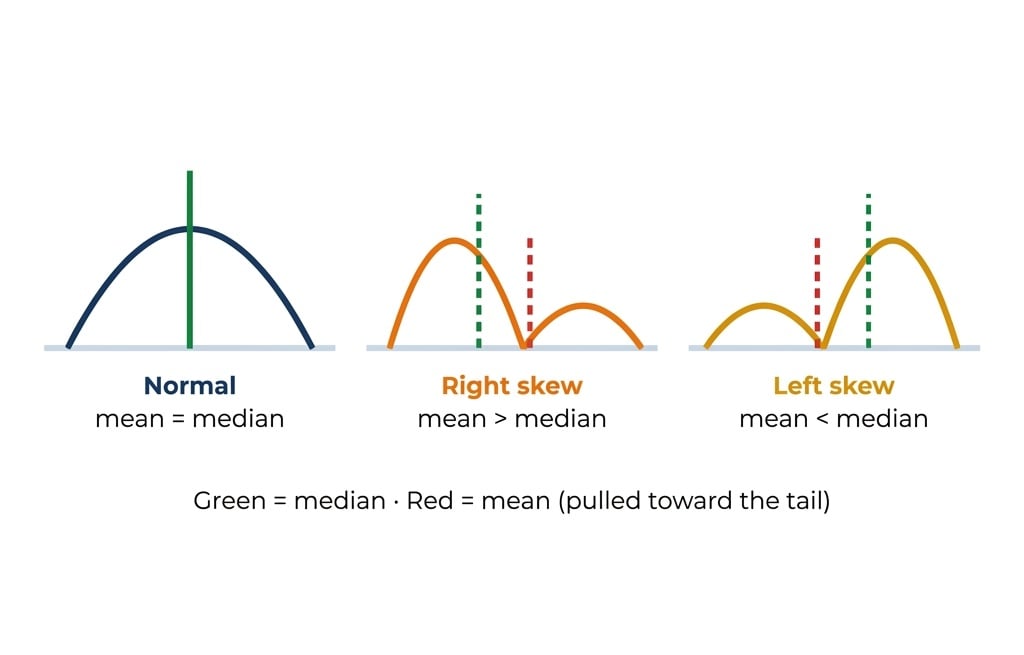
In a normal distribution, the data is symmetric around the center — the mean, median, and mode are all equal and located at the peak of the bell curve. Most data points cluster near the mean, with progressively fewer values farther away. Normal distributions appear on SAT Math questions about histograms and are the assumed shape for standard deviation interpretation questions.

Right-Skewed Distribution (Positive Skew)

A right-skewed distribution has a long tail extending to the right — a few high outliers pull the data in that direction. When data is right-skewed: mean > median > mode. The mean is pulled right (toward the outliers) while the median stays near the center of most of the data. Example: household income data is typically right-skewed (a few very high earners pull the mean up). On SAT: "In a right-skewed distribution, which is greater — the mean or the median?" → Mean.

Left-Skewed Distribution (Negative Skew)

A left-skewed distribution has a long tail extending to the left — a few low outliers pull the data in that direction. When data is left-skewed: mean < median < mode. The mean is pulled left (toward the low outliers) while the median stays closer to where most data is. Example: retirement age data — most people retire around 65, but a few retire very early, creating a left-skewed distribution. The SAT question format: "A histogram shows left-skewed data. What can you conclude about the relationship between mean and median?" → Mean < median.

How Statistics Appears on the SAT Math "Problem Solving and Data Analysis" Section

Mistake 1: Finding the median without ordering the data first. The median is the middle value of an ordered data set. Students find the middle position in the original, unordered list and report that value. For the data set {9, 3, 15, 7, 5}, the middle position (3rd) in the original list is 15 — but after ordering {3, 5, 7, 9, 15}, the median is 7. Fix: Always write “Step 1: Order the data” before doing anything else with median. Make it a reflex — never identify the median from an unordered list.
Mistake 2: Reporting the mean as the best measure of center when the data has an outlier. On SAT Math, “which measure best represents the typical value” questions expect the student to recognize that outliers make the mean misleading. Students default to the mean because it’s the most familiar measure. Fix: Check for outliers before choosing between mean and median. If one value is dramatically higher or lower than the rest, use the median as the representative measure of center. The median is resistant to outliers; the mean is not. InLighten’s certified math tutors in Orlando cover this decision rule in every statistics session.
Mistake 3: Confusing “no mode” with a mode of 0. When all values in a data set appear exactly once, there is NO mode — the concept of mode doesn’t apply. Students who see that no value repeats sometimes write “mode = 0” thinking zero is a placeholder. Zero is a number, not the absence of a mode. Fix: If no value appears more than once, write “no mode” — not “mode = 0.” If two values tie for most frequent, the data set is bimodal and both values are the mode. Zero is only the mode if the number 0 is the most frequent value in the data.
Mistake 4: Confusing skew direction — calling a left-tailed distribution “right-skewed.” Students look at which side of the histogram is taller (the left) and call it “left-heavy, therefore left skew is that direction” — the opposite of the correct labeling. The name of the skew refers to where the TAIL is, not where the PEAK is. Fix: Skew is named for the tail, not the peak. Right-skewed = long tail on the right = mean pulled right > median. Left-skewed = long tail on the left = mean pulled left < median. Draw an arrow pointing at the tail and name the skew by the direction that arrow points.

How Statistics Appears on the SAT Math "Problem Solving and Data Analysis" Section

How Statistics Appears on the SAT Math "Problem Solving and Data Analysis" Section

Mean, median, and mode are the three measures of central tendency in statistics. The mean is the arithmetic average: add all values and divide by the count (x̄ = Σx ÷ n). The median is the middle value when data is ordered from smallest to largest — for an even count, it is the average of the two middle values. The mode is the value that appears most frequently — a data set can have no mode (all values appear once), one mode, or multiple modes (bimodal or multimodal). For data sets with outliers, the median is a more reliable measure of center than the mean.

Mean formula: x̄ = Σx ÷ n (sum of all values divided by the count of values). Median formula: order the data set from smallest to largest, then find the middle value. For an odd number of values, the median is the single middle value. For an even number of values, the median is the average of the two middle values. Mode: no formula — the mode is simply the value that appears most often in the data set. There is no calculation; count how many times each value appears and identify the most frequent one.

An outlier (an extreme value much higher or lower than the rest of the data) has a large effect on the mean but little effect on the median and almost no effect on the mode. The mean is pulled toward the outlier because it includes every value in its calculation — one extreme value changes the sum significantly. The median is resistant to outliers because it depends only on the middle position, not the actual values at the extremes. The mode is unaffected unless the outlier happens to repeat. On the SAT Math section, “which measure best represents the typical value?” questions expect the answer: median, when the data contains an outlier or is skewed. See Florida’s MAFS.912.S-ID.3 standard for the full curriculum context.

Standard deviation (σ) measures how spread out the data values are around the mean. A low standard deviation means the data points cluster closely around the mean — the values are consistent. A high standard deviation means the data is spread over a wide range — the values vary significantly. On the SAT Math section, you are never asked to manually calculate standard deviation from a data set. Instead, you compare standard deviations between two data sets: the data set with values farther from the mean always has the greater standard deviation. See the SAT Math “Problem Solving and Data Analysis” specification on College Board for the full content breakdown.

Yes. InLighten’s certified math tutors in Orlando specialize in statistics for both Florida FSA/EOC assessments and SAT/ACT Math preparation — covering all five descriptive statistics measures (mean, median, mode, range, and standard deviation interpretation), outlier effects, data distribution shapes, and the specific question formats in the SAT Math “Problem Solving and Data Analysis” section. For Florida student-athletes working toward Bright Futures Scholarship score requirements (minimum SAT 1010–1290 depending on scholarship tier) or NCAA academic clearinghouse eligibility, statistics is consistently among the fastest topics to improve under targeted tutoring. We diagnose exactly which statistics concept is causing point loss before building a focused session plan.

Struggling with Statistics on the SAT or Florida FSA? Work with a Certified Math Tutor in Orlando.

Statistics is the fastest section to improve on the SAT Math section — and the most commonly overlooked in test prep. Most students can calculate the mean; far fewer know when to use the median instead, how to read a skewed distribution, or why two data sets with the same mean can have very different standard deviations. InLighten’s certified math tutors in Orlando identify which specific statistics concepts are costing your student points and build focused sessions around those gaps. For student-athletes in Orlando, Winter Park, and Lake Nona working toward Florida Bright Futures Scholarship eligibility or NCAA academic clearinghouse requirements, the SAT Math “Problem Solving and Data Analysis” section is frequently the most recoverable part of the score — and statistics is at the center of it.