
|
Preparing for the SAT? Claim Your Personalized Math Plan →
|
Solving equations means finding the value of a variable that makes the equation true, using inverse operations to isolate the variable on one side. The four steps for solving equations are: (1) Distribute — expand any parentheses; (2) Combine like terms on each side; (3) Move variable terms to one side using addition or subtraction; (4) Isolate the variable using multiplication or division. Solving linear equations is tested on the SAT Math section and required for Florida’s MAFS.912.A-REI.B.3 standard.
What does the value mean in real life.
Formal definition: Solving an equation means finding the value (or values) of a variable that make the equation a true statement. To solve algebraically, you apply inverse operations equally to both sides of the equation — maintaining balance — until the variable stands alone. The result is the solution: the value that satisfies the equation.
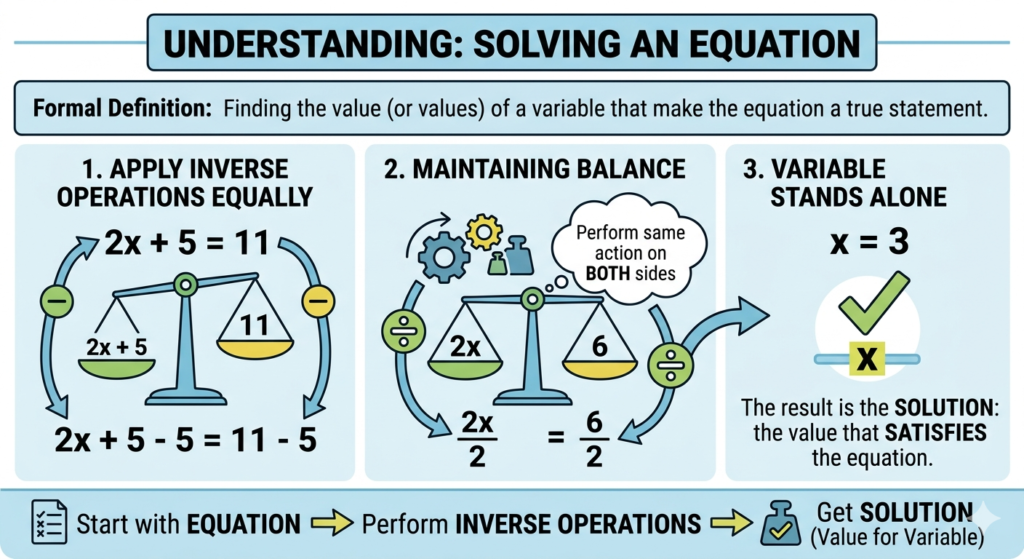
Where you’ll see it: Solving equations is the core skill of every algebra course (grades 7–11), Florida FSA and EOC assessments, the MAFS.912.A-REI.B.3 state standard, SAT Math (Algebra subscore), and ACT Mathematics. It is the prerequisite skill for solving systems of equations, quadratic equations, and all advanced algebra.
Every solvable equation follows the same four-step sequence. Work through each step in order — skipping any step is the most common source of errors on algebra tests and the SAT Math section:
Use the distributive property: a(b + c) = ab + ac. Example: 3(x + 4) becomes 3x + 12. Never skip this step — undistributed parentheses are a top student error.
Combine variable terms with variable terms, constants with constants — on each side of the equals sign independently. Do not combine across the equals sign at this step.
Use addition or subtraction to move all variable terms to one side and all constant terms to the other. Always perform the same operation on both sides — this is the "balance rule."
Divide both sides by the coefficient of x (or multiply if x has a fractional coefficient). The result is the solution: x = [value]. Always check by substituting back into the original equation.
Solving equations is the most tested algebra skill on the SAT — it appears in nearly every section in some form. The four-step method above handles the majority of SAT equation types. The equation-solving questions students miss most often are literal equations (Example 3 above) and equations with extraneous solutions. InLighten’s SAT Math tutors in Orlando specifically target these high-difficulty equation types in every SAT prep session.
| SAT MATH CATEGORY | HOW SOLVING EQUATIONS APPEARS | DIFFICULTY |
|---|---|---|
| Heart of Algebra | Linear equations in one variable; equation models from word problems; solving for x given constraints | Moderate |
| Advanced Math | Quadratic equations (factoring and quadratic formula); literal equations (solve for a specific variable); equations with rational expressions | Hard |
| Problem-Solving | Setting up and solving equations from real-world scenarios; multi-step word problems requiring equation models | Moderate– Hard |
| Passport to Science | Equation-solving in physics contexts (e.g., solve F = ma for a); solving rate-distance equations | Hard |
A one-step equation requires a single inverse operation to isolate x. Example: 3x = 21 → divide both sides by 3. These are the foundation of all equation-solving and appear in the simplest SAT Math questions. Mastering one-step equations is the prerequisite for every other type on this list.
Multi-step equations require two or more operations and often include distribution and combining like terms before isolating the variable. They are the most common equation type on Florida FSA algebra assessments and on the SAT Heart of Algebra section. The full 4-step method above applies to every multi-step equation.
A literal equation contains two or more variables, and you solve for one in terms of the others (e.g., solve A = lw for l). The steps are identical to numerical equations — apply inverse operations to isolate the target variable. Literal equations appear regularly on SAT Math Advanced problems and are the most commonly missed equation type on the exam (Example 3 above).
Some equations simplify to a false statement (e.g., 3 = 7) — these have no solution. Others simplify to a true statement (e.g., 5 = 5) — these have infinite solutions. Both cases appear on SAT Math as parameter-value questions: "For what value of k does this equation have no solution?" Recognizing these special cases is a high-difficulty skill tested in Florida EOC assessments.
❌ Not performing the same operation on both sides. Students subtract 5 from the left side but forget to subtract from the right, breaking the balance of the equation. This is the #1 algebra error in InLighten’s sessions with Orlando students. Fix: always say out loud “I’m subtracting 5 from both sides” — the word “both” forces the correct behavior. InLighten’s certified math tutors in Orlando diagnose this in session 1 using a balance-scale visual.
❌ Distributing incorrectly — forgetting the negative sign. Students write 3(x − 4) as 3x − 4 instead of 3x − 12. The negative sign must be distributed to every term inside the parentheses. Fix: circle every term inside the parentheses before distributing. Draw an arrow from the coefficient to each term. Negative signs in parentheses are the single most common distribution error on the SAT Math section.
❌ Dividing only one term when isolating x in a literal equation. Students solve P = 2l + 2w for l by writing l = P/2 + 2w instead of l = (P − 2w)/2. They divide just the first term instead of the entire expression. Fix: use parentheses explicitly before dividing: write P − 2w = 2l, then (P − 2w)/2 = l. The parentheses remind you that the entire left side is divided, not just the first term.
❌ Stopping after finding one variable in a two-variable setup. Students solve for x in a rearranged literal equation, then stop — missing that the question asked to solve for a different variable. On the SAT, the question always specifies which variable to solve for. Fix: underline the target variable in the original question before beginning. Check your answer against that underlined variable at the end of every step. This single habit eliminates this error entirely.
Add 7 to both sides: 5x = 25. Divide by 5: x = 5. Check: 5(5) − 7 = 25 − 7 = 18 ✓
Distribute: 6x + 8 = 5x + 11. Subtract 5x: x + 8 = 11. Subtract 8: x = 3. Check: 2(9+4) = 26, 5(3)+11 = 26 ✓
Divide both sides by t: r = d/t. Note: this is a literal equation — the steps are identical to numerical equations.
For infinite solutions, the equation must be true for all values of x. This requires k = 10. (Then 3x + 10 = 3x + 10 is always true.) Any other value of k produces no solution.
Solving an equation means finding the value of the variable that makes both sides of the equation equal — a true statement. You solve by applying inverse operations to both sides equally until the variable is isolated (stands alone). The result is the solution: the value that satisfies the equation.
The four steps for solving equations are: (1) Distribute — expand all parentheses using the distributive property; (2) Combine like terms on each side of the equation; (3) Move variable terms to one side and constant terms to the other using addition or subtraction; (4) Isolate the variable using multiplication or division. Check your solution by substituting it back into the original equation.
A literal equation is an equation with two or more variables, where you solve for one variable in terms of the others. Example: solve A = lw for l gives l = A/w. You use the same four-step inverse operations method, treating the target variable as x and all other variables as constants. Literal equations appear frequently on SAT Math Advanced problems and Florida FSA assessments.
An equation has no solution when solving produces a false statement — for example, 3 = 7. This means no value of x satisfies the equation. An equation has infinite solutions when solving produces a true statement — for example, 5 = 5. This means every value of x satisfies the equation. On the SAT Math section, these appear as parameter-value questions: “For what value of k does the equation have no solution?” (also covered in /vocab/systems/ for the two-variable case).
Solving equations is the most tested algebra skill on the SAT Math section. It appears in the Heart of Algebra subscore (linear equations in one variable), the Advanced Math subscore (literal equations, quadratic equations), and Problem-Solving (equation models from word problems). The SAT also tests special cases — equations with no solution or infinite solutions — as parameter-value questions. Students who master the four-step method and literal equations cover the majority of the algebra content on the SAT Math section. See MAFS.912.A-REI.B.3 on the Florida CPALMS standards database for the Florida curriculum alignment.
Understanding the steps is one thing — applying them reliably under test conditions is another. InLighten’s certified math tutors in Orlando diagnose exactly where your student loses points on algebra equations, multi-step problems, and literal equations, then build targeted sessions around those specific gaps. Students who work with InLighten on algebra see grade improvement within 3 sessions — and arrive better prepared for the SAT Math algebra questions that follow from these same skills.