
|
Preparing for the SAT? Claim Your Personalized Math Plan →
|
Number theory is the branch of mathematics that studies the properties and relationships of integers — whole numbers and their negatives. Core number theory topics include prime numbers (integers with exactly two factors: 1 and themselves), divisibility rules (shortcuts to determine if one integer divides another evenly), greatest common factor (GCF), and least common multiple (LCM). These concepts appear in Florida’s MAFS standards beginning in grade 6 and are tested on the SAT Math section under Number and Quantity.
Number multiplied by exponent.
Formal definition: Number theory is the branch of pure mathematics devoted to studying the properties of integers (whole numbers). It examines how numbers divide, factor, and relate to each other — answering questions like “What makes a number prime?” and “What is the smallest number two integers both divide into?” Number theory provides the foundational rules that underlie all arithmetic and algebra.
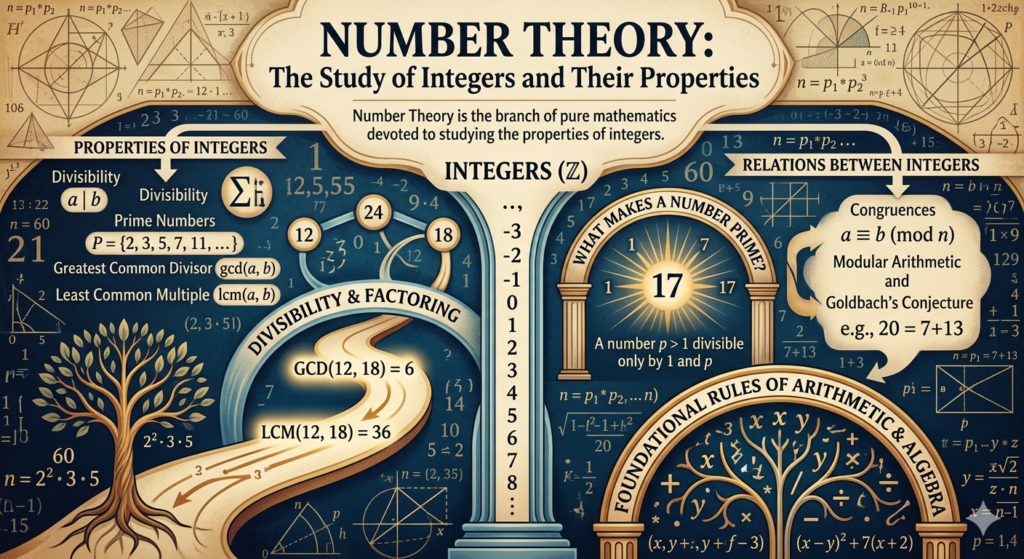
Where you’ll see it: Number theory topics appear in Florida’s MAFS.6.NS standards (grades 6–8), in the Florida FSA and EOC assessments, and in the SAT Math section under Number and Quantity. GCF and LCM are also essential tools for simplifying fractions, solving ratio problems, and factoring polynomials in higher-level algebra.
Number theory rests on four foundational concepts that every Florida math student encounters from grade 6 onward. Mastering these concepts — and the step-by-step procedures to apply them — is essential for simplifying fractions, solving ratio problems, and answering number properties questions on the SAT Math section.
Primes: 2, 3, 5, 7, 11, 13, 17, 19, 23...
Composite: any integer with more than 2 factors.
Special cases: 1 is neither prime nor composite. 2 is the only even prime.
To test: divide by every prime up to √n. If none divide evenly, the number is prime.
Method: divide by the smallest prime that goes in evenly, repeat until you reach 1.
Example: 60 = 2 × 30 = 2 × 2 × 15 = 2 × 2 × 3 × 5 = 22 × 3 × 5
Used for: finding GCF, LCM, simplifying fractions, and factoring polynomials.
Method 1 (Listing): list factors of each number, find the largest shared factor.
Method 2 (Prime Factorization): factor each number, multiply shared primes at lowest power.
Example: GCF(36, 48) = 22 × 3 = 12
Used for: simplifying fractions and ratio problems.
Method 1 (Listing): list multiples of each number, find the smallest shared multiple.
Method 2 (Prime Factorization): factor each number, multiply all primes at highest power.
Example: LCM(12, 18) = 22 × 32 = 36
Used for: adding fractions and solving word problems with cycles.
These rules let you factor large numbers quickly without long division — essential for SAT Math number properties questions under time pressure.
SAT Math tests number theory in approximately 3–4 questions per exam — spread across the Heart of Algebra, Problem Solving, and Advanced Math categories. These questions are often disguised as “integer properties” or “number relationships” problems. Students who know their prime factorization, GCF, and LCM procedures can solve these in under 60 seconds; students who don’t recognize the underlying number theory concept waste 3–4 minutes attempting trial and error. For Orlando-area students pursuing Florida Bright Futures scholarships, these are exactly the questions that push a score from 1100 to 1200.
| SAT MATH CATEGORY | HOW NUMBER THEORY APPEARS | FREQUENCY |
|---|---|---|
| Heart of Algebra | Integer properties in equations — "if n is a positive integer, which values of n satisfy..." | 1-2 per test |
| Problem Solving & Data | GCF/LCM applied in ratio, rate, or scheduling word problems | 1 per test |
| Advanced Math | Prime factorization in polynomial factoring or number property proofs | 1 per test |
| Special Cases | "How many prime factors does n have?" and "what is the greatest integer k such that 2k divides n?" | 1 per test |
Every integer greater than 1 is either prime or can be expressed as a unique product of prime numbers (up to the order of the factors). This means every number has exactly one prime factorization — making prime factorization the "DNA" of any number. This theorem is the foundation for all GCF and LCM procedures.
For any two positive integers a and b: GCF(a, b) × LCM(a, b) = a × b. This formula provides a shortcut — if you know the GCF and the product of the two numbers, you can find the LCM instantly without prime factorization. Example: GCF(12, 18) = 6 and 12 × 18 = 216, so LCM = 216 ÷ 6 = 36. This relationship appears on the SAT as a "what is the LCM" problem where the GCF is given.
If integer a divides integer b with no remainder, then b is divisible by a, b is a multiple of a, and a is a factor of b. These three statements are equivalent and interchangeable. On the SAT, remainder problems (often expressed as "when n is divided by k, the remainder is r") are a specific application of divisibility that requires knowing the relationship r = n − k × (n ÷ k, rounded down). Students who haven't studied this in number theory context consistently miss these questions.
❌ Calling 1 a prime number. Students remember “a prime is only divisible by 1 and itself” and conclude that 1 qualifies because it’s divisible by 1 and by 1 (itself). But 1 has only ONE factor, not two — the definition requires exactly two distinct factors. Fix: memorize the exception explicitly: 1 is neither prime nor composite. The smallest prime is 2.
❌ Confusing GCF with LCM (and vice versa). Students mix up which operation “goes up” versus “goes down.” They find the smallest shared number (LCM logic) but call it the GCF, or they find the largest shared factor (GCF logic) and present it as the LCM. Fix: anchor to the words themselves. “Greatest Common Factor” → you’re looking for FACTORS (numbers that divide in) and you want the GREATEST. “Least Common Multiple” → you’re looking for MULTIPLES (numbers they both divide into) and you want the LEAST.
❌ Stopping prime factorization before it’s complete. Students factor 72 as 8 × 9 and stop, not recognizing that 8 and 9 are composite and must be broken down further. An incomplete factorization produces a wrong GCF or LCM. Fix: a prime factorization is complete only when every factor in the product is a prime number. Check every number: 8 = 2³ and 9 = 3² — neither is prime. Continue until all factors are circled primes.v
❌ Using the listing method for large numbers. Students try to list all factors of 144 and 180 to find GCF. At large numbers, listing becomes error-prone and time-consuming — especially under SAT time pressure. Fix: use prime factorization for any number above 30. It is faster, more systematic, and eliminates the risk of missing a factor. The listing method is only appropriate for small numbers (under 30) where the factor list is short.
36 = 2² × 3². 84 = 2² × 3 × 7. Shared primes at lowest power: 2² × 3 = 12. GCF = 12.
LCM(15, 20): 15 = 3 × 5. 20 = 2² × 5. LCM = 2² × 3 × 5 = 60. They will arrive together again in 60 minutes.
√127 ≈ 11.3. Test primes up to 11: 127 ÷ 2 = 63.5 ✗ · ÷ 3: digit sum = 10, not divisible ✗ · ÷ 5: doesn’t end in 0 or 5 ✗ · ÷ 7 = 18.1 ✗ · ÷ 11 = 11.5 ✗. None divide evenly — 127 is prime.
Use GCF × LCM = a × b: 6 × 90 = 18 × b. 540 = 18b. b = 30. Answer: 30. Check: GCF(18,30) = 6 ✓ and LCM(18,30) = 90 ✓.
Number theory is the branch of mathematics that studies the properties and relationships of integers — whole numbers and their negatives. Core topics include prime numbers (integers with exactly two factors), prime factorization (expressing any integer as a unique product of primes), greatest common factor (GCF), least common multiple (LCM), and divisibility rules. These concepts are foundational to all algebra and appear in Florida’s MAFS standards beginning in grade 6.
The GCF (Greatest Common Factor) is the largest integer that divides evenly into two or more numbers — it “goes down” into the numbers. The LCM (Least Common Multiple) is the smallest integer that both numbers divide into evenly — it “goes up” from the numbers. For any two positive integers a and b, GCF(a,b) × LCM(a,b) = a × b. This relationship provides a shortcut when one value is known. Both appear on the Florida FSA and SAT Math section.
Divisibility rules are shortcuts to determine whether an integer divides evenly into another without performing full division. Key rules: divisible by 2 if the number ends in an even digit; by 3 if the sum of digits is divisible by 3; by 4 if the last two digits form a number divisible by 4; by 5 if the number ends in 0 or 5; by 6 if divisible by both 2 and 3; by 9 if the digit sum is divisible by 9; by 10 if the number ends in 0. These rules appear on the SAT Math section in number properties questions.
Number theory topics appear in approximately 3–4 questions on every SAT Math section, distributed across the Heart of Algebra (integer properties in equations), Problem Solving and Data Analysis (GCF/LCM in word problems), and Advanced Math (prime factorization in polynomial or exponential problems). Remainder problems — which use divisibility — appear once per exam. For Florida students, this is especially important because the SAT score threshold for Bright Futures scholarships is within reach for students who master these procedural topics.
Yes. InLighten’s certified math tutors in Orlando teach number theory as part of both our standard algebra tutoring and our SAT Math prep program. We cover prime factorization, GCF and LCM methods, divisibility rules, and the SAT-specific remainder and integer properties question formats. We identify exactly where your student is losing points — whether in the procedure, the concept, or the word problem setup — then build targeted sessions around those specific gaps. Book a free math assessment to get started.
Understanding prime factorization, GCF, and LCM is one thing — applying them quickly under timed SAT conditions, inside a word problem, with a twist on the GCF×LCM relationship, is another. InLighten’s certified math tutors in Orlando diagnose exactly where your student is losing points on number theory — whether it’s the factorization procedure, the GCF/LCM confusion, or the SAT remainder and integer property question formats — then build targeted sessions around those specific gaps. For Orlando families pursuing Florida Bright Futures scholarships, mastering these SAT Math topics is one of the most direct paths to meeting the score requirement.