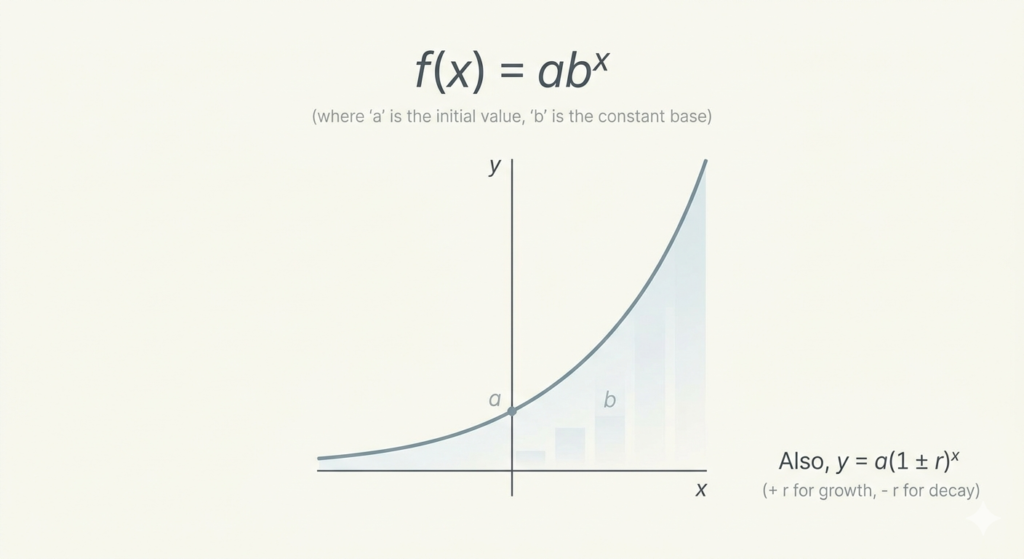
An exponential function is a mathematical function in the form f(x) = ab^x, where a is the initial value (the y-intercept when x = 0), b is the base (the growth or decay factor, always positive and not equal to 1), and x is the exponent. When b > 1, the function models exponential growth — the value increases at an accelerating rate. When 0 < b < 1, the function models exponential decay — the value decreases toward zero. Exponential functions appear in the SAT Math Advanced Mathematics domain and Florida Algebra 2 (MAFS.912.F-LE).

"Exponential Function" Explained

y=S(1+-%/100)^x.
y = output.
S = y-intercept.
r = rate of change (1+-%/100).
x = input (usually time)

Exponential Functions — Definition, Formula & Growth vs Decay

Formal definition: An exponential function is a function of the form f(x) = ab^x, in which the variable x appears as the exponent rather than the base. The value a is the initial value of the function (the output when x = 0), and b is the constant base — the factor by which the output is multiplied for each unit increase in x. Because the variable is in the exponent, exponential functions grow or shrink at a rate proportional to their current value, producing curves that are distinctly faster than any linear or polynomial function.

Exponential Functions

Where you’ll see it: Exponential functions appear in Florida Algebra 2 (MAFS.912.F-LE.1 and MAFS.912.F-BF), Pre-Calculus, AP Calculus, SAT Math Advanced Mathematics, and ACT Mathematics. Real-world applications include compound interest, population growth, radioactive decay, and viral spread — making this one of the most cross-disciplinary math topics tested on standardized exams.

The Exponential Function Formula — f(x) = ab^x Explained

Every exponential function follows the same general form. Understanding what each part does is the key to identifying growth vs. decay, reading graphs, and setting up word problems on the SAT and Florida Algebra 2 exams.

ω GENERAL FORMULA – EXPONENTIAL FUNCTION

f(x) = a · bx

x is the exponent (the input / independent variable) · a is the initial value · b is the base (growth or decay factor) · Output f(x) changes by a factor of b for every unit increase in x

PARAMETER A – INITIAL VALUE

a = f(0) = y-intercept

When x = 0: f(0) = a·b0 = a·1 = a

a is always the y-intercept of the graph. a cannot equal 0. If a is negative, the graph reflects below the x-axis.

PARAMETER B – THE BASE

b > 0 and b ≠ 1

b > 1 → exponential growth (increasing)
0 < b < 1 → exponential decay (decreasing)

b = 1 is excluded because 1x = 1 for all x – that's not exponential, it's constant.

PARAMETER X – THE EXPONENT

x is the variable
(not the base)

This is what makes exponential ≠ power function. In 2x, the variable is in the exponent. In x2, the variable is the base – that's a power function, not exponential.

SAT KEY RULES – EXPONENTIAL FUNCTIONS

Growth: b > 1 · Decay: 0 < b < 1 · Y-intercept always = a · Horizontal asymptote always y = 0

On SAT Advanced Mathematics: if a question gives you two points and asks you to build the exponential equation, use the ratio method – divide the outputs to find b, then back-solve for a. The horizontal asymptote (y = 0) is the highest-difficulty graph feature tested on the SAT – it is never crossed but approached infinitely.

Exponential Functions — 3 Worked Examples

EXAMPLE 1 – IDENTIFYING GROWTH VS DECAY EASY

Determine whether each function represents exponential growth or decay, then identify the initial value and base: (A) f(x) = 3 · 2^x (B) g(x) = 500 · (0.8)^x

Function A: a = 3 (initial value) · b = 2 (base) · Since b = 2 > 1 → exponential GROWTH
Function A check: f(0) = 3 · 20 = 3 · 1 = 3 ✓ (y-intercept = 3) · f(1) = 3 · 2 = 6 · f(2) = 3 · 4 = 12 · output doubles each step → growth confirmed
Function B: a = 500 (initial value) · b = 0.8 (base) · Since 0 < b = 0.8 < 1 → exponential DECAY
Function B check: g(0) = 500 · g(1) = 500 · 0.8 = 400 · g(2) = 500 · 0.64 = 320 · output shrinks by 20% each step → decay confirmed
Answer: f(x) = growth (b=2 > 1, start=3) · g(x) = decay (b=0.8 < 1, start=500)
EXAMPLE 2 – WORD PROBLEM (POPULATION DECAY) MEDIUM

A wildlife biologist tracking a deer population in Central Florida records 1,200 deer in 2020. The population is declining at a rate of 15% per year. Write an exponential function for the population after t years, then estimate the population in 2025.

Step 1: Identify parameters → a = 1,200 (initial value in year 0 = 2020) · rate = 15% decay per year
Step 2: Find b → Decay rate 15% means the population keeps 85% each year → b = 1 - 0.15 = 0.85
Step 3: Write the function → P(t) = 1200 · (0.85)^t
Step 4: Evaluate at t = 5 (year 2025) → P(5) = 1200 · (0.85)^5 = 1200 · 0.4437 ≈ 532 deer
Verify b: 0 < 0.85 < 1 ✓ (decay) · a = 1200, so P(0) = 1200 ✓ (initial condition satisfied)
Answer: P(t) = 1200 · (0.85)^t · Population in 2025 ≈ 532 deer
EXAMPLE 3 – SAT LEVEL (BUILD THE EQUATION FROM TWO POINTS) HARD – SAT LEVEL

An exponential function f(x) = ab^x passes through the points (1, 12) and (3, 108). Find the values of a and b.

Step 1: Set up two equations using f(x) = ab^x → f(1): ab1 = 12 · f(3): ab3 = 108
Step 2: Use the ratio method – divide the second equation by the first: (ab3)/(ab) = 108/12 → b2 = 9
Step 3: Solve for b → b = 3 (b must be positive for an exponential function)
Step 4: Back-substitute into f(1) = 12 → a · 3 = 12 → a = 4
Step 5: Verify with f(3) → 4 · 33 = 4 · 27 = 108 ✓
SAT trap: many students try to solve simultaneously using substitution (algebraically correct but slow). The ratio method eliminates a in one step – solving in under 60 seconds vs. 3+ minutes with substitution.
Answer: a = 4, b = 3 · Equation: f(x) = 4 · 3^x · SAT insight: always use the ratio method to find b – divide the larger output by the smaller

How Exponential Functions Appear on the SAT Math Section

The SAT Math Advanced Mathematics domain — the highest-difficulty section — tests exponential functions in 2–4 questions per exam. These questions are among the most commonly missed by students who understand exponential functions in a classroom context but struggle to recognize them in the abstract, data-table, or real-world formats the SAT uses. InLighten’s SAT Math tutors in Orlando specifically address the parameter-interpretation and ratio-method skills that separate a 650 Math score from a 750+.

SAT MATH CATEGORY HOW EXPONENTIAL FUNCTIONS APPEAR DIFFICULTY
Advanced Math Identify growth vs. decay from f(x) = ab^x or a table of values Moderate
Advanced Math Build the exponential equation from two given points (ratio method) Hard
Advanced Math Interpret what a or b represents in a real-world context (percent growth, initial population) Hard
Problem-Solving Compare exponential growth to linear growth — which scenario models which function type? Moderate–Hard
Advanced Math Rewrite an exponential expression — e.g., 2^(x+3) = 8 · 2^x (exponent laws with exponential) Hard

How Exponential Functions Appear on the SAT Math Section

Exponential Growth (b > 1)

An exponential growth function has a base b greater than 1. Each time x increases by 1, the output multiplies by b — producing a curve that rises steeply to the right and approaches zero from above as x decreases toward negative infinity. The graph has a y-intercept at (0, a), always stays above the x-axis (horizontal asymptote at y = 0), and increases without bound. Real-world models: compound interest, population growth, viral spread. On SAT Math: "A town's population doubled every 12 years" → growth function with b = 2.

Exponential Decay (0 < b < 1)

An exponential decay function has a base b between 0 and 1 (exclusive). Each time x increases by 1, the output is multiplied by b — a fraction less than 1 — so the output decreases toward zero but never reaches it. The horizontal asymptote is still y = 0. Real-world models: radioactive half-life, drug concentration in the body, depreciation of a vehicle's value. On SAT Math: "A car loses 12% of its value each year" → b = 1 − 0.12 = 0.88, a decay function. Note: exponential vs linear functions — linear decreases by a constant amount; exponential decays by a constant ratio.

Natural Exponential Function (base e)

The natural exponential function f(x) = e^x uses the mathematical constant e ≈ 2.718 as its base. The natural base arises in continuous growth and decay models — where growth happens at every instant rather than in discrete steps. f(x) = e^x appears in AP Calculus (its derivative is itself — d/dx[e^x] = e^x) and in the compound interest formula A = Pe^(rt) for continuously compounded interest. On the SAT and in Florida Algebra 2, e appears in context problems; students need to recognize it as a base greater than 1, making f(x) = e^x an exponential growth function.

4 Common Mistakes with Exponential Functions

Confusing exponential functions with power functions. Students see f(x) = x² and f(x) = 2^x and treat them as the same type. They are fundamentally different: in a power function, the variable is the base; in an exponential function, the variable is the exponent. Fix: check where the variable (x) is. In the exponent → exponential function. In the base → power function. This distinction appears as a classification question on the SAT.

Setting up the decay base incorrectly. A population declining at 15% per year has a decay factor of b = 0.85, not b = 0.15. Students confuse the rate of decay with the remaining fraction. Fix: decay base b = 1 − (decay rate). If 15% is lost, 85% remains → b = 0.85. The base is always the proportion that remains, not the proportion that is lost. InLighten’s certified math tutors in Orlando address this specific error in every Algebra 2 and SAT Math session involving exponential word problems.

Forgetting that the y-intercept is always a, not 1. Students memorize that “exponential functions cross the y-axis at 1” — this is only true when a = 1 (like f(x) = 2^x). When a ≠ 1 (like f(x) = 500 · (0.85)^x), the y-intercept is 500. Fix: the y-intercept is always f(0) = a·b⁰ = a·1 = a. Never assume the y-intercept is 1 unless a = 1 is explicitly stated or confirmed by calculation.

Treating exponential growth as linear in word problems. Students read “grows by 20% each year” and add 20% of the original amount each year (linear) instead of multiplying by 1.20 each year (exponential). After 5 years, the difference in the calculated value is significant. Fix: “grows by a constant percentage” = exponential (multiply by 1 + rate each period). “Grows by a constant amount” = linear (add the same value each period). This conceptual distinction is tested on every SAT in the Problem-Solving and Data Analysis domain.

4 Common Mistakes with Exponential Functions

4 Common Mistakes with Exponential Functions

An exponential function is a function of the form f(x) = ab^x, in which the variable x is in the exponent. The value a is the initial value (the output when x = 0, and the y-intercept of the graph), and b is the base — a positive constant not equal to 1. When b > 1, the function grows; when 0 < b < 1, the function decays. Exponential functions appear in Florida Algebra 2 (MAFS.912.F-LE) and on the SAT Math Advanced Mathematics domain.

The standard formula for an exponential function is f(x) = ab^x, where a is the initial value (f(0) = a), b is the base (growth or decay factor, b > 0, b ≠ 1), and x is the exponent. The y-intercept of the graph is always the point (0, a). All exponential functions have a horizontal asymptote at y = 0 — the graph approaches but never crosses the x-axis.

In exponential growth (b > 1), the output increases by a constant factor (b) each time x increases by 1 — producing a curve that rises steeply. Example: f(x) = 3 · 2^x doubles each step. In exponential decay (0 < b < 1), the output decreases by a constant factor each step — producing a curve that falls toward zero. Example: f(x) = 500 · (0.85)^x decreases by 15% each step. The horizontal asymptote (y = 0) applies to both types.

SAT Math Advanced Mathematics tests exponential functions in 2–4 questions per exam: identifying growth vs. decay from an equation or table; building an exponential model from two given points; interpreting what the initial value a or base b represents in a real-world scenario; and rewriting exponential expressions using exponent laws. The hardest question type is parameter interpretation — “in f(x) = 200 · (1.08)^x, what does 1.08 represent?” — which requires knowing that b = 1 + growth rate. Refer to College Board’s SAT Math specification for the full Advanced Mathematics domain description.

Yes. InLighten’s certified math tutors in Orlando specialize in Algebra 2 and SAT Math Advanced Mathematics — including exponential growth and decay functions, building exponential models from two points, and interpreting the parameters a and b in real-world scenarios. We diagnose exactly where your student is losing points on SAT Advanced Math and build targeted sessions around those gaps. Most students see measurable grade and score improvement within 3 sessions. We serve student-athletes and college-bound students throughout Orlando, Winter Park, Lake Nona, and Dr. Phillips — and support Bright Futures and NCAA eligibility requirements.

Still Struggling with Exponential Functions or SAT Advanced Math? Work with a Certified Math Tutor in Orlando.

Understanding the formula is one thing — correctly setting up the decay factor, using the ratio method under test pressure, and interpreting what b means in a real-world scenario on the SAT is another. InLighten’s certified math tutors in Orlando diagnose exactly where your student is losing points on exponential functions — whether it’s in Algebra 2 classwork, the Florida EOC assessment, or the SAT Math Advanced Mathematics domain — then build targeted sessions around those specific gaps. Most students see measurable grade and score improvement within 3 sessions. We support Bright Futures and NCAA eligibility requirements throughout Orlando, Winter Park, Lake Nona, and Dr. Phillips.