
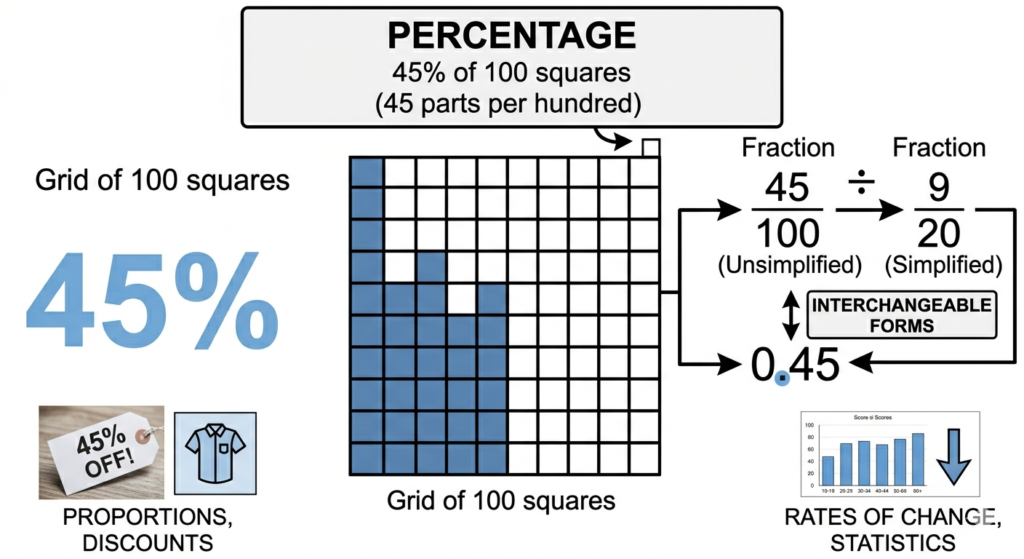
percentage is a number expressed as a fraction of 100, written with the % symbol. To find a percentage, use the formula: Percentage = (Part ÷ Whole) × 100. To convert a percentage to a decimal, divide by 100 (e.g., 45% = 0.45). Percentages appear throughout Florida math courses from grade 7 through SAT Math, including percent change, percent increase, and percent decrease problems on the SAT’s Problem Solving & Data Analysis section.
"Percentages" Explained

(1+-%/100)

Percentages in Math — Definition, Formulas & How to Calculate

Formal definition: A percentage is a way of expressing a number as a part of 100. The word “percent” means “per hundred” — so 45% means 45 out of every 100. Percentages are used to describe proportions, rates of change, scores, discounts, and statistical data. Any percentage can be expressed equivalently as a fraction (45% = 45/100 = 9/20) or a decimal (45% = 0.45), and all three forms are interchangeable in calculations.

Percentages

Where you’ll see it: Percentages appear in Florida math courses beginning in grade 7 (MAFS.7.RP.3), continuing through high school algebra and data analysis. They are one of the most tested concepts on the SAT Problem Solving & Data Analysis section, the ACT Mathematics section, Florida FSA assessments, and in GPA calculations that directly determine Bright Futures scholarship eligibility for Florida student-athletes.

Percentage Formulas — All Three Question Types

Every percentage problem asks you to find one of three things: the part, the percent, or the whole. The formula is the same in all three cases — you just rearrange it to solve for what’s missing. Knowing which type you’re facing is the first step to solving any percentage problem on the SAT or FSA.

TYPE 1 – FIND THE PART

Part = Percent × Whole

Convert the percent to decimal first (÷100), then multiply.

Example: What is 30% of 80?

Part = 0.30 × 80 = 24

SAT phrasing: "What is X% of Y?"

TYPE 2 – FIND THE PERCENT

Percent = (Part ÷ Whole) × 100

Divide part by whole, then multiply by 100 to convert to %.

Example: 18 is what % of 72?

Percent = (18 ÷ 72) × 100 = 25%

SAT phrasing: "What percent of Y is X?"

TYPE 3 – FIND THE WHOLE

Whole = Part ÷ Percent

Convert percent to decimal first, then divide.

Example: 15 is 20% of what number?

Whole = 15 ÷ 0.20 = 75

SAT phrasing: "X is Y% of what number?"

🔀 PERCENT – DECIMAL – FRACTION CONVERSION
% → decimal: divide by 100 | decimal → %: multiply by 100 | % → fraction: write over 100, simplify
Examples: 75% = 75/100 = 3/4 = 0.75 • 0.4 = 40% • 1/8 = 0.125 = 12.5%
Rule for mental math on SAT: convert percent to decimal before calculating – never leave the % symbol in an equation. 30% of 80 = 0.30 × 80 = 24, not 30 × 80 ÷ 100 (which produces the same answer but takes longer and introduces more chances for error).

Percentages — 3 Worked Examples

EXAMPLE 1 – FIND THE PERCENT EASY

A student scored 34 out of 40 on a math quiz. What is the student's percentage score?

  • Step 1: Identify part and whole → Part = 34, Whole = 40
  • Step 2: Apply Type 2 formula → Percent = (Part ÷ Whole) × 100
  • Step 3: Calculate → (34 ÷ 40) × 100 = 0.85 × 100 = 85
  • Step 4: State the answer with % symbol → 85%
Answer: 85% • Bright Futures connection: Florida's Bright Futures Academic Scholars Award requires a 3.5 unweighted GPA – knowing how to calculate class scores keeps students on track.
EXAMPLE 2 – DISCOUNT WORD PROBLEM MEDIUM

A jacket originally costs $120. It is on sale for 35% off. What is the sale price?

  • Step 1: Find the discount amount (Type 1 – find the part) → 35% of $120
  • Step 2: Convert to decimal → 35% = 0.35
  • Step 3: Calculate discount → 0.35 × 120 = $42
  • Step 4: Subtract discount from original → $120 - $42 = $78
Shortcut: instead of subtracting, multiply by (1 - 0.35) = 0.65 → 0.65 × 120 = $78 (one step)
Answer: Sale price = $78 • Note: the "multiply by 0.65" shortcut is the multiplier method covered in Block 05 – the fastest SAT approach.
EXAMPLE 3 – SAT MULTI-STEP PERCENTAGE HARD - SAT LEVEL

A store increases the price of a shirt by 20%, then offers a 20% discount on the new price. Is the final price equal to, greater than, or less than the original price? What is the percent change overall?

  • Step 1: Start with $100 (any value – use 100 for easy percent calculation)
  • Step 2: Increase by 20% → 100 × 1.20 = $120
  • Step 3: Apply 20% discount to new price → 120 × 0.80 = $96
  • Step 4: Compare to original → $96 < $100 – final price is LESS than original
  • Step 5: Calculate overall percent change → (96 - 100) ÷ 100 × 100 = -4%
SAT trap: students assume "20% up then 20% down = no change." Wrong – percent change applies to different bases each time. The overall change is -4%, not 0%.
Answer: Final price = $96 • Overall change = -4% • The two operations do NOT cancel – a classic SAT Problem Solving trap.

Percentages on the SAT — Problem Solving & Data Analysis

The SAT’s Problem Solving & Data Analysis domain tests percentages in multiple forms — from straightforward “what is X% of Y” calculations to multi-step scenarios involving successive percent changes. Florida students targeting the Bright Futures Medallion Scholars Award (1330+ SAT composite) or the Academic Scholars Award (1290+ composite) cannot afford to lose points on percentage problems, which appear predictably and are fixable with targeted practice.

SAT QUESTION TYPE WHAT IT TESTS FREQUENCY
Basic percent calculation Find part, percent, or whole using the core formula 2–3× per test
Percent change
(increase/decrease)
Calculate percent change between two values using the formula 2–3× per test
Successive percent changes Two or more percent operations applied sequentially — the trap question (Example 3 above) 1–2× per test
Percent of a percent Nested percentage calculation — "X% of Y% of Z" 1× per test
Data table interpretation Calculate a percentage from raw data in a table or chart 1–2× per test
SAT STRATEGY – PERCENTAGE PROBLEMS

Convert to decimal first • Use 100 as your base • Multiply multipliers together

Rule 1: Always convert % to decimal before calculating – never leave the % symbol in an equation.

Rule 2: For problems without a stated value, use 100 as your base number – it makes percentages into simple arithmetic.

Rule 3: For successive percent changes, multiply the multipliers together: 20% increase then 20% decrease = 1.20 × 0.80 = 0.96 → 4% net decrease.

Percent Change — Formula & the Multiplier Method

Percent change measures how much a value has increased or decreased relative to its original value, expressed as a percentage. There are two methods: the standard textbook formula (reliable for straightforward problems) and the multiplier method (faster for SAT multi-step problems).

📈 PERCENT INCREASE

% Increase = ((New - Old) ÷ Old) × 100

Always divide by the ORIGINAL (old) value – not the new value.

Example: Price rises from $80 to $100.

% Increase = ((100 - 80) ÷ 80) × 100 = 25%

Multiplier: 1 + 0.25 = 1.25 → New = Old × 1.25

📉 PERCENT DECREASE

% Decrease = ((Old - New) ÷ Old) × 100

Always divide by the ORIGINAL (old) value.

Example: Price drops from $100 to $75.

% Decrease = ((100 - 75) ÷ 100) × 100 = 25%

Multiplier: 1 - 0.25 = 0.75 → New = Old × 0.75

THE MULTIPLIER METHOD – SAT-PREFERRED TECHNIQUE
Increase by X% → multiply by (1 + X/100) | Decrease by X% → multiply by (1 - X/100)

Increase by 30%: multiply by 1.30

Decrease by 15%: multiply by 0.85

Successive changes: multiply the multipliers → 20% up then 25% down = 1.20 × 0.75 = 0.90 → 10% net decrease

Why multipliers win on the SAT: instead of two subtraction operations, you do one multiplication. For successive changes – the most common SAT trap – you multiply multipliers directly, avoiding the error of applying percents to the wrong base. This is the method InLighten's tutors teach in every SAT Problem Solving session.

4 Common Mistakes with Percentages

Using the new value instead of the original value in the percent change formula. The percent change formula always divides by the original (starting) value — not the new value. Students who divide by the new value get a different percentage and lose points on every SAT percent change question. Fix: label “old” and “new” before substituting. The denominator in the percent change formula is always OLD (original) — the value before the change occurred.

Assuming successive percent changes cancel out. “20% increase followed by 20% decrease = no change” is wrong. The second percentage applies to a different (larger or smaller) base, so the effects do not cancel. The net result is always a decrease (as shown in Example 3). Fix: use the multiplier method. Multiply the multipliers together: 1.20 × 0.80 = 0.96 → always produces the correct net result, eliminating the cancellation error.

Forgetting to convert percent to decimal before multiplying. Students write 30% × 80 = 2,400 instead of 0.30 × 80 = 24. Leaving the % symbol in the equation and treating it as a plain number produces an answer 100× too large. Fix: the % symbol means “÷100.” Always convert to decimal (or fraction) before any multiplication or division. Write the conversion as a separate step: 30% → 0.30 → then calculate.

Misidentifying which is the “part” and which is the “whole” in word problems. In “18 is 25% of what number?”, students sometimes put 18 as the whole and the unknown as the part — inverting the relationship. The whole is always the reference amount; the part is the portion of it. Fix: look for the phrase “of what number” — the unknown after “of” is the whole. The stated number before “is” is the part. Always identify part and whole before selecting the formula type.

Practice Problems — Percentages

Frequently Asked Questions — Percentages

A percentage is a number expressed as a fraction of 100, written with the % symbol. “Per cent” means “per hundred,” so 45% means 45 out of every 100. Any percentage can be written as a fraction (45% = 45/100 = 9/20) or a decimal (45% = 0.45). Percentages are used to describe proportions, scores, discounts, and rates of change — and appear in Florida math courses from grade 7 (MAFS.7.RP.3) through SAT Math Problem Solving & Data Analysis.

To find a percentage of a number (the “part”), convert the percent to a decimal by dividing by 100, then multiply by the whole. Formula: Part = Percent × Whole. Example: 30% of 80 → convert 30% to 0.30 → 0.30 × 80 = 24. So 30% of 80 is 24. This is the most common percentage calculation in Florida math courses and on the SAT Math section.

The percent change formula is: Percent Change = ((New Value − Old Value) ÷ Old Value) × 100. Always divide by the original (old) value — not the new value. A positive result is a percent increase; a negative result is a percent decrease. The faster SAT method uses multipliers: increase by X% → multiply by (1 + X/100); decrease by X% → multiply by (1 − X/100). This is the most heavily tested percentage concept on the SAT Problem Solving & Data Analysis section.

Percentages appear on the SAT in the Problem Solving & Data Analysis domain — approximately 2–3 questions on percent calculations, 2–3 on percent change (increase/decrease), 1–2 on successive percent changes (the most common trap), and 1–2 on data table interpretation requiring percentage calculation. Florida students targeting Bright Futures scholarship SAT thresholds (1290+ for Academic Scholars, 1330+ for Medallion Scholars) cannot afford to lose points on percentage problems, which are predictable and fixable with targeted practice.

Yes. InLighten’s certified math tutors in Orlando cover all percentage topics — from basic part/whole calculations to the percent change formula, the multiplier method for SAT multi-step problems, and the successive percent change trap that most Florida students miss on the SAT. We identify exactly where your student loses points and build targeted sessions around those gaps. Whether your student needs Bright Futures score improvement, SAT Problem Solving prep, or foundational percentage help for class, we build the plan that fits. Book a free math assessment to start.

Losing SAT Points on Percentages? Your Student's Bright Futures Score May Depend on It.

The difference between the Florida Bright Futures Academic Scholars Award (1290 SAT composite) and the Medallion Scholars Award (1330 SAT composite) is 40 points — the equivalent of getting 3–4 more percentage problems right on the SAT. InLighten’s certified math tutors in Orlando specialize in exactly this: finding where your student loses points on percentage calculations, percent change, and the successive-percent trap questions that most Florida students miss — then building targeted sessions around those specific gaps. We also address the foundational calculation errors that cause point loss on the FSA and EOC assessments. For Florida student-athletes tracking both GPA and SAT scores for Bright Futures and NCAA academic eligibility, we build a plan that covers both.