
|
Preparing for the SAT? Claim Your Personalized Math Plan →
|
An exponential function is a mathematical function in the form f(x) = ab^x, where a is the initial value (the y-intercept when x = 0), b is the base (the growth or decay factor, always positive and not equal to 1), and x is the exponent. When b > 1, the function models exponential growth — the value increases at an accelerating rate. When 0 < b < 1, the function models exponential decay — the value decreases toward zero. Exponential functions appear in the SAT Math Advanced Mathematics domain and Florida Algebra 2 (MAFS.912.F-LE).
An exponential function has the form f(x) = ab^x, where a is the initial value, b is the base (the growth or decay factor), and the variable x sits in the exponent. When b > 1 the function grows; when 0 < b < 1 it decays.
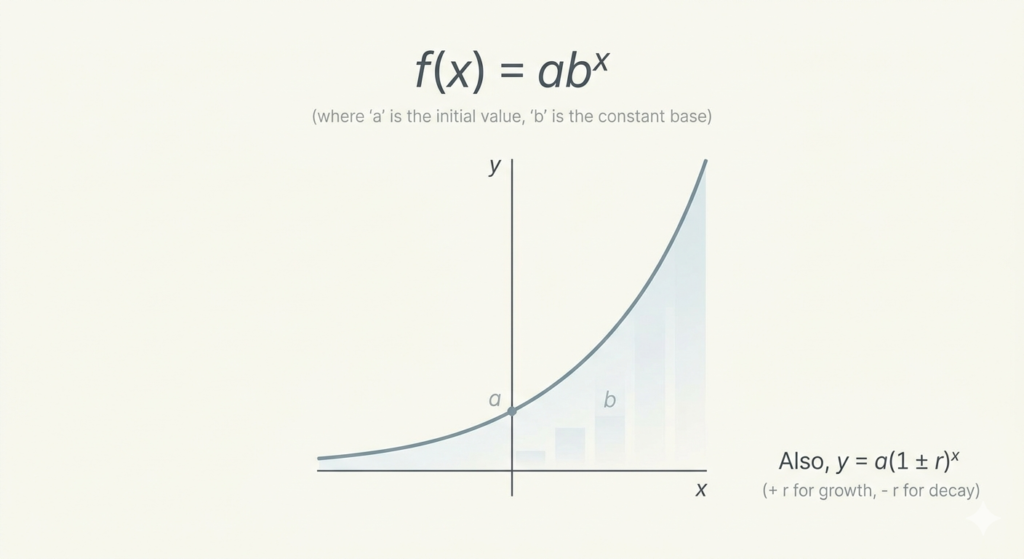
A function of the form f(x) = ab^x, in which the variable x appears as the exponent rather than the base. a is the initial value (the output when x = 0); b is the constant base, the factor the output is multiplied by for each unit increase in x. Because the variable is in the exponent, the function grows or shrinks proportional to its current value — far faster than any linear or polynomial function.
Also written in percent-rate form: y = a(1 ± r)x — use + r for growth, − r for decay.
The output when x = 0, and always the y-intercept: f(0) = a · b0 = a. Note a ≠ 0.
The growth/decay factor. b > 1 → growth · 0 < b < 1 → decay · b ≠ 1 (b = 1 is constant, not exponential).
The variable lives in the exponent — that's what makes it exponential. In x2 the variable is the base (a power function).
Each time x increases by 1, the output multiplies by b — a curve rising steeply to the right, y-intercept (0, a), always above the x-axis. Models: compound interest, population, viral spread. SAT: "doubled every 12 years" → b = 2.
Each step multiplies by a fraction < 1, so the output falls toward zero but never reaches it (asymptote y = 0). Models: half-life, drug concentration, depreciation. SAT: "loses 12% each year" → b = 0.88.
f(x) = e^x uses the constant e for continuous growth. It appears in AP Calculus (its own derivative) and continuous interest A = Pe^(rt). Since e > 1, it's an exponential growth function.
Identify growth vs. decay, and the initial value and base: (A) f(x) = 3·2^x (B) g(x) = 500·(0.8)^x
Population decay. 1,200 deer in 2020, declining 15% per year. Write P(t) and estimate 2025.
Build from two points. f(x) = ab^x passes through (1, 12) and (3, 108). Find a and b.
The Advanced Mathematics domain tests these in 2–4 questions per exam — among the most-missed by students who know the concept but not the SAT’s formats.
| SAT MATH CATEGORY | HOW IT APPEARS | DIFFICULTY |
|---|---|---|
| Advanced Math | Identify growth vs. decay from f(x) = ab^x or a table | Moderate |
| Advanced Math | Build the equation from two points (ratio method) | Hard |
| Advanced Math | Interpret what a or b means in context (percent growth, initial value) | Hard |
| Problem-Solving | Compare exponential vs. linear growth scenarios | Moderate–Hard |
| Advanced Math | Rewrite an exponential expression (exponent laws) | Hard |
x² and 2^x are different: power has the variable as the base, exponential has it as the exponent.
Fix: variable in the exponent → exponential.
A 15% decline gives b = 0.85, not 0.15.
Fix: b = 1 – decay rate; the base is the proportion that remains.
It's 1 only when a = 1. For 500·(0.85)^x it's 500.
Fix: y-intercept = f(0) = a.
"Grows 20% each year" means ×1.20 each year, not +20% of the original.
Fix: constant % = exponential; constant amount = linear.
Work each one, then reveal the answer to check yourself.
Is f(x) = 5·(1/3)^x growth or decay? What is the y-intercept and the horizontal asymptote?
A laptop costs $1,200 and depreciates 25% per year. Write V(t) and find its value after 3 years.
g(x) = ab^x passes through (0, 6) and (2, 54). Find a and b.
In f(x) = 200·(1.08)^x with x in years, what does 1.08 represent?
A function of the form f(x) = abx, where the variable x is in the exponent. a is the initial value (and y-intercept); b is a positive base ≠ 1. b > 1 grows; 0 < b < 1 decays. Covered in Florida Algebra 2 (MAFS.912.F-LE) and SAT Advanced Mathematics.
f(x) = abx — a is the initial value (f(0) = a), b is the base (b > 0, b ≠ 1), x is the exponent. The y-intercept is always (0, a), and the horizontal asymptote is always y = 0.
Growth (b > 1) multiplies the output by b each step — e.g., 3·2x doubles. Decay (0 < b < 1) shrinks it each step — e.g., 500·(0.85)x falls 15% per step. Both share the asymptote y = 0.
In 2–4 Advanced Math questions: identifying growth/decay, building a model from two points, interpreting a or b in context, and rewriting expressions with exponent laws. The hardest is parameter interpretation — knowing b = 1 + growth rate.
Yes — Algebra 2 and SAT Advanced Math, including growth/decay, building models from two points, and parameter interpretation. We diagnose exactly where points are lost and target them. We serve Orlando, Winter Park, Lake Nona, and Dr. Phillips.
Book a free math assessment and get a personalized Digital SAT plan built around your gaps.