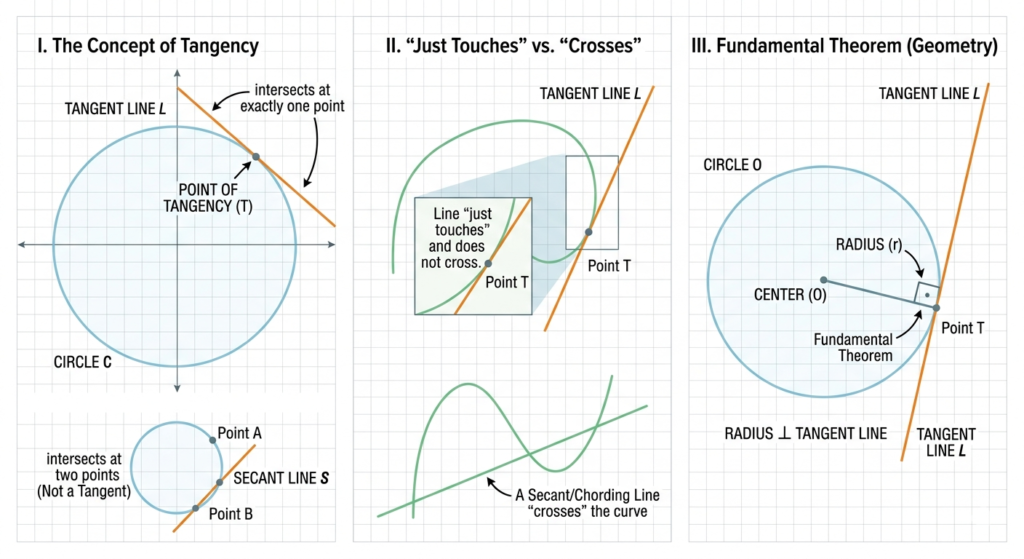
tangent line is a straight line that touches a curve or circle at exactly one point — called the point of tangency — without crossing it. In circle geometry, a tangent line is always perpendicular to the radius drawn to the point of tangency. In calculus, a tangent line to a curve at a point represents the instantaneous rate of change (slope = derivative) at that point. Tangent lines appear in Florida’s MAFS.912.G-C standards and on the SAT Math geometry section.

"Tangent Lines" Explained

Line that has a slope perpendicular to the radius and intersects the circle at one point.

Tangent Lines — Definition, Circle Theorems & Calculus Connection

Formal definition: A tangent line is a line that intersects a curve or circle at exactly one point, called the point of tangency. At the point of tangency, the line “just touches” the curve — it does not cross to the other side. In geometry, tangent lines are most commonly studied in relation to circles, where a fundamental theorem states that a tangent line is always perpendicular (at a 90° angle) to the radius drawn to the point of tangency.

Tangent Lines

Where you’ll see it: Tangent lines to circles appear in Florida geometry courses (grades 9–10), Florida FSA and EOC assessments, SAT Math geometry questions (Problem Solving & Data Analysis and Geometry & Trigonometry), and Florida MAFS.912.G-C.2 standards for circle relationships. The calculus concept of tangent lines (as the slope of a curve at a point) appears in Pre-Calculus and AP Calculus courses for Florida 11th and 12th graders.

Three Key Tangent Line Theorems — Circle Geometry

These three theorems govern how tangent lines behave in relation to circles. Mastering all three is essential for Florida geometry EOC assessments and for the SAT Math geometry questions that test tangent-circle relationships. Each theorem produces a specific SAT question type.

Circle Theorems
Theorem 1 – Tangent-Radius Perpendicularity
A tangent line ⊥ the radius at the point of tangency
If a line is tangent to a circle at point P, then the line is perpendicular to the radius OP, where O is the center.
Consequence: angle OPT = 90° (where T is any point on the tangent line).
SAT application: "If a line is tangent to circle O at point P and OP = 5, what is the distance from the tangent line to the center?" – the answer is always the radius length, found using the Pythagorean theorem with the perpendicular distance.
Florida EOC application: find a missing angle in a triangle formed by a radius, tangent, and chord.
Theorem 2 – Equal Tangent Segments From External Point
Two tangent segments from the same external point are equal in length
If two tangent lines are drawn from an external point P to a circle, touching at points A and B, then PA = PB.
Consequence: the external point lies on the perpendicular bisector of the chord AB.
SAT application: "Point P is outside a circle. PA and PB are tangent to the circle at A and B. If PA = 12, what is PB?" – Answer: PB = 12, because tangent segments from the same external point are always equal.
Common trap: students assume the longer visual segment is longer – but equal tangent lengths apply regardless of how the diagram is drawn.
Theorem 3 – Secant-Tangent Angle
Angle = ½ × (intercepted arc) · or · ½ × |arc₁ – arc₂|
When a tangent and a secant (or chord) meet at a point on or outside a circle, the angle formed equals half the intercepted arc(s).
At the point of tangency (on the circle): angle = ½ × intercepted arc
From an external point: angle = ½ × |far arc – near arc|
Florida MAFS.912.G-C.2 specifically covers this theorem. SAT application: given arc measures, find the tangent-chord angle – a medium-hard geometry question type that eliminates most students who only memorized Theorem 1.

Tangent Lines — 3 Worked Examples

Geometry Examples Collection
Example 1 – Tangent-Radius Right Angle
Easy
Line ℓ is tangent to circle O at point P. The radius OP = 8. A point Q is on line ℓ such that OQ = 10. Find the distance PQ.
Step 1: Recall Theorem 1 – tangent is perpendicular to radius at P → angle OPQ = 90°
Step 2: Triangle OPQ is a right triangle with hypotenuse OQ = 10 and leg OP = 8
Step 3: Apply the Pythagorean theorem → PQ² = OQ² – OP² = 100 – 64 = 36
Step 4: Solve → PQ = √36 = 6
Answer: PQ = 6 · Key insight: the tangent-radius right angle always creates a Pythagorean relationship – look for the right triangle.
Example 2 – Equal Tangent Segments
Medium
From external point P, two tangent lines are drawn to circle O, touching at A and B. PA = 3x – 4 and PB = x + 10. Find PA and PB.
Step 1: Recall Theorem 2 – tangent segments from the same external point are equal → PA = PB
Step 2: Set expressions equal → 3x – 4 = x + 10
Step 3: Solve for x → 2x = 14 → x = 7
Step 4: Substitute back → PA = 3(7) – 4 = 17 · PB = 7 + 10 = 17
Answer: PA = PB = 17 · This equal-tangent-segment setup is a recurring SAT algebra-in-geometry question type.
Example 3 – Secant-Tangent Angle (SAT Level)
Hard – SAT Level
Line ℓ is tangent to circle O at point A. Chord AB is drawn through the circle. The arc AB (not containing the tangent point) measures 140°. Find the measure of the angle between the tangent line and chord AB at point A.
Step 1: Identify the theorem – tangent-chord angle = ½ × intercepted arc (Theorem 3, "at the point of tangency" case)
Step 2: The intercepted arc is the arc AB = 140°
Step 3: Apply the formula → angle = ½ × 140° = 70°
SAT trap: students sometimes use the wrong arc (the minor arc vs. the arc the angle "opens into"). The tangent-chord angle is always half the arc it intercepts – identify which arc is "inside" the angle.
Answer: The tangent-chord angle = 70° · This is a MAFS.912.G-C.2 problem type and appears on the SAT geometry section as a medium-hard question.

Tangent Lines on the SAT Math Section

SAT Math geometry questions appear in both the Math (no calculator) and Math (calculator) sections. Tangent line questions specifically test the perpendicular radius theorem and the equal tangent segment theorem — the two rules that produce the most elegant SAT setups. Most tangent questions on the SAT combine circle geometry with the Pythagorean theorem, creating a two-step problem that eliminates students who know only one rule.

SAT Question Type Frequency Table
SAT Question Type Theorem Applied Frequency
Right triangle from tangent-radius Theorem 1 (perpendicular) → Pythagorean theorem to find a missing length 1–2× per test
Equal tangent segments (algebra setup) Theorem 2 — set two expressions equal, solve for variable 1× per test
Tangent-chord angle from arc measure Theorem 3 — angle = ½ × arc · higher difficulty question 0–1× per test
Identify tangent vs. secant in diagram Definition — which line touches at exactly one point? 1× per test
SAT Strategy Card
SAT Strategy – Tangent Line Questions
Identify the theorem · Draw the radius · Apply Pythagorean theorem if needed
Step 1: Read the diagram label – does it say "tangent"? If yes, a radius to the point of tangency creates a 90° angle. Draw it.
Step 2: Identify which theorem applies – perpendicular right triangle (Theorem 1), equal segments (Theorem 2), or arc angle (Theorem 3).
Step 3: Set up the equation – most SAT tangent problems reduce to a Pythagorean theorem calculation or an algebraic equal-length setup.

Tangent Lines in Calculus — Slope as Rate of Change

In calculus, a tangent line to a curve at a specific point is the straight line that best approximates the curve at that instant. While a circle tangent line touches the circle at one point and never re-enters it, a calculus tangent line touches a curve at one point and may cross the curve elsewhere — the defining property is local, not global. The slope of the tangent line at any point on a curve is the derivative of the function at that point.

Tangent Line Slope in Calculus

slope of tangent at x = a → m = f'(a) (the derivative at that point)

The tangent line to f(x) at the point (a, f(a)) has:

Slope: m = f'(a) – the derivative evaluated at x = a

Equation: y – f(a) = f'(a) · (x – a) – point-slope form

Geometric meaning: The tangent line is the limit of secant lines as the second point approaches the first. As the two points get infinitely close, the secant line "becomes" the tangent line.

Connection to circle geometry: In both contexts, the tangent line touches the curve/circle at exactly one local point – the geometry theorem is actually a special case of the calculus concept applied to a circle.

4 Common Mistakes with Tangent Lines

Confusing a tangent line with a secant line. A tangent touches the circle at exactly one point; a secant intersects it at two points. Students draw a secant and label it “tangent” — or apply the perpendicular-radius theorem to a secant, which does not apply. Fix: tangent = one intersection point. Secant = two. Before applying any tangent theorem, verify the line touches the circle at exactly one point as stated in the problem.

Forgetting that the right angle is at the point of tangency, not at the center. Theorem 1 creates a 90° angle between the tangent line and the radius — at the point where they meet on the circle (P), not at the center (O). Students mark the angle at O instead of P, then calculate incorrect triangle angles. Fix: draw the radius to the point of tangency first, then mark the 90° angle at the point of tangency on the circle — not at the center.

Assuming equal tangent segments must be visually equal in the diagram. Theorem 2 guarantees PA = PB algebraically — but SAT diagrams are not drawn to scale. Students reject the equal-length conclusion because the segments “look different” in the figure. Fix: in SAT geometry, the note “not drawn to scale” means the diagram is intentionally misleading. Apply the theorem algebraically regardless of how the diagram appears visually.

Using the full arc instead of half the arc in the secant-tangent angle theorem. Theorem 3 states angle = ½ × intercepted arc. Students read the arc measure from the diagram and write it directly as the angle — forgetting the ½ factor. Fix: for any angle formed by tangents, secants, or chords, always check: does the formula include a ½? For tangent-chord angles, it always does. Write the formula first, then substitute the arc measure.

Practice Problems — Tangent Lines

Frequently Asked Questions — Tangent Lines

A tangent line in geometry is a straight line that touches a circle (or curve) at exactly one point, called the point of tangency, without crossing through it. In circle geometry, the most important property is that a tangent line is always perpendicular to the radius drawn to the point of tangency — creating a 90° angle. This relationship is governed by Florida’s MAFS.912.G-C.2 standards for circle relationships in high school geometry.

A tangent line is perpendicular to the radius at the point of tangency because, by definition, it touches the circle at exactly one point without entering the interior. The shortest distance from the center of a circle to a tangent line is always the radius — and the shortest distance from a point to a line is always measured along the perpendicular. Therefore, the radius to the point of tangency must be perpendicular to the tangent line. This creates a 90° angle and is the foundation of all tangent-circle calculations.

In calculus, a tangent line to a curve at a specific point is the straight line that has the same slope as the curve at that exact instant — representing the instantaneous rate of change. The slope of the tangent line at any point x = a is equal to f'(a), the derivative of the function at that point. To find the equation of the tangent line, use point-slope form: y − f(a) = f'(a)(x − a). This is a foundational concept in AP Calculus and Pre-Calculus courses for Florida 11th–12th grade students.

Tangent line questions appear on the SAT Math section under Geometry & Trigonometry — typically 1–3 questions per test. The most common types are: (1) finding a missing length using the tangent-radius right angle and Pythagorean theorem, (2) setting two equal tangent segments equal to solve for a variable, and (3) finding a tangent-chord angle from an arc measure. Most SAT tangent questions require knowing that a tangent creates a 90° angle with the radius — the single most tested tangent theorem on the exam.

Yes. InLighten’s certified math tutors in Orlando specialize in geometry including tangent line theorems — covering the perpendicular radius theorem, equal tangent segments, secant-tangent angles, and the specific SAT question types that combine circle geometry with the Pythagorean theorem. We also support AP Calculus students working with tangent lines as derivatives and rates of change. We identify exactly where your student is losing points before building targeted sessions around those gaps. Book a free math assessment to get started.

Still Losing Points on Geometry or Calculus? Work with a Certified Math Tutor in Orlando.

Knowing that a tangent is perpendicular to the radius is different from applying it under time pressure in a two-step SAT problem — where you also need the Pythagorean theorem, the right triangle setup, and the discipline not to use the arc formula. InLighten’s certified math tutors in Orlando specialize in exactly that gap: finding where your student loses points on geometry and helping them build the theorem recognition that turns a 2-step SAT problem into a 30-second solve. For AP Calculus and Pre-Calculus students, we connect the geometry tangent concept to derivatives and rates of change — the bridge most AP students miss. Florida student-athletes preparing for Bright Futures and NCAA academic eligibility thresholds get a personalized plan for both GPA and SAT performance.