
|
Preparing for the SAT? Claim Your Personalized Math Plan →
|
The slant height is the diagonal distance from the apex of a cone or pyramid down to the edge of the base measured along the surface of the shape, not straight down through the middle. It always forms the hypotenuse of a right triangle with the vertical height and the base radius (or apothem), and you need it any time a problem asks about lateral surface area.
Get to know the InLighten Tutoring team while you review this concept, a dedicated slant height walkthrough is coming soon.
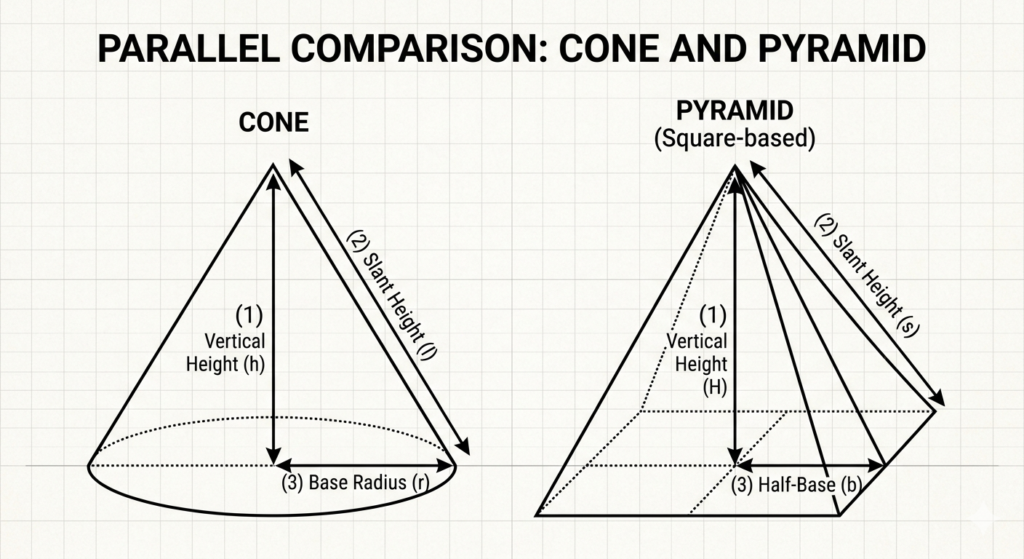
In both cases, slant height is the hypotenuse — always the longest of the three measurements.
The slant height formula calculates the distance from the apex of a solid figure down to a point on the edge of its base. Unlike the vertical height, which measures the straight distance from top to bottom, the slant height follows the slope of the lateral face.
In a right circular cone, the slant height (l), the vertical height (h), and the radius (r) form a right-angled triangle, so the formula comes straight from the Pythagorean theorem: l = √(r² + h²). When you need the surface area of a cone, this is the first step, the lateral area is π·r·l.
For a regular square pyramid the triangle is formed using the vertical height (h) and half the base side (s/2). So the formula is l = √((s/2)² + h²).
The SAT never gives slant height directly — it makes you find it from height and radius. Recognize the right triangle.
SAT problems often give lateral surface area and ask for a missing dimension. Rearrange the formula.
The SAT's geometry section increasingly includes 3D shapes since going digital. Slant height appears 1–2× per test.
For pyramids, the right triangle uses s/2 (half the base), not the full side length. Always halve it first.
The lateral edge (apex to a base corner) is longer than the slant height. Slant height goes to the midpoint of a base edge.
Volume always uses vertical height (h). Only surface area uses slant height (l).
l = the square root of (r squared plus h squared), where r is the base radius and h is the vertical height.
Vertical height goes straight down through the center of the shape, while slant height runs along the sloped face. Slant height is always longer than vertical height.
Use slant height when calculating lateral surface area. Use vertical height when calculating volume.
Slant height isn't just an SAT concept. Architects use it to calculate the material needed for a conical roof. Tent manufacturers use it to cut fabric panels efficiently. Packaging engineers rely on it to design paper cups and ice cream cone wrappers. Any time a real object has a sloped surface instead of a flat one, from megaphones to lampshades, slant height determines exactly how much material covers it.
Book a free session with an InLighten tutor and get a personalized Digital SAT math plan built around your gaps.