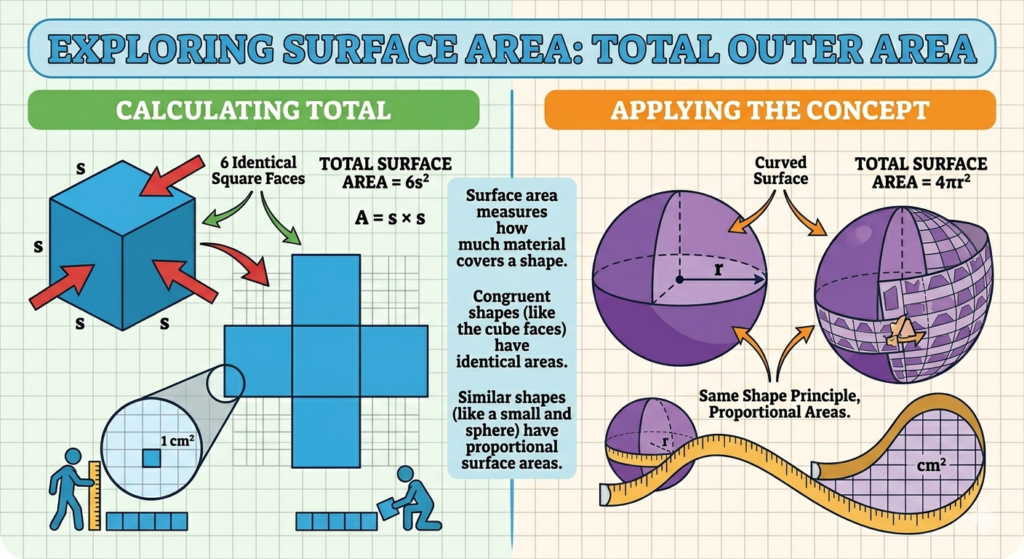
Surface area is the total area of all the outer faces of a three-dimensional shape — the amount of material that would be needed to wrap the outside of the object. It is measured in square units (cm², m², in²). Every 3D shape has its own surface area formula: a rectangular prism uses SA = 2lw + 2lh + 2wh; a cylinder uses SA = 2πr² + 2πrh. Surface area appears in Florida MAFS geometry standards (grades 6–10) and on the SAT Math section.

"Surface Area" Explained

Surface area is the total area of all the faces (or surfaces) of a 3D figure.


Why this matters for the SAT:

Surface area problems appear in 3D geometry questions.
Knowing how to sum all individual areas lets you calculate the total area needed to cover a shape.

Surface Area — Definition, Formulas & How to Calculate It

Surface Area
Formal definition: Surface area is the total area of all the faces (flat surfaces) and curved surfaces of a three-dimensional object. It answers the question: “How much material would be needed to cover the outside of this shape?” Surface area is always measured in square units — square centimeters (cm²), square inches (in²), or square feet (ft²) — because it is a measure of area, not length or volume.
Surface area vs lateral surface area: The total surface area includes every face of a shape, including the top and bottom (called the bases). Lateral surface area includes only the side faces — not the bases. This distinction is tested on Florida assessments and is the most common source of surface area errors. When a problem says “lateral surface area,” do not include the area of the bases.
Where you’ll see it: Surface area appears in Florida MAFS geometry standards (MAFS.7.G.B.6 and MAFS.8.G.C.9), FSA and EOC assessments, SAT Math (3D shape word problems, packaging and optimization problems), and ACT Mathematics. It is also a prerequisite for understanding surface area scaling — when a shape’s dimensions are scaled by k, its surface area scales by k².

Surface Area Formulas — Every Shape You Need to Know

Each 3D shape has a unique surface area formula derived from the sum of all its face areas. The five shapes below cover every surface area formula tested in Florida MAFS geometry standards and on the SAT Math section. Memorizing which formula goes with which shape — and knowing when to use lateral vs total surface area — is the skill tested most often on assessments.
⚀ Cube
SA = 6s2
s = side length (all sides equal)
Use when: all 6 faces are identical squares.
Example: cube with side 4 cm → SA = 6(42) = 6(16) = 96 cm2
Lateral surface area (4 sides only): 4s2
▭ Rectangular Prism
SA = 2lw + 2lh + 2wh
l = length · w = width · h = height
Use when: the three dimensions are different (a box). Also written SA = 2(lw + lh + wh).
Lateral surface area (4 sides, no top/bottom): 2lh + 2wh = 2h(l + w)
● Cylinder
SA = 2πr2 + 2πrh
r = radius · h = height
2πr2 = the two circular bases
2πrh = the curved lateral surface
Lateral SA only: 2πrh
⚠️ Use radius, not diameter. Most common SAT cylinder error: using d instead of r.
△ Cone
SA = πr2 + πrl
r = radius · l = slant height
πr2 = the circular base
πrl = the lateral (curved) surface
Lateral SA only: πrl
⚠️ Use slant height l, not vertical height h. These are not the same. Use l = √(r2 + h2) to find l if not given.
● Sphere
SA = 4πr2
r = radius
A sphere has no flat faces – only a curved surface. There is no separate lateral SA formula for a sphere.
SAT note: The sphere SA formula is sometimes given in the reference sheet. Still, knowing it saves 30–60 seconds per problem.

Surface Area Examples — Worked Step-by-Step

Example 1 Easy

Find the total surface area of a rectangular prism with length = 5 cm, width = 3 cm, and height = 4 cm.

Step 1: Use formula SA = 2lw + 2lh + 2wh
Step 2:
Example 2 Medium

A cylinder has a radius of 6 cm and a height of 10 cm. Find the total surface area. Use π ≈ 3.14.

Step 1: Use formula SA = 2πr² + 2πrh
Step 2: SA = 2(3.14)(6²) + 2(3.14)(6)(10)
Step 3: SA = 2(3.14)(36) + 2(3.14)(60)
Step 4: SA = 226.08 + 376.80
SA ≈ 602.88 cm² Common error: using diameter 12 instead of radius 6 in Step 2 – always halve the diameter first.
Example 3 Hard - SAT Level

A cone has a base radius of 5 cm and a vertical height of 12 cm. Find the total surface area to the nearest whole number. (Use π ≈ 3.14)

Step 1: Find slant height l – l = √(r² + h²) = √(5² + 12²) = √(25 + 144) = √169 = 13 cm
Step 2: Use formula SA = πr² + πrl
Step 3: SA = (3.14)(5²) + (3.14)(5)(13)
Step 4: SA = (3.14)(25) + (3.14)(65)
Step 5: SA = 78.5 + 204.1
SA ≈ 283 cm² SAT trap: using h = 12 instead of l = 13 in Step 2 gives SA ≈ 251 cm² – a wrong answer choice often included.

How Surface Area Appears on the SAT Math Section

Surface area appears on the SAT Math section in the Additional Topics in Math category — 3D geometry questions that require students to either calculate surface area directly or apply surface area concepts in word problem contexts (packaging, material costs, optimization). The cone trap question (Example 3 above) is one of the most commonly missed SAT geometry problems. The SAT reference sheet provides the surface area formula for a sphere and a cone — but students must still know how to apply them correctly. InLighten’s certified SAT Math tutors in Orlando target these geometry question types in every prep program.

SAT Math Category How Surface Area Appears Frequency
Additional Topics: 3D Geometry Calculate total or lateral surface area of a cylinder, cone, or sphere; choose the correct formula 1–2 per test
Word Problems — Real Context Packaging material cost (find SA, multiply by unit cost); painting or covering a 3D object 1 per test
Optimization Minimize surface area for a given volume — maximizing efficiency of a container design Rare (1 per 2 tests)
Reference Sheet Traps Formula given — student must still identify correct variables (r vs d; l vs h for cone) 1 per test

3D Shapes & Their Surface Areas — Quick Reference

Cube

A cube has 6 identical square faces — so surface area is simply 6 × (side)². For a cube with side 3 cm: SA = 6(9) = 54 cm². A cube is a special case of a rectangular prism where l = w = h. On assessments, cubes are often used in multiple-part questions where one calculation builds on the surface area result.

Rectangular Prism

A rectangular prism (box) has 3 pairs of opposite, identical faces. The formula SA = 2lw + 2lh + 2wh adds the areas of all 6 faces. This is the most commonly tested surface area shape on Florida MAFS grades 6–8 assessments. Always identify all three dimensions before applying the formula — confusing l, w, and h is a frequent error.

Cylinder

A cylinder has two circular bases (top and bottom, each with area πr²) and one curved lateral surface (which "unrolls" into a rectangle with area 2πrh). Total SA = 2πr² + 2πrh. The cylinder formula is the most tested 3D shape formula on the SAT. Key: always use radius, not diameter. If given diameter, divide by 2 before any calculation.

Cone

A cone has one circular base (πr²) and one curved lateral surface (πrl, where l is slant height). SA = πr² + πrl. The slant height l must be calculated from the Pythagorean theorem (l = √(r² + h²)) if only the vertical height h is given. This two-step process is the cone's SAT trap — students who skip Step 1 get the wrong answer even with the right formula.

Sphere

A sphere has no flat faces — only one continuous curved surface with area 4πr². The sphere is the only 3D shape where total SA and lateral SA are identical. SA = 4πr². On the SAT, the sphere formula is provided in the reference box — but students must still correctly identify r vs d and apply the squaring correctly. A sphere with r = 3: SA = 4π(9) = 36π ≈ 113.1 units².

4 Common Surface Area Mistakes — and How to Fix Them

Confusing Total Surface Area with Lateral Surface Area

When a problem asks for "lateral surface area," students include the top and bottom faces — getting the answer for total surface area instead. Fix: read the problem twice and circle the word "lateral" or "total." Lateral = sides only (no bases). Total = sides + bases. For a cylinder: lateral SA = 2πrh (no circular ends); total SA = 2πr² + 2πrh (circular ends added). InLighten's certified math tutors in Orlando identify this in the first geometry diagnostic.

Using Diameter Instead of Radius for Cylinders and Spheres

When a problem gives the diameter of a circle (the full width), students plug that number directly into the formula as r — doubling every area calculation. Fix: always check whether the problem says "radius" or "diameter." If diameter is given, divide by 2 before any calculation. For a cylinder with diameter 8 cm: r = 4 cm. Then SA = 2π(4)² + 2π(4)h — not 2π(8)².

Using Vertical Height Instead of Slant Height for Cones

The cone formula SA = πr² + πrl uses slant height l — the length along the side of the cone from base to tip. Students use the vertical height h (the straight-up measurement from base to tip) instead. These are never the same value. Fix: if slant height is not given, calculate it first using l = √(r² + h²). A cone with r = 3 and h = 4 has slant height l = √(9 + 16) = √25 = 5 — then apply the formula.

Reporting Surface Area in Cubic Units Instead of Square Units

Surface area is a 2D measurement of the outside of a 3D shape — it is always measured in square units (cm², m², in²), not cubic units. Cubic units are for volume. Fix: whenever you finish a surface area calculation, check your units label. If you wrote "cm³" for a surface area answer, change it to "cm²." On standardized tests, the correct numerical answer with the wrong unit label is marked wrong.

Surface Area vs Volume — What's the Difference?

Surface area and volume are both measurements of 3D shapes — but they measure different things. Surface area measures the outside of a shape (the wrapper); volume measures the inside (how much it can hold). A box of cereal has a surface area (the cardboard needed to make it) and a volume (the amount of cereal it holds) — these are two completely separate calculations.

Property Surface Area Volume
What it measures The total area of the outer faces The space enclosed inside the shape
Units cm², m², in², ft² (square units) cm³, m³, in³, ft³ (cubic units)
Think of it as The amount of paint to coat the outside The amount of water to fill the inside
Formula structure Sum of all face areas Base area × height (varies by shape)
When scaling by k Multiplied by k² Multiplied by k³

The scaling connection: When a 3D shape’s dimensions are scaled by a factor of k, its surface area multiplies by k² (because area is two-dimensional) and its volume multiplies by k³ (because volume is three-dimensional). This relationship — and why k² vs k³ — is explained in our scaling in math guide →

Frequently Asked Questions — Surface Area

Surface area is the total area of all the outer faces of a three-dimensional shape — it measures how much material would be needed to cover the outside of the object. Surface area is always measured in square units (cm², m², in²). It is different from volume, which measures how much space is inside a shape. Surface area appears in Florida MAFS geometry standards beginning in grade 6 (MAFS.7.G.B.6).

Total surface area includes all faces of a 3D shape — the sides and the bases (top and bottom). Lateral surface area includes only the side faces, not the bases. For a cylinder: total SA = 2πr² + 2πrh (both circles + curved side); lateral SA = 2πrh (curved side only). When a problem specifically says “lateral surface area,” do not include the area of the bases — this is the most common surface area error on standardized tests.

The cone surface area formula SA = πr² + πrl uses slant height l, not vertical height h. If only vertical height h is given, first calculate slant height using the Pythagorean theorem: l = √(r² + h²). Then substitute l into the formula. Example: cone with r = 5 and h = 12 → l = √(25 + 144) = √169 = 13 → SA = π(5²) + π(5)(13) = 25π + 65π = 90π ≈ 283 cm². Skipping the slant height calculation is the most common SAT Math cone error.

When a 3D shape’s dimensions are all scaled by a factor of k, its surface area multiplies by k² — because surface area is a two-dimensional measurement. If a box has surface area 50 cm² and all its dimensions are doubled (k = 2), its new surface area is 50 × 2² = 50 × 4 = 200 cm². Volume, by contrast, multiplies by k³. This k² vs k³ relationship is one of the most tested SAT Math scaling concepts — and explains why doubling size quadruples surface area but octuplies volume.

Yes. InLighten’s certified math tutors in Orlando cover all surface area concepts — total vs lateral surface area, formulas for all 3D shapes, slant height calculations for cones, and the SAT Math question types that most students miss. Our diagnostic-first approach identifies exactly which geometry problems are costing your student points — whether it’s a formula error, a lateral vs total confusion, or a units mistake — then builds targeted sessions around those gaps. Book a free geometry assessment to start.

Still Losing Points on Surface Area? Work with a Certified Math Tutor in Orlando.

Knowing the formula is one thing — applying it correctly under test pressure, knowing when to use lateral vs total surface area, and not confusing slant height with vertical height are another. InLighten’s certified math tutors in Orlando diagnose exactly which surface area and geometry problems are costing your student points — whether it’s a formula setup issue, a unit error, or the cone slant height trap — then build targeted sessions around those specific gaps. Most students see geometry grade improvement within 3 sessions. Florida Bright Futures and NCAA eligibility score requirements depend on geometry performance in exactly these areas.