
|
Preparing for the SAT? Claim Your Personalized Math Plan →
|
A quadratic function is a polynomial function of degree 2 written in standard form as f(x) = ax² + bx + c (where a ≠ 0). Its graph is a parabola — a U-shaped curve that opens upward when a > 0 and downward when a < 0. Quadratic functions have three equivalent forms (standard, vertex, and factored), are solved using factoring, completing the square, or the quadratic formula, and appear throughout Florida MAFS Algebra standards and the SAT Math “Advanced Math” section.
A quadratic function is a degree-2 polynomial written f(x) = ax² + bx + c (where a ≠ 0). Its graph is a parabola, a U-shaped curve that opens up when a > 0 and down when a < 0. It has three equivalent forms and is the most-tested topic in SAT “Advanced Math.”
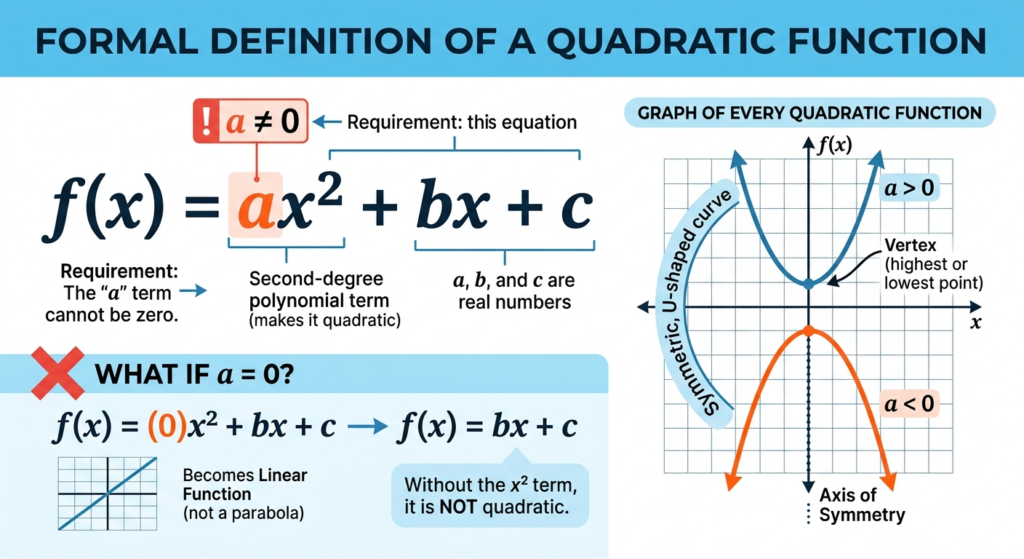
A second-degree polynomial function of the form f(x) = ax² + bx + c, where a, b, and c are real numbers and a ≠ 0. The a ≠ 0 requirement is what makes it quadratic, if a = 0 the x² term vanishes and it becomes linear. Its graph is always a parabola: a symmetric, U-shaped curve with a single highest or lowest point called the vertex.
Where you'll see it: Florida MAFS Algebra 1 & 2 and Precalculus, the Florida EOC, and — above all — the SAT "Advanced Math" category, the single largest SAT Math domain at roughly 35% of all questions. Also foundational for AP Calculus (optimization) and AP Physics (projectile motion).
Each form reveals different information. Choosing the right one depends on whether you need the y-intercept, the vertex, or the roots, and the SAT tests converting between them.
a sets direction (up if a>0, down if a<0) · c = y-intercept · vertex x = -b/(2a). Use for the quadratic formula, discriminant, and y-intercept.
Vertex at (h, k) — min if a>0, max if a<0 · axis of symmetry x = h. SAT key: when asked for the max/min value, the answer is k.
r₁, r₂ are the roots (x-intercepts) — set each factor = 0 · sum = -b/a, product = c/a (Vieta's). Only works when factorable over integers.
Five examples covering every quadratic skill the SAT tests, consolidated from the live page’s two example sets.
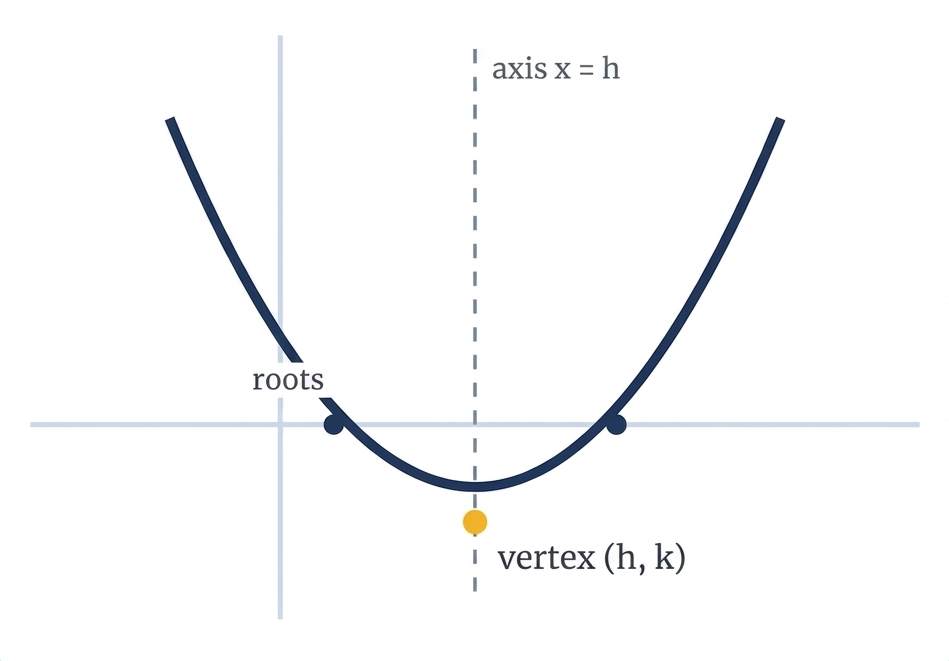
The turning point — the maximum if a < 0, the minimum if a > 0. Vertex form gives (h, k) directly; from standard form, x = -b/(2a), then substitute for k. The most-tested parabola feature.
The vertical line x = h that mirrors the parabola. From standard form: x = -b/(2a). SAT use: if one root is x = 3 and the axis is x = 5, the other root is x = 7 (equidistant).
Set x = 0. In standard form f(x) = ax² + bx + c, the y-intercept is always c. The simplest feature to read — a frequent 10-second SAT question.
Where the parabola crosses the x-axis — found by factoring or the quadratic formula. The discriminant sets the count: >0 → two, =0 → one, <0 → none.
| DISCRIMINANT B² − 4AC | REAL ROOTS | GRAPH BEHAVIOR | SAT IMPLICATION |
|---|---|---|---|
| b² − 4ac > 0 | Two distinct | Crosses the x-axis twice | Two x-intercepts; factoring or QF gives two answers |
| b² − 4ac = 0 | Exactly one | Touches the x-axis at the vertex | Vertex on the x-axis; "tangent to the x-axis"; root = -b/(2a) |
| b² − 4ac < 0 | None (real) | Doesn't cross the x-axis | "How many real solutions?" = 0; complex roots exist |
Quadratics dominate “Advanced Math.” Knowing which form reveals which feature is what saves time under pressure.
| SAT QUESTION TYPE | WHAT IT TESTS | FREQUENCY |
|---|---|---|
| Vertex / Max / Min | Identify (h, k) from vertex form or convert from standard; find the max or min value and where | 3–4 per test |
| Number of Solutions | Use the discriminant to count real solutions; "How many x-intercepts?" | 2–3 per test |
| Roots / Zeros | Solve by factoring or QF; read roots from factored form; Vieta's sum/product | 2–3 per test |
| Form Conversion | Convert between forms; complete the square; equivalent expressions | 1–2 per test |
| Line + Quadratic System | Intersection of a line and a parabola; substitute; tangency via discriminant | 1 per test |
Drawn from the SAT traps flagged throughout this guide
When a < 0 the parabola opens downward, so the vertex is a maximum.
Fix: check the sign of a first — a > 0 → minimum, a < 0 → maximum.
The SAT does not provide it.
Fix: memorize x = (-b ± √(b²−4ac))/2a cold before test day.
Forgetting that the sign of b² − 4ac decides the number of real solutions.
Fix: >0 → two, =0 → one, <0 → none. "How many solutions?" = evaluate the discriminant.
In a(x − h)² + k, the form (x + 2)² means h = −2, not +2.
Fix: h is the value that makes the parenthesis zero — flip the sign inside.
A quadratic function is a second-degree polynomial function of the form f(x) = ax² + bx + c, where a, b, and c are real numbers and a ≠ 0. That a ≠ 0 requirement is what makes it quadratic, if a = 0, the x² term vanishes and it becomes linear. Its graph is always a parabola: a symmetric, U-shaped curve with a single highest or lowest point called the vertex.
Standard form (f(x) = ax² + bx + c) is best for the y-intercept, the quadratic formula, and the discriminant. Vertex form (f(x) = a(x − h)² + k) directly reveals the vertex (h, k), the answer to any max/min question. Factored form (f(x) = a(x − r₁)(x − r₂)) directly reveals the roots, or x-intercepts. Knowing which form to use for which question is one of the most tested skills on the SAT.
No. The quadratic formula, x = (−b ± √(b² − 4ac)) / 2a, must be memorized before test day. It works for any quadratic equation, whether or not it factors evenly, making it the most reliable method when factoring isn't obvious.
The discriminant is b² − 4ac, the expression under the radical in the quadratic formula. If it's greater than 0, the equation has two distinct real roots. If it equals 0, there's exactly one real root (the parabola touches the x-axis at its vertex). If it's less than 0, there are no real roots, the parabola never crosses the x-axis.
Check the sign of a. If a > 0, the parabola opens upward and the vertex is a minimum. If a < 0, it opens downward and the vertex is a maximum. This is one of the most common SAT traps, students correctly find the vertex but assume it's always a minimum.
Book a free math assessment and get a personalized Digital SAT plan built around your gaps.