|
Preparing for the SAT? Claim Your Personalized Math Plan →
|
A system of equations is a set of two or more equations with the same variables, solved to find values that satisfy all equations simultaneously. Systems of equations are solved using three main methods: substitution (isolate one variable and plug it into the other equation), elimination (add or subtract equations to cancel one variable), or graphing (find the point of intersection). Systems appear on the SAT Math section in both linear and nonlinear forms.
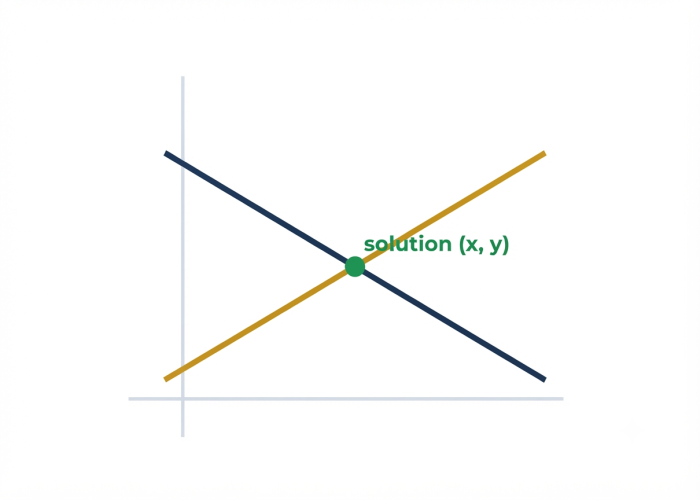
Plug into DESMOS, then look for intersection.
Every system of equations can be solved using one of three algebraic methods. Substitution and elimination both give exact solutions; graphing gives a visual answer. On the SAT Math section, elimination is the fastest method for linear systems — substitution is preferred for nonlinear systems.
On the SAT Math section, elimination solves most linear systems in under 90 seconds. Graphing takes 3+ minutes. Substitution is faster than elimination only when one variable is already isolated (coefficient = 1 with no constant).
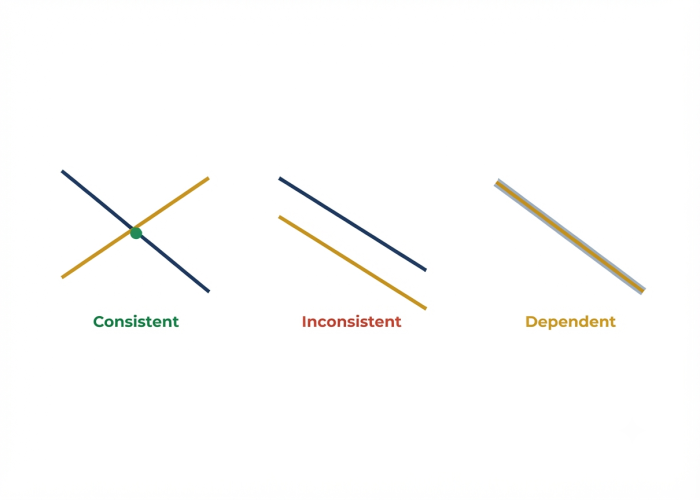
A consistent system has exactly one solution — a single coordinate pair (x, y) that satisfies both equations. Graphically, the two lines intersect at exactly one point. This is the standard case for most algebra and SAT Math systems problems.
An inconsistent system has no solution — no coordinate pair satisfies both equations simultaneously. Graphically, the lines are parallel (same slope, different y-intercept). On the SAT, inconsistent systems appear as parameter-value questions: "For what value of k does this system have no solution?
A dependent system has infinitely many solutions — every point on the line satisfies both equations because both equations represent the same line. This occurs when the equations are proportional (one is a multiple of the other). Like inconsistent systems, dependent systems appear as parameter-value questions on the SAT (Example 3 above).
Forgetting to back-substitute after finding one variable. Students find x = 3, then stop and write “x = 3” as the answer. A system’s solution requires both variables. Fix: always substitute back to find the second variable, then write the answer as an ordered pair (x, y).
Sign errors when applying the elimination method. Subtracting the second equation from the first, students forget to subtract every term — especially when a term is already negative. Fix: rewrite subtraction as “add the opposite” — multiply the equation being subtracted by −1, then add both equations together.
Confusing “no solution” with “infinite solutions” on special-case problems. Both produce 0 = 0 or 0 = 5 style results — students mix up which is which. Fix: 0 = 0 (true statement) → infinite solutions (dependent system). 0 = 5 (false statement) → no solution (inconsistent system). If both sides equal the same value, infinite; if they don’t match, no solution.
Setting up the wrong system for a word problem. Students write equations that are individually correct but don’t represent both constraints from the problem. Fix: identify two separate facts in the problem — each fact becomes one equation. Example 2 above demonstrates this: “200 total tickets” is one equation, “$1,240 collected” is the other.
Add equations: 3x = 15 → x = 5. Back-substitute: 5 + y = 10 → y = 5. Answer: (5, 5)
Set equal: 3x − 1 = −x + 7 → 4x = 8 → x = 2. Back-substitute: y = 3(2)−1 = 5. Answer: (2, 5)
East: 300 = 5r₁ → r₁ = 60 mph. West: 180 = 3r₂ → r₂ = 60 mph. Answer: yes, both travel at 60 mph. System: r₁ = 60 and r₂ = 60
Multiply first equation by 3: 3ax + 6y = 18. For infinite solutions: 3a = 3 → a = 1. Check: when a = 1, both equations represent the same line.
A system of equations is a set of two or more equations with the same variables. The solution is the set of values that makes all equations true simultaneously. In a two-variable linear system (the most common type in algebra), the solution is an ordered pair (x, y) that satisfies both equations. Systems appear in Florida MAFS.912.A-REI standards and on the SAT Math section.
Systems of equations are solved using three main methods: (1) Substitution — isolate one variable in one equation, substitute into the other, then solve. (2) Elimination — multiply equations to match one variable’s coefficient, then add or subtract to eliminate it. (3) Graphing — graph both equations and identify the point of intersection. On the SAT Math section, elimination is typically the fastest method for linear systems.
A system of equations has no solution when the equations represent parallel lines — they have the same slope but different y-intercepts, so they never intersect. Algebraically, eliminating all variables produces a false statement (for example, 0 = 5). On the SAT Math section, these “no solution” problems typically ask: “For what value of k does this system have no solution?” — requiring the student to identify when the equations represent parallel lines.
Systems of equations appear 3–5 times on every SAT Math section, making it one of the most heavily tested single algebra topics on the exam. Linear systems (solve for x and y) appear 2–3 times, nonlinear systems (one quadratic equation plus one linear equation) appear 1–2 times, and special cases (no solution or infinite solutions parameter problems) appear about once per test.
Yes. InLighten’s certified math tutors in Orlando specialize in algebra including systems of equations — covering all three solution methods (substitution, elimination, graphing), word problem setup, and the special-case SAT trap questions (no solution and infinite solutions). We diagnose exactly where your student is making errors before building a targeted session plan. Book a free math assessment to start.
Understanding all three solution methods is one thing — applying them correctly under test pressure, on a word problem, with a special-case twist, is another. InLighten’s certified math tutors in Orlando diagnose exactly where your student is losing points on systems of equations — whether it’s the setup, the algebra, or the special-case SAT traps — then build targeted sessions around those specific gaps. Most students see grade improvement within 3 sessions.