
|
Preparing for the SAT? Claim Your Personalized Math Plan →
|
The vertex is the turning point of a parabola, its lowest point (minimum) when it opens upward, or its highest point (maximum) when it opens downward. From standard form, the x-coordinate is x = −b/2a; in vertex form y = a(x−h)² + k, it’s simply (h, k). One of the SAT’s most-tested quadratic concepts.
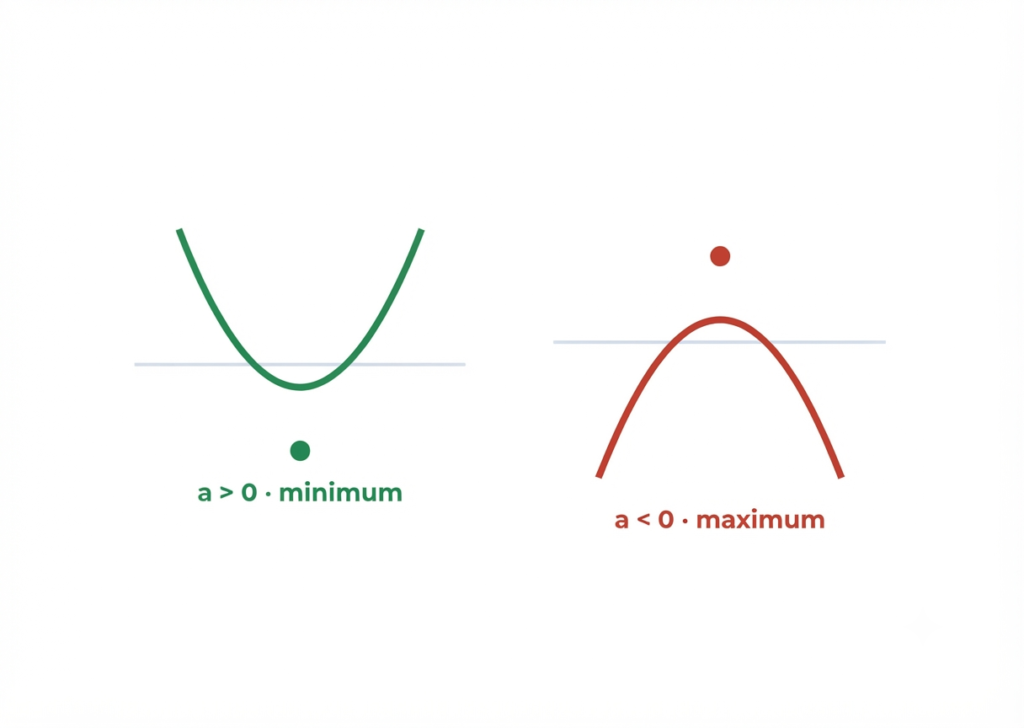
When you graph a quadratic equation, the U-shaped curve is a parabola, and the vertex is its absolute minimum or maximum point. When the parabola opens upward (a > 0), the vertex is the lowest point a minimum. When it opens downward (a < 0), the vertex is the highest point a maximum.
Axis of symmetry: the vertical line through the vertex, x = -b/2a. It splits the parabola into two mirror-image halves, so the vertex's x-coordinate is always exactly halfway between the two x-intercepts.
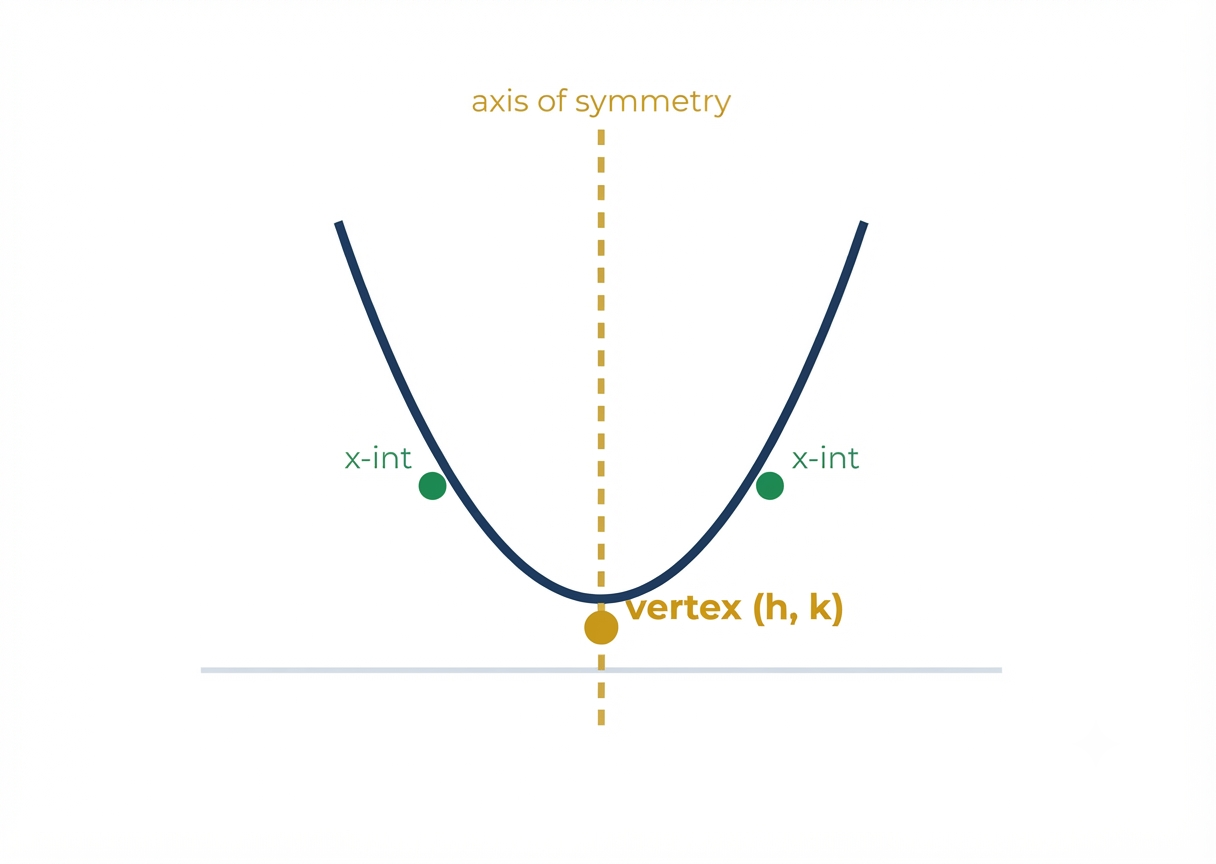
From standard form you calculate the vertex; in vertex form you can read it straight off. Both appear on the SAT.
The axis-of-symmetry formula gives the vertex's x-coordinate. Then substitute that x back into the equation to get y.
No calculation needed, the vertex is simply (h, k).
he coefficient a controls both which way the parabola opens (and so whether the vertex is a min or max) and how wide or narrow it is.
From standard form y = ax2 + bx + c, note the values of a and b (keep negative signs).
Apply the axis-of-symmetry formula: x = -b/2a.
Substitute that x-value back into the original equation to get y. The vertex is (x, y).
Vertex (2, -3), a minimum, since a = 2 > 0
Vertex (-1, 7), a maximum
The vertex answers any “maximum” or “minimum” question, the max/min value is simply the y-coordinate of the vertex. It appears in word problems across business, physics, and engineering contexts.
| CONTEXT | WHAT THE VERTEX GIVES YOU | SAT FREQUENCY |
|---|---|---|
| Projectile motion | Maximum height of a thrown/launched object (a < 0) | 1–2 per test |
| Business / profit | Maximum profit or revenue, or minimum cost | 1 per test |
| "Minimum value of f" | The y-coordinate of the vertex when a > 0 | 1 per test |
| Graph features | Axis of symmetry, vertex coordinates from a graph or equation | 1 per test |
When b is already negative, -b becomes positive. Students write -b/2a as negative anyway.
When squaring the x-coordinate to find y, students multiply by a before applying the exponent.
Reading (x + 3) as h = +3. The form is (x - h), so (x + 3) means h = -3.
Work each one, then reveal the answer to check yourself.
Don’t let complex equations slow you down. Book a free math assessment and get a Digital SAT plan built around your gaps.