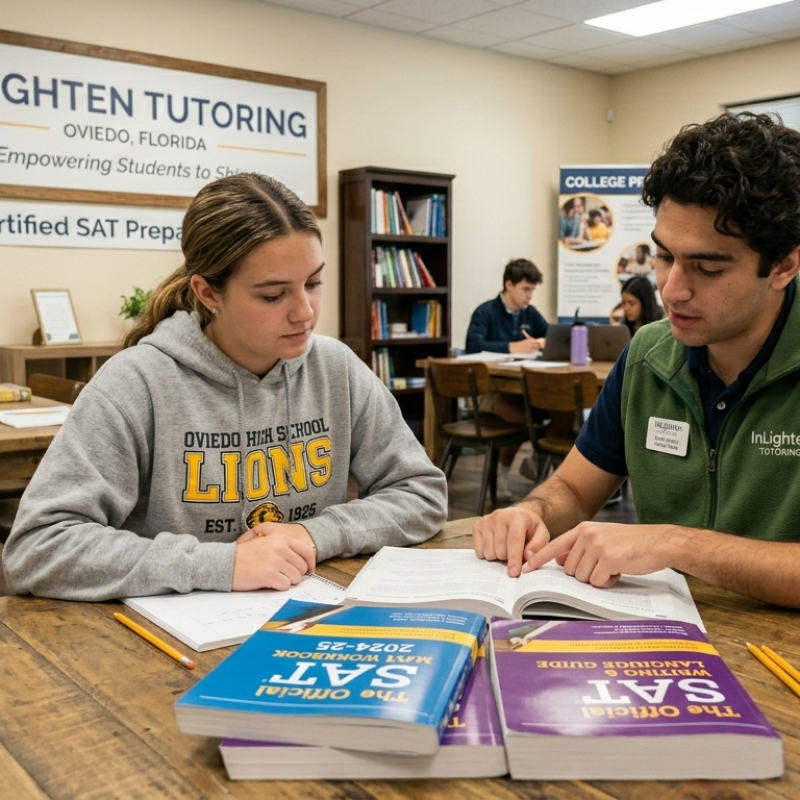
2026 Complete Guide
Bright Futures is among the most valuable state merit scholarships in the country — and available to every eligible Florida graduate. Florida Academic Scholars covers 100% of tuition; Florida Medallion Scholars covers 75%. Over four years, qualifying versus not can mean $20,000+ for an Orlando family.
This guide explains exactly what your student needs GPA, SAT or ACT score, community service hours, and application timing and how InLighten’s certified tutors serving Orlando, Winter Park, and Lake Nona help meet every threshold before the deadline.
| REQUIREMENT | FLORIDA ACADEMIC SCHOLARS (FAS) | FLORIDA MEDALLION SCHOLARS (FMS) | GOLD SEAL VOCATIONAL (FGSV) |
|---|---|---|---|
| Weighted GPA | 3.5 or higher | 3.0 or higher | 3.0 in CTE courses |
| SAT Score (ERW + Math) | 1170 or higher | 1010 or higher | Not required |
| ACT Composite | 26 or higher | 22 or higher | Not required |
| Community Service Hours | 100 hours | 75 hours | 30 hours |
| Diploma | Standard diploma (not GED) | Standard diploma (not GED) | Standard diploma |
| Award — Public University | 100% tuition + fees | 75% tuition + fees | 75% (CTE programs) |
| Award — State College | 100% tuition + fees | 75% tuition + fees | 75% tuition + fees |
▲ Requirements reflect current OSFA policy and may change. Always verify at floridastudentfinancialaidsg.org before making academic decisions. Last verified: June 2026.
Qualifying for Bright Futures is only the first hurdle. Once your student is enrolled, the scholarship renews automatically each year based on college GPA and credit hours, no separate application required while funding continues. Here's exactly what it takes to keep the award through graduation.
| Award Type | Renewal GPA Required | Credit Hours (Full-Time) | If Your Student Falls Short |
|---|---|---|---|
| Florida Academic Scholars (FAS) | 3.0 cumulative college GPA | 24 earned hours per year | GPA of 2.75–2.99: automatically renews as FMS instead, no paperwork needed. Below 2.75: one-time restoration opportunity, first year of funding only. |
| Florida Medallion Scholars (FMS) | 2.75 cumulative college GPA | 24 earned hours per year | Below 2.75: one-time restoration opportunity, first year of funding only. No restoration available in later years. |
Credit hours work differently than GPA: missing the required hours in any year, not just the first, disqualifies a student from the one-time restoration option. GPA misses are more forgiving than hour misses, so protecting course load matters as much as protecting grades.
Requirements reflect current OSFA renewal policy and may change. Verify at floridastudentfinancialaidsg.org before making academic decisions. Last verified: July 2026.
Bright Futures accepts the SAT, ACT, or CLT, whichever a student has already taken usually decides which one to focus on, but for families starting from scratch, the choice comes down to test structure and superscoring. Both tests let Florida students combine their best section scores across multiple sittings of the same test; a strong Math score from one SAT date and a strong Reading/Writing score from another SAT date can combine into one qualifying composite. However, SAT and ACT scores cannot be mixed with each other. One notable ACT-specific rule: starting with the 2025–26 graduating class, the ACT Science section is optional for Bright Futures purposes, so a student who skips it is scored on English, Math, and Reading alone. Structured ACT prep or SAT prep can target whichever test fits your student's strengths.
| What Matters | SAT | ACT |
|---|---|---|
| FAS Score Needed | 1330 composite (ERW + Math) | 29 composite |
| FMS Score Needed | 1190 composite | 24 composite |
| Sections Scored | Reading & Writing, Math | English, Math, Reading (Science optional for Class of 2026 and later) |
| Superscoring | Best section scores combine across SAT sittings | Best section scores combine across ACT sittings |
| Often a Better Fit For | Students who prefer more time per question and evidence-based reading passages | Students who prefer a faster pace and a more straight-forward science/data section |
Neither test is objectively "easier" for Bright Futures specifically; the right one is whichever plays to your student's pacing and reading style. A short diagnostic on both tests is the fastest way to find out, rather than guessing based on which test is more popular at their school.
Bright Futures uses a weighted GPA not the unweighted GPA printed on the report card. This distinction matters enormously: a student taking honors and AP courses with a 3.3 unweighted GPA may have a 3.5+ weighted GPA that qualifies for Florida Academic Scholars.
Florida adds quality points on a 4.5 scale for advanced coursework in grades 9–12:
Only grades from 9–12 count, calculated from all courses — electives and PE included. All-standard maxes at 4.0; all AP/IB has a theoretical max of 5.0.
Of all the eligibility requirements, the SAT or ACT score is the one a student can most directly improve with structured prep. Crossing from the FMS threshold (1190) to the FAS threshold (1330) matters: at Florida public universities, FAS covers 100% of tuition versus FMS’s 75%. At UF that’s roughly $3,000–$4,000 per year, or $12,000–$16,000 over four years.
| SAT SCORE RANGE | ACT EQUIVALENT | BRIGHT FUTURES TIER | COVERAGE |
|---|---|---|---|
| Below 1010 | Below 22 | Does not qualify | $0 |
| 1190+ | 24 | Florida Medallion Scholars | 75% tuition |
| 1330+ | 29 | Florida Academic Scholars | 100% tuition |
What a score increase is worth: Most Orlando, Winter Park, and Lake Nona students are within 50–150 points of their tier cutoff a predictable, solvable gap.
The weighted GPA includes only academic courses — AP, IB, AICE, and dual enrollment receive additional weight, so students taking rigorous coursework have a higher qualifying GPA than their transcript shows. A 2.9 unweighted student with several AP courses may have a 3.2+ weighted GPA — qualifying for Medallion Scholars.
| COURSE TYPE | A | B | C |
|---|---|---|---|
| Regular Course | 4.0 | 3.0 | 2.0 |
| Honors Course | 4.5 | 3.5 | 2.5 |
| AP / IB / AICE / Dual Enrollment | 5.0 | 4.0 | 3.0 |
FAS requires 100 service hours; FMS requires 75. Hours must be documented, unpaid, and completed during grades 9–12 through a nonprofit, government entity, or school-sponsored program. Documentation is the parent’s responsibility — undocumented hours are not accepted.
Tip: Keep a service log in a Google Sheet — date, organization, supervisor name and phone, hours served. Upload any verification letters. OSFA may request verification before awarding the scholarship. Losing eligibility on a senior-year technicality is the most common Bright Futures heartbreak InLighten counselors see across Orlando, Winter Park, and Lake Nona.
Eligibility is built over four years — not a single semester. Here’s the focus for each stage and the deadlines that can’t be missed.
Take at least one honors or AP math tutoring course to build weighted GPA early. Start logging service hours now even 2–3 hours a month reaches 24+ by year's end. Research Orlando/Winter Park service orgs; ask about NHS timing.
Take the PSAT in October to spot Math/Reading weaknesses early. Target 25+ service hours. Confirm course selections meet standard-diploma credits. Consider spring SAT prep to front-load gains.
Take the SAT in spring with time for a fall retake. Target both the FAS (1170) and FMS (1010) thresholds. Junior-year GPA is now your primary data point. Address any service-hour deficit over the summer.
Bright Futures needs a 2.75 GPA per semester to renew. Probation risks losing the award mid-college. Close any subject gap before college — not after — to protect thousands in annual funding.
The most costly false belief. Bright Futures uses a weighted GPA. A 3.2 unweighted student with honors/AP courses may have a 3.6+ weighted GPA.
FAS hours must be earned in grades 9–12. Starting in senior year means ~2.5 hours every week with no breaks — most seniors can't sustain that alongside coursework and applications.
The FFAA and FAFSA are separate. The FFAA is Florida's application via floridastudentfinancialaidsg.org. Submitting only the FAFSA means no Bright Futures funding.
There's no single minimum — there are binary tier thresholds. 1009 qualifies for nothing; 1010 for FMS; 1170 for FAS. Missing by one point means a full tier difference.
My daughter improved her SAT from a 1180 to a 1340 in 12 sessions. She qualified for Florida Academic Scholars — that's $25,000 in scholarships. InLighten knew exactly which sections to target.
As a student-athlete with baseball practice every afternoon, I needed SAT prep that worked around my schedule. InLighten built sessions at 7am and hit my NCAA eligibility SAT score in 8 weeks.
We tried a national chain first — generic materials, large groups, no improvement. After switching to InLighten's diagnostic-first program, my son raised his SAT score to a 1600 in 6 weeks.
Bright Futures uses a weighted GPA. The Florida Academic Scholars (FAS) award requires a 3.5 weighted GPA, while the Florida Medallion Scholars (FMS) award requires a 3.0 weighted GPA. Florida weights on a 4.5 scale, adding 0.5 points for honors courses and 1.0 for AP, IB, and dual enrollment. Always verify your specific standing with a school counselor or at floridastudentfinancialaidsg.org.
For the SAT, FAS requires a 1330 composite (ERW + Math) and FMS requires a 1190. For the ACT, FAS requires a 29 and FMS requires a 24. These are strict thresholds; scores below these do not qualify for that specific tier. The SAT/ACT score is often the most improvable eligibility factor through structured prep.
The FAS award requires 100 verified service hours by graduation, and the FMS award requires 75 hours. Gold Seal Vocational awards have no service hour requirement. Hours must be documented on an official service log with supervisor verification; check OSFA's current requirements before submitting.
Yes. InLighten's SAT and ACT prep in Orlando is designed to help Florida students reach their Bright Futures target. Our diagnostic-first approach identifies the exact sections holding a student below the cutoff, then builds targeted sessions. Most students within 100–150 points reach it in 8–12 sessions. Book a free diagnostic to start.
Ideally, track requirements from 9th grade and start SAT/ACT prep no later than spring of 10th grade. The critical window is 11th grade — that year's scores are the most realistic predictor before the senior-year deadline, with one full year and 2–3 test attempts remaining.
Book a free SAT diagnostic and get a personalized score plan built around your student’s exact cutoff.