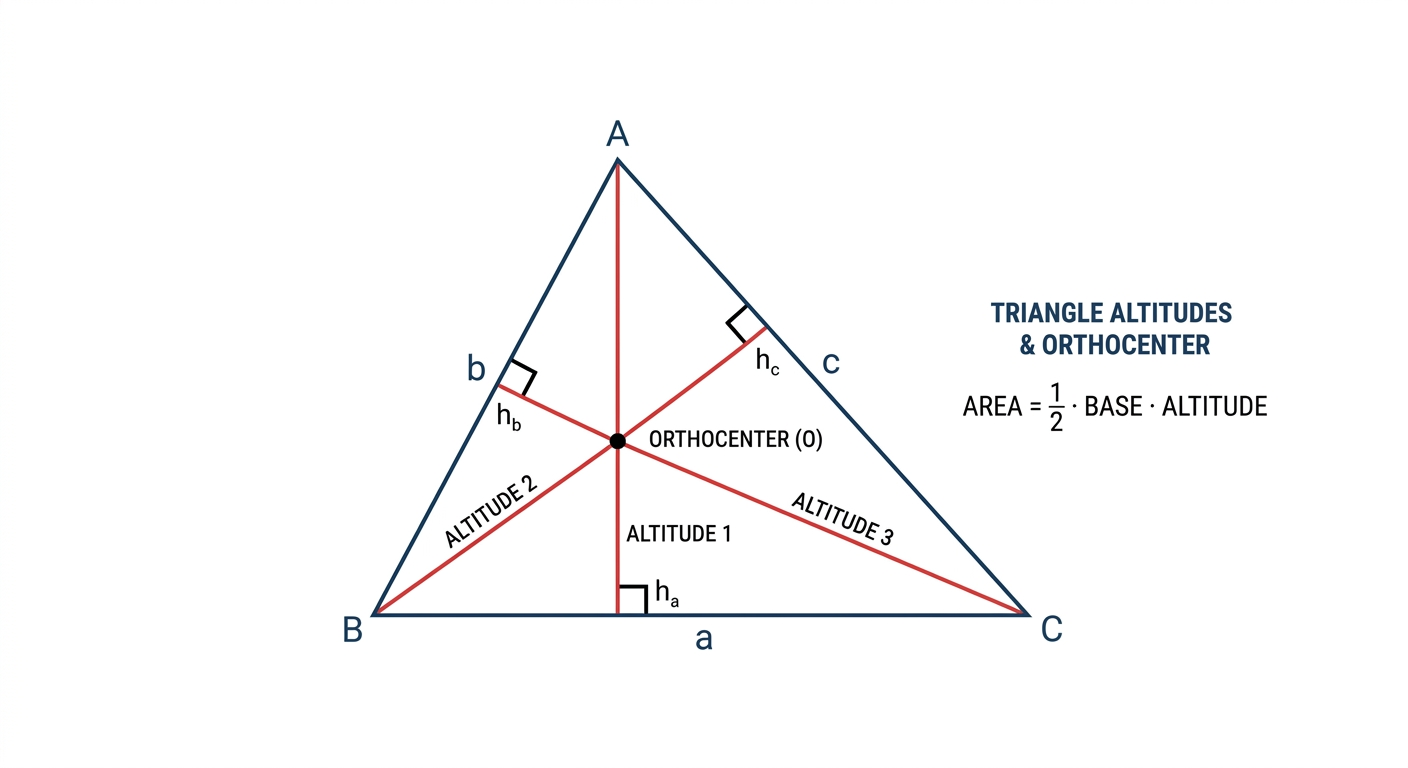
In geometry, the altitude of a triangle is a perpendicular segment drawn from a vertex to the line containing the opposite side (called the base). The altitude represents the triangle’s height (h) and is used in the area formula: Area = ½ × base × height. Every triangle has three altitudes, one from each vertex. In a right triangle, two of the three altitudes are the legs themselves. The altitude-area relationship appears on the SAT Math section in triangle geometry problems.

"Altitude" Explained

A line that is perpendicular to the hypotenuse and cuts right angle of a triangle. Creates 3 similar right triangles.

Altitude of a Triangle — Definition, Formula & How to Find It

Formal definition: The altitude of a triangle is a perpendicular line segment drawn from any vertex of the triangle to the line containing the opposite side (the base). It is always perpendicular to the base — forming a 90° angle — regardless of triangle type. The length of the altitude is the triangle’s height (h) and determines the triangle’s area through the formula A = ½ × base × height.

The altitude of a triangle

Where you’ll see it: The altitude of a triangle appears throughout geometry (grades 9–10), Florida FSA and EOC geometry assessments, SAT Math (triangle area and coordinate geometry questions), ACT Mathematics, and the Florida MAFS.912.G-SRT and MAFS.912.G-CO standards for high school geometry.

Altitude Formula in Geometry — How to Find Triangle Height

The altitude of a triangle connects directly to both the area formula and, in right triangles, the geometric mean altitude theorem. Master these two formulas and you can solve the majority of SAT Math triangle problems involving altitude.

FORMULA 1 – TRIANGLE AREA

A = ½ × b × h

A = area of the triangle.
b = length of the base.
h = altitude (height) – perpendicular to b.

To find altitude when area is known: h = 2A ÷ b.

Applies to ALL triangle types: acute, right, and obtuse.

FORMULA 2 – FINDING ALTITUDE IN A RIGHT TRIANGLE

h² = leg₁ × leg₂  ·  a² = p × c

When altitude (h) is drawn to the hypotenuse of a right triangle:

h² = p × q (geometric mean of two segments)
a² = p × c  ·  b² = q × c

p, q = segments the altitude cuts the hypotenuse into
c = full hypotenuse  ·  a, b = legs

SAT EFFICIENCY RULE – ALTITUDE PROBLEMS

Always draw the altitude. Label base, height, and right angle. Then apply A = ½bh.

On SAT Math, altitude problems are often disguised as area problems or coordinate geometry questions. The trap: assuming the height is always inside the triangle. In an obtuse triangle, the altitude from the obtuse vertex's opposite vertices falls outside the triangle – but the formula A = ½bh still applies. Always draw and label before calculating.

Altitude of a Triangle — 3 Worked Examples

EXAMPLE 1 EASY – FIND ALTITUDE FROM AREA

A triangle has an area of 24 cm² and a base of 8 cm. Find its altitude (height).

Step 1: Identify the standard formula → A = ½ × b × h
Step 2: Rearrange for altitude (h) → h = 2A ÷ b
Step 3: Substitute values → h = (2 × 24) ÷ 8 = 48 ÷ 8
Step 4: Calculate → h = 6 cm
Check: Plug back into original area formula: A = ½ × 8 × 6 = 24 cm²
EXAMPLE 2 MEDIUM – RIGHT TRIANGLE & PYTHAGOREAN THEOREM

A right triangle has a hypotenuse of 10 cm and one leg measuring 8 cm. Find its altitude relative to the other leg.

Step 1: Find the missing leg → Use the Pythagorean theorem ($a^2 + b^2 = c^2$): $a^2 + 8^2 = 10^2 \rightarrow a^2 + 64 = 100 \rightarrow a^2 = 36 \rightarrow a = 6\text{ cm}$
Step 2: Identify the base and altitude → In a right triangle, the two perpendicular legs serve as each other's bases and altitudes. If we treat the $8\text{ cm}$ leg as the base ($b$), the other leg ($6\text{ cm}$) is its relative altitude ($h$).
Check: Calculate area both ways: $A = \frac{1}{2} \times 8 \times 6 = 24\text{ cm}^2$. The relationship holds true perfectly.
SAT trap: Confusing the altitude relative to a leg with the altitude drawn to the hypotenuse. If the question asked for the altitude to the hypotenuse, you would use the area or geometric mean: $h = \frac{\text{leg}_1 \times \text{leg}_2}{\text{hypotenuse}} = \frac{6 \times 8}{10} = 4.8\text{ cm}$. Always read carefully to see which side is the base.
EXAMPLE 3 HARD – SAT LEVEL · GEOMETRIC MEAN ALTITUDE THEOREM

In right triangle ABC, the right angle is at C. The altitude from C to the hypotenuse AB has length 6. If CD divides AB into segments AD = 4 and DB = p, find p and verify with the geometric mean theorem.

Step 1: Geometric Mean Altitude Theorem → $h^2 = AD \times DB$
Step 2: Substitute → $6^2 = 4 \times p \rightarrow 36 = 4p \rightarrow p = 9$
Step 3: Verify → $h^2 = 4 \times 9 = 36 \rightarrow h = 6$
SAT trap: Students often confuse which segment pair to multiply. Always: $\text{altitude}^2 = (\text{left segment}) \times (\text{right segment})$. The altitude is the geometric mean between the two hypotenuse segments — not the legs.

How Altitude of a Triangle Appears on the SAT Math Section

Altitude isn’t tested by name on the SAT Math section — but the altitude-area relationship is tested in every form: direct area calculations, coordinate geometry perpendicular distance problems, and right-triangle geometric mean questions. Recognizing “height” as the altitude in a triangle area problem is the first step; applying A = ½bh is the second.

SAT BREAKDOWN SAT QUESTION TYPES · ALTITUDE FREQUENCY

How Altitude Appears on the SAT Math Sections

SAT QUESTION TYPE HOW ALTITUDE APPEARS FREQUENCY
Triangle Area Find area given base and height (altitude) or find altitude given area and base. $A = \frac{1}{2}bh$ is tested directly. 2–3× per test
Coordinate Geometry "Find the area of triangle ABC with vertices at..." — requires recognizing that altitude = perpendicular distance from one vertex to the opposite side (a line equation). 1–2× per test
Right Triangle —
Geometric Mean
"Altitude drawn to hypotenuse of a right triangle..." — requires $h^2 = p \times q$ theorem. Often appears in calculator-prohibited section. ∼1× per test
Similar Triangles Two triangles sharing an altitude — prove similarity or find ratios. Uses altitude as the shared element to establish proportionality. ∼1× per test

How Altitude of a Triangle Appears on the SAT Math Section

Altitude in an Acute Triangle

All three altitudes lie inside the triangle. The foot of each altitude (where it meets the opposite side) is on the side itself — not on an extension. This is the "standard" case most textbooks use for altitude diagrams. All three altitudes meet at the orthocenter, which lies inside an acute triangle.

Altitude in a Right Triangle

Two of the three altitudes are the legs themselves (each leg is perpendicular to the other). The third altitude — from the right-angle vertex to the hypotenuse — is the one governed by the geometric mean altitude theorem: h² = p × q. The orthocenter of a right triangle is at the right-angle vertex.

Altitude in an Obtuse Triangle

Two of the three altitudes fall outside the triangle — they must be drawn to the extensions of the opposite sides, not the sides themselves. This is the most common source of student error on SAT Math (see Common Mistakes, Block 06). The orthocenter of an obtuse triangle falls outside the triangle. The area formula A = ½bh still applies with the correct base and full altitude length.

The Orthocenter — Where All Three Altitudes Meet

The orthocenter is the point where all three altitudes of a triangle intersect. In an acute triangle, it is inside. In a right triangle, it is at the right-angle vertex. In an obtuse triangle, it is outside the triangle. The orthocenter appears in MAFS.912.G-CO standards for geometric construction and on SAT Math in multi-step proof-style questions.

Common Mistakes — Altitude of a Triangle

Confusing altitude with slant height. In a 3D shape (cone, pyramid), the “slant height” is the diagonal measurement along the surface — not the perpendicular height. In a 2D triangle, the altitude is always the perpendicular distance from vertex to base. Fix: In a 2D triangle, altitude = height = perpendicular. In 3D, always distinguish slant height from vertical height.

Assuming altitude always lands inside the triangle. In an obtuse triangle, two of the three altitudes fall outside the triangle — they must be drawn to extensions of the sides. Students incorrectly draw the altitude to the side itself, getting the wrong foot of the altitude and calculating the wrong length. Fix: Always extend obtuse triangle sides when drawing altitudes from the acute vertices. The foot of the altitude is on the line containing the base, not necessarily on the segment. InLighten’s certified math tutors in Orlando address this in every geometry session using annotated diagrams.

Misapplying the geometric mean theorem — multiplying the wrong segments. The most common SAT error: confusing which quantities are multiplied. The altitude² equals the product of the two hypotenuse segments (h² = p × q). Each leg² equals the product of the hypotenuse and its adjacent segment (a² = p × c, NOT p × q). Fix: Label all four lengths (p, q, h, c) before applying the theorem. h uses p and q. The legs use the full hypotenuse c.

Using a slanted side length as the altitude in the area formula. Students often mistake a visible side length for the height. In A = ½ × base × height, the height must be perpendicular to the base — it is almost never the same as a side length (exception: right triangles where legs are perpendicular to each other). Fix: Before using A = ½bh, draw a 90° angle symbol on the altitude to confirm it is perpendicular. If the diagram doesn’t show a right angle on the height, you need to find the perpendicular distance, not the side length.

Practice Problems — Altitude of a Triangle

Frequently Asked Questions — Altitude of a Triangle

The altitude of a triangle is a perpendicular line segment drawn from any vertex of the triangle to the line containing the opposite side (the base). It is always perpendicular to the base, forming a 90° angle. The altitude represents the triangle’s height and is used in the area formula A = ½ × base × height. Every triangle has three altitudes, one from each vertex. In Florida MAFS.912.G-SRT standards, altitude is a foundational concept in triangle geometry and similarity.

To find the altitude, use the area formula rearranged: h = 2A ÷ b, where h is the altitude, A is the area, and b is the base. If the area isn’t given, use coordinate geometry (perpendicular distance from a point to a line) or the Pythagorean Theorem within the triangle. In a right triangle, the altitude drawn to the hypotenuse uses the geometric mean theorem: altitude² = (segment 1) × (segment 2).

Yes. In an obtuse triangle, two of the three altitudes fall outside the triangle. They must be drawn to the extensions of the opposite sides, not the sides themselves. The foot of the altitude (where the perpendicular meets the base line) is outside the triangle when the vertex angle from which the altitude is drawn is an acute angle in an obtuse triangle. The area formula A = ½bh still applies correctly using these altitudes and their corresponding bases.

Altitude appears on the SAT Math section in three main forms: (1) Triangle area problems — find area given base and height, or find altitude given area and base using A = ½bh. This appears 2–3 times per test. (2) Coordinate geometry — “Find the area of triangle ABC with vertices at…” requiring the student to identify the perpendicular distance from one vertex to the opposite side. (3) Right triangle geometric mean — altitude drawn to the hypotenuse creates two similar sub-triangles governed by h² = p × q. Understanding altitude is essential for SAT Math geometry questions.

Yes. InLighten’s certified math tutors in Orlando specialize in geometry including all aspects of triangle altitude — the area formula, the geometric mean altitude theorem for right triangles, altitude in obtuse triangles, and the orthocenter. We diagnose exactly which altitude concept is causing confusion before building targeted sessions. Students preparing for Florida FSA geometry assessments, SAT Math, or ACT Mathematics all benefit from our geometry tutoring program. Book a free geometry assessment to start.

Still Struggling with Altitude and Triangle Geometry? Work with a Certified Math Tutor in Orlando.

Understanding altitude on a diagram is one thing — identifying it in a coordinate geometry problem, setting up the geometric mean theorem correctly under time pressure, or drawing altitude in an obtuse triangle on a Florida FSA geometry assessment is another. InLighten’s certified math tutors in Orlando work with high school students on exactly these geometry concepts: altitude types, triangle area, the geometric mean altitude theorem, and orthocenter problems. We pinpoint the exact gap — whether it’s the diagram, the formula setup, or the special-case SAT trap — before building a targeted session plan. Most students see measurable improvement within 3 sessions.