
|
Preparing for the SAT? Claim Your Personalized Math Plan →
|
A percentage is a number expressed as a fraction of 100, written with the % symbol. To find a percentage, use the formula: Percentage = (Part ÷ Whole) × 100. To convert a percentage to a decimal, divide by 100 (e.g., 45% = 0.45). Percentages appear throughout Florida math courses from grade 7 through SAT Math, including percent change, percent increase, and percent decrease problems on the SAT’s Problem Solving & Data Analysis section.
A percentage expresses a number as a fraction of 100, written with the % symbol. To find one: Percentage = (Part ÷ Whole) × 100. To convert to a decimal, divide by 100 (45% = 0.45). Percentages dominate the SAT’s Problem Solving & Data Analysis section.
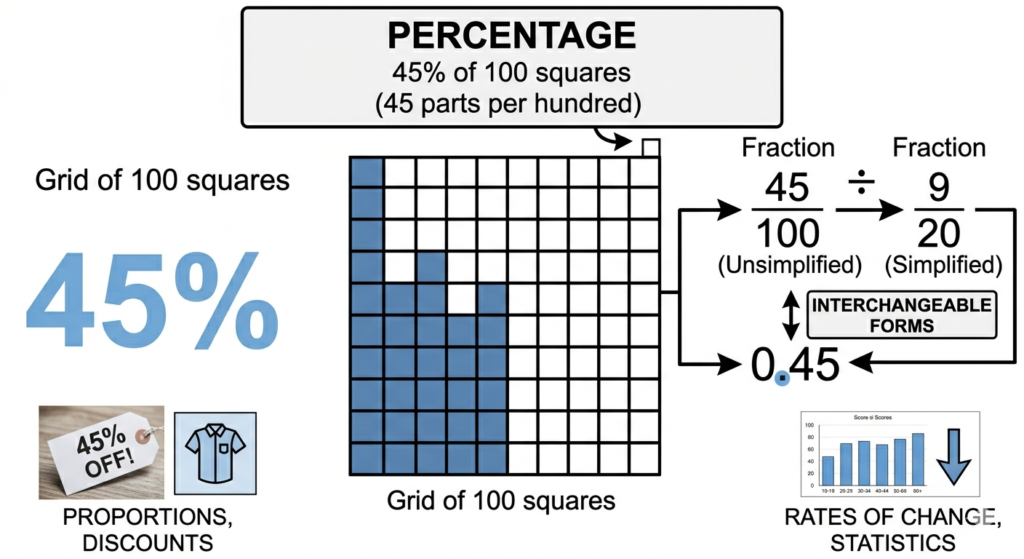
A way of expressing a number as a part of 100. “Percent” means “per hundred,” so 45% means 45 out of every 100. Percentages describe proportions, rates of change, scores, discounts, and statistical data and any percentage can be written equivalently as a fraction or a decimal.
Three interchangeable forms: every percentage is also a fraction and a decimal — 45% = 45/100 = 9/20 = 0.45. All three are interchangeable in calculations. The SAT mental-math rule: convert % to a decimal before calculating — never leave the % symbol inside an equation.
Every percentage problem asks for one of three things. The formula is the same, you just rearrange it to solve for what’s missing.
Convert percent to decimal first, then multiply. 30% of 80 → 0.30 × 80 = 24.
SAT phrasing: "What is X% of Y?"
Divide, then ×100 to convert to %. 18 of 72 → (18 ÷ 72) × 100 = 25%.
SAT phrasing: "What percent of Y is X?"
Convert percent to decimal, then divide. 15 is 20% of → 15 ÷ 0.20 = 75.
SAT phrasing: "X is Y% of what number?"
% ↔ decimal ↔ fraction: % → decimal (÷100) · decimal → % (×100) · % → fraction (over 100, simplify). Examples: 75% = 3/4 = 0.75 · 0.4 = 40% · 1/8 = 0.125 = 12.5%.
Find the percent. A student scored 34 out of 40 on a quiz. What is the percentage score?
Discount word problem. A $120 jacket is 35% off. Find the sale price.
Successive changes (SAT). A price goes up 20%, then gets a 20% discount. Greater, less, or equal to the original? Overall change?
Percentages are among the most-tested SAT concepts, from “what is X% of Y” to multi-step successive changes. They appear predictably and are fixable with targeted practice.
| SAT QUESTION TYPE | WHAT IT TESTS | FREQUENCY |
|---|---|---|
| Basic percent calculation | Find part, percent, or whole with the core formula | 2–3× per test |
| Percent change | Calculate increase/decrease between two values | 2–3× per test |
| Successive percent changes | Two or more operations in sequence — the trap question | 1–2× per test |
| Percent of a percent | Nested calculation — "X% of Y% of Z" | 1× per test |
| Data table interpretation | Calculate a percentage from raw data in a table/chart | 1–2× per test |
Percent change measures how much a value rose or fell relative to its original value. Two methods, the textbook formula and the faster multiplier method.
Always divide by the ORIGINAL (old) value. Price $80 → $100: ((100 - 80) ÷ 80) × 100 = 25%.
Multiplier: 1 + 0.25 = 1.25 → New = Old × 1.25
Again divide by the ORIGINAL value. Price $100 → $75: ((100 - 75) ÷ 100) × 100 = 25%.
Multiplier: 1 - 0.25 = 0.75 → New = Old × 0.75
multiply by 1.30
multiply by 0.85
20% up then 25% down → 1.20 × 0.75 = 0.90 → 10% net decrease
Percent change always divides by the ORIGINAL value, not the new one.
Fix: label "old" and "new" before substituting — the denominator is always old.
"20% up then 20% down = no change" is wrong — the second percent applies to a different base.
Fix: multiply the multipliers: 1.20 × 0.80 = 0.96 → -4%, never 0%.
Writing 30% × 80 = 2,400 instead of 0.30 × 80 = 24 — an answer 100× too large.
Fix: the % symbol means ÷100. Convert as a separate step before multiplying.
In "18 is 25% of what number?", putting 18 as the whole inverts the relationship.
Fix: the number after "of" is the whole; the number before "is" is the part.
Work each one, then reveal the answer to check yourself.
What is 45% of 200?
24 is what percent of 60?
A laptop originally costs $850. After a 15% discount, what is the sale price? Use the multiplier method.
A value increases by 40%, then decreases by 40%. What is the overall percent change?
A number expressed as a fraction of 100, written with %. "Per cent" means "per hundred," so 45% = 45 out of 100 = 45/100 = 9/20 = 0.45. Percentages describe proportions, scores, discounts, and rates of change, and appear in Florida math from grade 7 (MAFS.7.RP.3) through SAT Problem Solving & Data Analysis.
Convert the percent to a decimal (÷100), then multiply by the whole: Part = Percent × Whole. Example: 30% of 80 → 0.30 × 80 = 24. This is the most common percentage calculation on the SAT and in Florida math courses.
Percent Change = ((New − Old) ÷ Old) × 100 — always divide by the original value. Positive = increase, negative = decrease. The faster SAT method uses multipliers: increase X% → ×(1 + X/100); decrease X% → ×(1 − X/100). This is the most heavily tested percentage concept on the SAT.
In Problem Solving & Data Analysis: ~2–3 basic percent calculations, 2–3 percent change, 1–2 successive changes (the most common trap), and 1–2 data-table percentages. They're predictable and fixable — among the most efficient SAT Math points to lock in.
Yes — basic part/whole, percent change, the multiplier method, and the successive-change trap most students miss. We identify exactly where points are lost and build targeted sessions. Whether for SAT Problem Solving, Bright Futures score improvement, or class help, book a free math assessment to start.
Book a free math assessment and get a personalized Digital SAT plan built around your gaps.