
|
Preparing for the SAT? Claim Your Personalized Math Plan →
|
A tangent line is a straight line that touches a curve or circle at exactly one point — called the point of tangency — without crossing it. In circle geometry, a tangent line is always perpendicular to the radius drawn to the point of tangency. In calculus, a tangent line to a curve at a point represents the instantaneous rate of change (slope = derivative) at that point. Tangent lines appear in Florida’s MAFS.912.G-C standards and on the SAT Math geometry section.
A tangent line touches a curve or circle at exactly one point, the point of tangency, without crossing it. In circle geometry it’s always perpendicular to the radius drawn to that point; in calculus its slope is the derivative (the instantaneous rate of change).
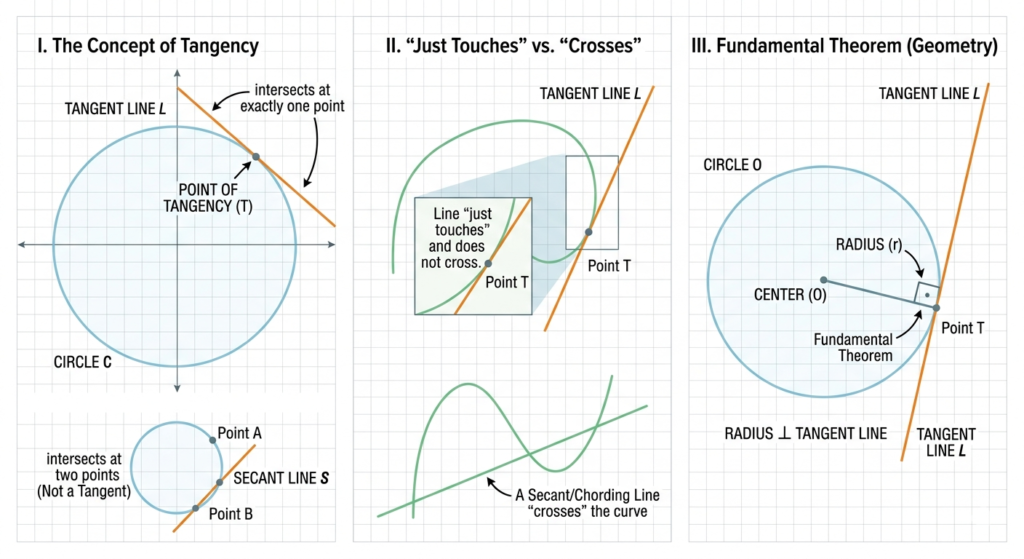
A line that intersects a curve or circle at exactly one point, the point of tangency, where it “just touches” without crossing to the other side. For circles, the fundamental theorem is that the tangent is always perpendicular (90°) to the radius drawn to the point of tangency.
Where you’ll see it: Florida geometry (grades 9–10), FSA/EOC, SAT Math (Geometry & Trigonometry), MAFS.912.G-C.2, plus the calculus tangent (slope of a curve) in Pre-Calculus and AP Calculus.
Master all three for the Florida geometry EOC and the SAT, each produces a specific question type.
A tangent line is perpendicular to the radius at the point of tangency.
Consequence: ∠OPT = 90°. SAT: creates a right triangle → use the Pythagorean theorem to find a missing length.
Two tangent segments from the same external point are equal: PA = PB.
Consequence: P lies on the perpendicular bisector of chord AB. SAT: set two expressions equal and solve.
Angle = ½ × intercepted arc (on the circle), or ½ × |far arc – near arc| (external point).
MAFS.912.G-C.2. SAT: given arc measures, find the tangent-chord angle — a medium-hard type.
Tangent–radius right angle. Line ℓ is tangent to circle O at P. Radius OP = 8, and Q is on ℓ with OQ = 10. Find PQ.
PQ = 6 — the tangent-radius right angle always creates a Pythagorean relationship.
Equal tangent segments. From external point P, tangents touch at A and B. PA = 3x − 4 and PB = x + 10. Find PA and PB.
PA = PB = 17 — a recurring SAT algebra-in-geometry setup.
Tangent-chord angle. Line ℓ is tangent at A; chord AB is drawn. Arc AB (not containing the tangent point) = 140°. Find the tangent-chord angle at A.
Tangent-chord angle = 70°
SAT trap: use the arc the angle "opens into," not the other arc. The tangent-chord angle is always half the arc it intercepts.
Most tangent questions combine circle geometry with the Pythagorean theorem, a two-step problem that eliminates students who know only one rule.
| SAT QUESTION TYPE | THEOREM APPLIED | FREQUENCY |
|---|---|---|
| Right triangle from tangent-radius | Theorem 1 → Pythagorean theorem for a missing length | 1–2× per test |
| Equal tangent segments (algebra setup) | Theorem 2 — set two expressions equal, solve | 1× per test |
| Tangent-chord angle from arc measure | Theorem 3 — angle = ½ × arc | 0–1× per test |
| Identify tangent vs. secant in a diagram | Definition — touches at exactly one point? | 1× per test |
Read the diagram label — does it say "tangent"? If yes, a radius to the point of tangency creates a 90° angle. Draw it.
Identify which theorem applies — perpendicular right triangle (1), equal segments (2), or arc angle (3).
Set up the equation — most tangent problems reduce to a Pythagorean calculation or an equal-length setup.
A calculus tangent line best approximates a curve at one point; its slope is the derivative there. (Unlike a circle tangent, it may cross the curve elsewhere, the property is local.)
The slope at x = a is the derivative evaluated there — the instantaneous rate of change.
The tangent is the limit of secant lines as the second point approaches the first.
A tangent touches at one point; a secant crosses at two.
Fix: verify exactly one intersection point before applying any tangent theorem.
The 90° angle is at the point of tangency (P), not the center (O).
Fix: draw the radius to P, then mark 90° there.
SAT figures aren't to scale, so equal tangents may "look" unequal.
Fix: apply PA = PB algebraically regardless of the picture.
The tangent-chord angle is half the intercepted arc.
Fix: write the formula first — it always includes ½.
Work each one, then reveal the answer to check yourself.
Line ℓ is tangent to circle O at P. OP = 6 and Q on ℓ has OQ = 10. Find QP.
From external point P, tangent PA = 2x + 3 and PB = 5x − 9. Find PA.
A tangent and a chord meet at point A on the circle. The intercepted arc measures 96°. Find the tangent-chord angle.
Can a line be tangent to a single circle at two different points at once? Explain.
A straight line that touches a circle (or curve) at exactly one point — the point of tangency — without crossing it. In circle geometry, the key property is that it's perpendicular to the radius drawn to that point (90°), governed by MAFS.912.G-C.2.
The shortest distance from the center to the tangent line is the radius, and the shortest distance from a point to a line is along the perpendicular. So the radius to the point of tangency must be perpendicular to the tangent, the foundation of all tangent-circle calculations.
The straight line with the same slope as the curve at one point, the instantaneous rate of change. Its slope at x = a is $f'(a)$; its equation is $y - f(a) = f'(a)(x - a)$. A foundational AP Calculus and Pre-Calculus concept.
Under Geometry & Trigonometry, typically 1–3 per test: a missing length via the tangent-radius right angle and Pythagorean theorem; equal tangent segments solved algebraically; and a tangent-chord angle from an arc. The most-tested fact is the 90° tangent-radius angle.
Yes, the perpendicular-radius theorem, equal tangent segments, secant-tangent angles, and the SAT types that combine circle geometry with the Pythagorean theorem, plus calculus tangents as derivatives. We diagnose where points are lost and target those gaps. Book a free math assessment to start.
Book a free math assessment and get a personalized Digital SAT plan built around your gaps.