
|
Preparing for the SAT? Claim Your Personalized Math Plan →
|
A translation is a rigid transformation that shifts a graph horizontally or vertically without changing its size or orientation. Every point moves the same distance in the same direction, and three simple rules tell you exactly how.
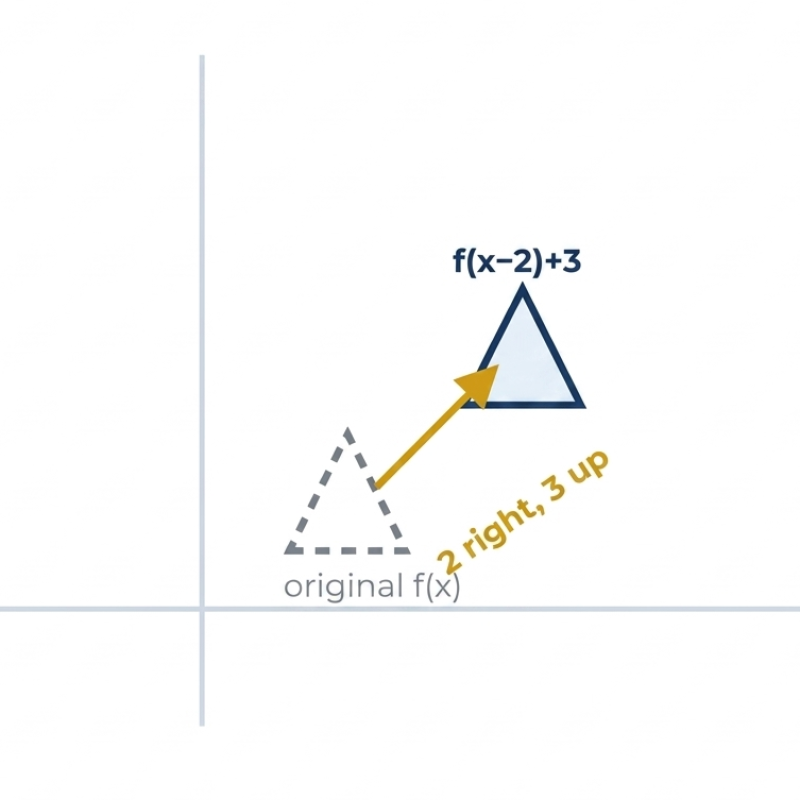
A rigid transformation that slides a graph horizontally or vertically without changing its size or orientation. Every point on the graph moves the exact same distance in the same direction, the shape is identical, only its position changes.
Moves the graph left or right along the x-axis controlled inside the parenthesis.
Moves the graph up or down along the y-axis controlled outside the parenthesis.
Three rules cover every translation question on the SAT and ACT – for the calculator and non-calculator sections alike.
Inside the parenthesis. A change to the input x moves the graph along the x-axis in the opposite direction of the sign.
Outside the parenthesis. Adding or subtracting from the whole function moves the graph along the y-axis in the same direction as the sign.
Diagonal movement. Combine the two: parent f(x) → f(x − 2) + 3 shifts the graph 2 units right and 3 units up at once.
The horizontal direction is counter-intuitive. Inside the parenthesis, always think the opposite sign: f(x − 4) moves right 4 (not left). Why? Setting the input to zero, x − 4 = 0, gives x = 4 the graph's reference point lands on the positive side.
Describe the translation. The graph of g(x) = f(x − 4) + 2 is a translation of f(x). Which way, and how far?
The most common error: reading "x − 4" as a shift left. Inside the parenthesis, the sign is reversed.
Write the equation. The parent function f(x) is shifted 3 units left and 5 units down. Write the new function.
Changes inside f(x) affect the horizontal (x) axis; changes outside affect the vertical (y) axis.
Fix: inside the parenthesis = left/right; outside = up/down.
A positive number in the grouped input (x − h) moves the function right, not left.
Fix: inside the parenthesis, flip the sign subtract = right, add = left.
A horizontal shift changes the x-values inside the function f(x − h) or f(x + h) moving the graph left or right. A vertical shift adds or subtracts from the entire function f(x) + k or f(x) − k moving the graph up or down.
Because setting the input to zero (e.g. x − h = 0) isolates the offset, x = h, which moves the graph's reference point to the positive side. So f(x − h) a subtraction actually shifts the graph right by h.
Yes graph-shifting rules are highly useful on both the calculator and non-calculator sections of the SAT and ACT. Function transformations appear frequently and are an easy way to pick up points once the three rules are automatic.