
Trigonometric ratios (trig ratios) define the relationship between the angles and side lengths of a right triangle. The three primary trig ratios are remembered using SOH-CAH-TOA: Sine = Opposite / Hypotenuse, Cosine = Adjacent / Hypotenuse, Tangent = Opposite / Adjacent. These ratios are foundational in Florida MAFS Geometry standards (MAFS.912.G-SRT) and appear on the SAT Math “Additional Topics in Math” section.
Trigonometric ratios define the relationship between the angles and side lengths of a right triangle. The three primary ratios are remembered with SOH-CAH-TOA: sine = opposite/hypotenuse, cosine = adjacent/hypotenuse, tangent = opposite/adjacent.
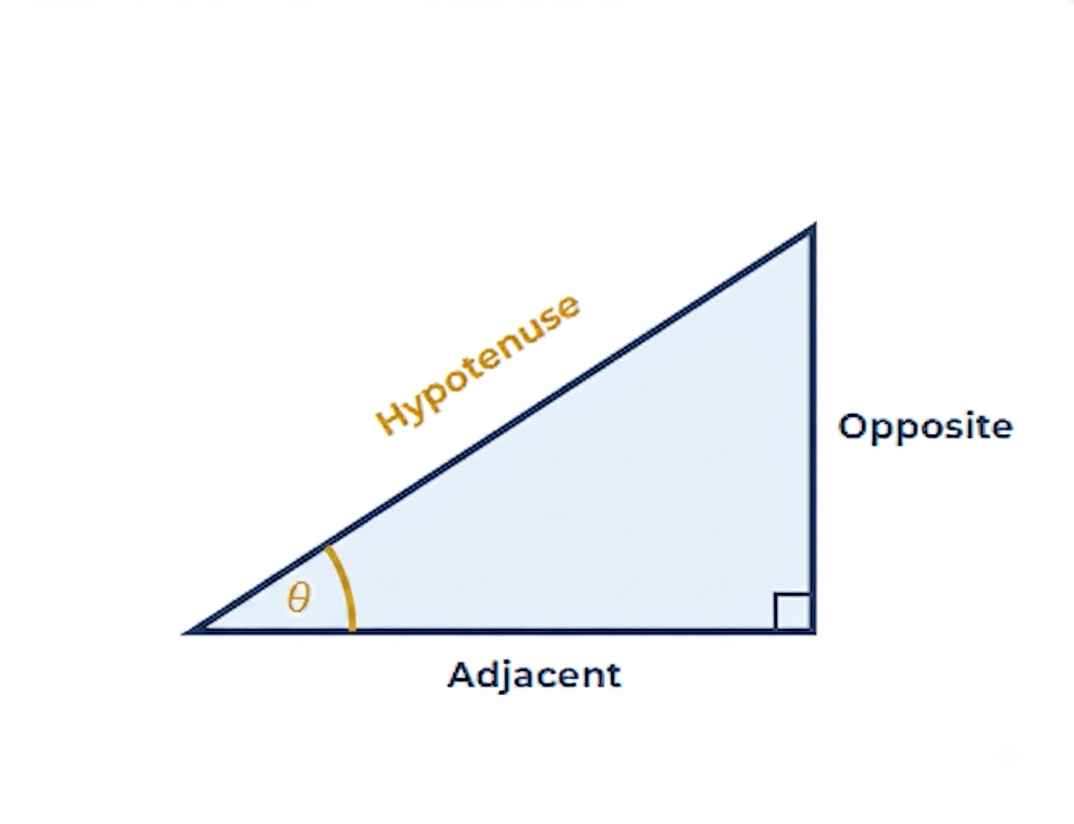
Ratios of side lengths in a right triangle that correspond to a specific angle. Relative to an acute angle, every right triangle has an opposite side (facing the angle), an adjacent side (next to the angle), and the hypotenuse (the longest side, opposite the 90° angle). Sine, cosine, and tangent each compare two of these three sides.
Each syllable is a ratio: SOH = Sine, CAH = Cosine, TOA = Tangent. The SAT tests them individually and combined.
sin(θ) = O / H
Opposite ÷ Hypotenuse. SAT: "sin(A) = 3/5, find cos(A)" → O = 3, H = 5, Pythagorean gives A = 4, so cos = 4/5.
cos(θ) = A / H
Adjacent ÷ Hypotenuse. Key: sin(θ) = cos(90°–θ). Frequent SAT trap: "sin(30°) = cos(?)" → cos(60°).
tan(θ) = O / A
Opposite ÷ Adjacent. Identity: tan(θ) = sin(θ)/cos(θ); undefined when cos(θ) = 0. Used for heights via angles of elevation.
Opposite ≈ 5.74 units
θ ≈ 16.3°
m + n = 5 + 13 = 18
Used so often that they should be memorized, or derived from the 30-60-90 and 45-45-90 triangles. Knowing them cold saves 30–60 seconds per SAT question.
| ANGLE θ | SIN θ | COS θ | TAN θ |
|---|---|---|---|
| 0° | 0 | 1 | 0 |
| 30° | 1/2 | √3/2 | 1/√3 = √3/3 |
| 45° | √2/2 | √2/2 | 1 |
| 60° | √3/2 | 1/2 | √3 |
| 90° | 1 | 0 | Undefined |
Memory trick: for sin(0°, 30°, 45°, 60°, 90°), the values follow √0/2, √1/2, √2/2, √3/2, √4/2 — which simplify to 0, 1/2, √2/2, √3/2, 1. For cosine, the same pattern runs in reverse. Many students find this far easier than memorizing each value independently.
Trig appears in “Additional Topics in Math”, about 10% of SAT Math. The SAT provides the two special triangles, but not the SOH-CAH-TOA definitions, so memorizing them is a real time advantage.
| SAT Question Type | What It Tests | Frequency |
|---|---|---|
| Basic Trig Ratio | Given a labeled right triangle, find sin/cos/tan of an angle | 2–3 per test |
| Complementary Angles | sin(θ) = cos(90°–θ) — the "sin(30°) = cos(?)" format | 1–2 per test |
| Special Angle Values | Exact sin/cos/tan of 30°, 45°, 60° without a calculator | 1 per test |
| Multi-Step Trig + Pythagorean | Find one side with trig, another with Pythagorean — or a second ratio from a given one | 1 per test |
"Opposite" and "adjacent" are relative to the angle in use, not fixed to a side.
Fix: re-label for each new reference angle. The hypotenuse never changes; opposite and adjacent do.
tan⁻¹(x) is the inverse tangent (arctan) — the angle whose tangent is x — not the reciprocal.
Fix: the -1 in sin⁻¹/cos⁻¹/tan⁻¹ means "inverse function." For a reciprocal, write 1/tan or cot.
Reaching for sin on every problem because SOH is memorized first.
Fix: identify the two known/needed sides first. O&H → sin, A&H → cos, O&A → tan.
Writing the hypotenuse on top under time pressure.
Fix: "over" means the named side is on top. Cross-check: sin and cos are always ≤ 1, so a result > 1 is upside-down.
Try each problem before revealing the answer.
Angle B = 52°, the side adjacent to B = 9 cm. Find the hypotenuse.
Adjacent & Hypotenuse → CAH: cos(52°) = 9/H → H = 9/cos(52°) = 9/0.6157 ≈ 14.62 cm.
If sin(x°) = cos(42°), what is x?
sin(θ) = cos(90°–θ) → x = 90 – 42 = 48. The complementary-angle identity — a frequent SAT type.
In a right triangle, cos(A) = 8/17. What is tan(A)?
cos(A) = 8/17. Pythagorean: Opposite² = 17² – 8² = 225 → Opposite = 15. tan(A) = 15/8.
A mnemonic for the three primary trig ratios: SOH = Sine = Opposite/Hypotenuse; CAH = Cosine = Adjacent/Hypotenuse; TOA = Tangent = Opposite/Adjacent. Each syllable uses the first letter of each term in the formula.
The hypotenuse (longest side, opposite the 90° angle), the opposite side (across from the reference angle), and the adjacent side (next to the reference angle, not the hypotenuse). Opposite and adjacent change depending on which acute angle you reference.
Yes — in "Additional Topics in Math," about 10% of SAT Math. The SAT doesn't provide the SOH-CAH-TOA definitions, so memorize them. Common types: missing side/angle, the complementary-angle identity sin(θ) = cos(90°−θ), and finding a second ratio from a given one.
sin⁻¹(x) is the inverse sine (arcsin) — the angle whose sine is x; e.g. sin⁻¹(0.5) = 30°. csc(θ) is the cosecant — the reciprocal of sine, 1/sin(θ) = H/O. Completely different operations. Only sin⁻¹, cos⁻¹, tan⁻¹ are tested on the SAT and Florida EOC — not csc, sec, cot.
MAFS.912.G-SRT.C.6 (similarity defines the ratios), C.7 (sine/cosine of complementary angles), and C.8 (use trig ratios and the Pythagorean theorem to solve right triangles). Assessed on the Florida EOC Geometry exam.
Book a free math assessment and get a personalized Digital SAT plan built around your gaps.