
|
Preparing for the SAT? Claim Your Personalized Math Plan →
|
Volume measures the amount of three-dimensional space a solid object occupies, expressed in cubic units (cm³, m³, in³, ft³). The volume formula depends on the shape: rectangular prism: V = l × w × h; cylinder: V = πr²h; cone: V = ⅓πr²h; sphere: V = 4/3πr³. Volume is tested on the SAT Math section and covered in Florida MAFS geometry standards (grades 7–11).
Volume is how much three-dimensional space an object takes up, tested throughout Florida MAFS geometry standards and the SAT Math section. This guide covers all 5 volume formulas you need, from rectangular prisms to spheres.
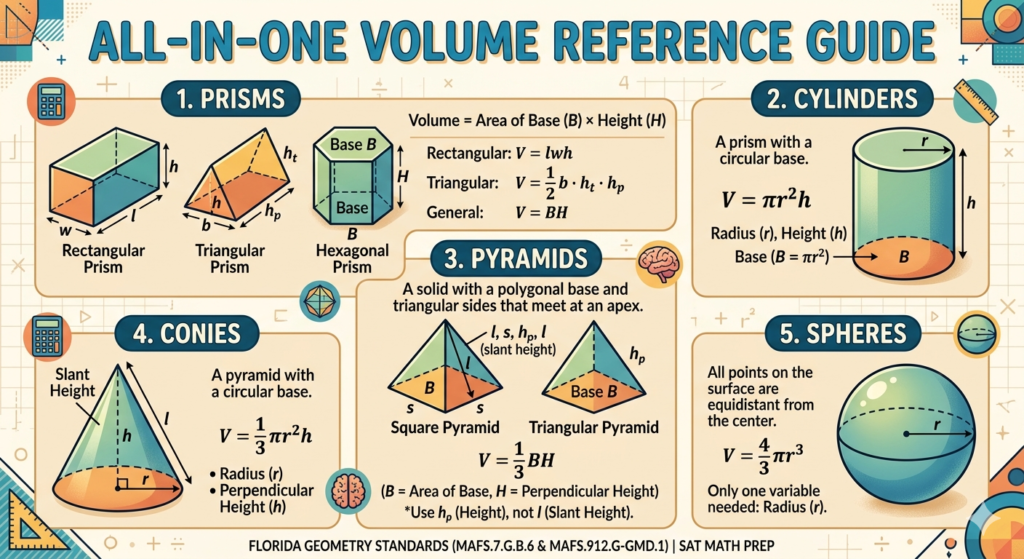
Volume is how much three-dimensional space an object takes up. Unlike area, which measures a flat surface in square units, volume measures the interior of a solid in cubic units. Florida MAFS standards (MAFS.7.G.B.6, MAFS.912.G-GMD.1) expect students to find the volume of prisms, cylinders, pyramids, cones, and spheres, the same shapes the SAT tests.
The formula you use depends on the shape. These five cover every volume question on Florida MAFS and the SAT, learn all five.
SAT volume problems rarely ask you to just plug in numbers, expect to find a missing dimension, compare two volumes, or work out how many smaller containers fit inside a larger one.
SAT reference-sheet reminder: the SAT provides V = πr²h (cylinder), V = ⅓πr²h (cone), and V = 4/3πr³ (sphere). It does NOT provide V = lwh (prism) or V = s³ (cube) — know those cold before test day.
V = 20,000 cm³
V ≈ 942 cm³
240π ≈ 753.98 in³ remains in the cylinder
Every volume answer is in cubic units because volume measures three dimensions at once. Leaving an answer in square units (cm²) is a common Florida MAFS and SAT error.
| Measurement System | Common Volume Units | Conversion |
|---|---|---|
| Metric | cm³, m³, mm³, L, mL | 1 L = 1,000 cm³ |
| US Customary | in³, ft³, yd³ | 1 ft³ = 1,728 in³ |
| Fluid (liquid) | fl oz, cups, gallons | 1 gallon = 231 in³ |
| The Mistake | ✕ Wrong | ✓ Correct |
|---|---|---|
| Using diameter instead of radius in πr²h or ⁴/₃πr³ | V = π(10)²(5) when r = 5 was given | V = π(5)²(5) = 125π — halve the diameter before squaring |
| Forgetting the ⅓ in the cone formula | V = πr²h (cylinder formula on a cone) | V = ⅓πr²h — a cone holds one-third of the cylinder |
| Answering in square units instead of cubic | V = 200 cm² (area units) | V = 200 cm³ — volume always uses cubic units |
Work each one, then reveal the answer to check yourself.
A cube has a side length of 7 cm. What is its volume?
A sphere has a radius of 3 in. Find its volume in terms of π.
A cylindrical tank has a diameter of 8 ft and height 15 ft. How many cubic feet of water (nearest whole)?
It depends on the shape: prism V = lwh, cylinder V = πr²h, cone V = ⅓πr²h, sphere V = ⁴/₃πr³. Identify the shape, substitute the dimensions, and solve — always in cubic units. Florida MAFS covers all five from grade 7 through 11.
Yes — cylinders, cones, and spheres, with formulas on the reference sheet. It does not provide V = lwh or V = s³, so memorize those. SAT volume problems are usually multi-step: a missing dimension, comparing volumes, or combining shapes.
Volume measures the space inside (cubic units, cm³); surface area measures the outer surface (square units, cm²). Fill a box with water → volume. Wrap it in paper → surface area. The units tell you which you're calculating.
Because exactly three identical cones (same base and height) fill one cylinder — Cavalieri's Principle (MAFS.912.G-GMD.1). Vcone = ⅓ Vcylinder is the single most important cone fact, and the SAT tests it directly in "fill the cone from the cylinder" problems.
Three steps: (1) write all five formulas from scratch daily for a week; (2) do one worked example per shape until substitution is automatic; (3) practice SAT multi-step problems where you choose the formula first. InLighten's program in Orlando, Winter Park, and Lake Nona structures practice exactly this way.
Book a free math assessment and get a personalized Digital SAT plan built around your gaps.