
|
Preparing for the SAT? Claim Your Personalized Math Plan →
|
Both terms describe how shapes relate to one another, but they have distinct definitions. It comes down to size and shape: congruent shapes are identical in every way, while similar shapes share the same shape and angles but differ in size.
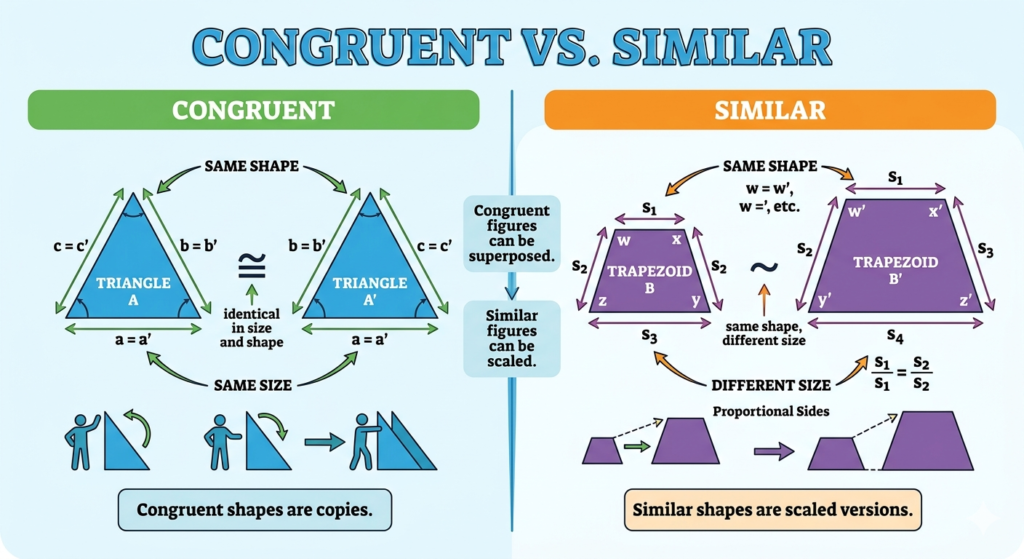
When comparing congruent vs. similar figures, look at three things: angles (equal in both cases), sides (equal for congruent, proportional for similar), and the scale factor. If Triangle A is 3-4-5 and Triangle B is 3-4-5, they’re congruent. If Triangle C is 6-8-10, then A and C are similar — their sides are in a 1:2 ratio.
| Property | Congruent Shapes | Similar Shapes |
|---|---|---|
| Same shape? | ✓ Yes | ✓ Yes |
| Same size? | ✓ Yes | ✕ Not necessarily |
| Corresponding angles | Equal | Equal |
| Corresponding sides | Equal length | Proportional (same ratio) |
| Symbol | ≅ | ~ |
| Can be congruent too? | Already congruent | Only if scale factor = 1 |
| Used to find... | Unknown angles/sides by transfer | Missing sides via proportion / scale factor |
If a pair of triangles satisfies any one of these, they are congruent.
Two shapes are similar when one can be obtained from the other through scaling (expansion or contraction) — possibly with translation, rotation, or reflection. The key numbers are the corresponding angles (always equal) and the scale factor (the ratio between any pair of corresponding sides).
If two shapes are congruent (same size and shape), they automatically qualify as similar — the scale factor is just 1:1. Congruence is a special case of similarity.
If two shapes are only similar (same shape, different sizes), they're not congruent — the scale factor ≠ 1. Every square is similar to every other square, but two squares are only congruent if their sides are the same length.
The SAT uses ≅ for congruent and ~ for similar. If a problem shows ~, you're working with proportions — never assume sides are equal.
For similar triangles, write the ratio first: (Side of A)/(Side of B) = (Side of A')/(Side of B'). Cross-multiply to solve.
Given areas or volumes of similar shapes, the length scale factor ≠ the area factor (square it) or volume factor (cube it).
Congruent shapes are identical in both size and shape. Similar shapes share the same angles and shape, but their sizes differ — their sides are in proportion rather than equal.
Yes. Any two shapes with the same angles but different side lengths are similar but not congruent. All squares are similar to each other, but only squares with equal side lengths are congruent.
No. Congruence is a stricter condition — if two shapes are congruent (same size and shape), they automatically meet the definition of similar. Congruence implies similarity.
The five main criteria are SSS, SAS, ASA, AAS, and HL (for right triangles). If a pair of triangles satisfies any one of these, they are congruent.
Set up a proportion using corresponding sides: (Side 1 of A) / (Side 1 of B) = (Side 2 of A) / (Side 2 of B). Cross-multiply and solve.
Still feeling unsure about when to use congruence proofs versus similarity ratios? Geometry concepts build on each other, and we’re here to help you bridge the gaps.