
|
Preparing for the SAT? Claim Your Personalized Math Plan →
|
A prism is a 3D solid with two identical parallel bases connected by rectangular lateral faces. The volume of a prism is V = Bh, where B is the area of the base and h is the height. The surface area of a prism is SA = 2B + Ph, where P is the perimeter of the base. Prisms are tested on the Florida Geometry EOC (MAFS.912.G-GMD) and the SAT Math “Additional Topics in Math” domain.
A prism is a 3D solid with two identical parallel bases connected by rectangular lateral faces. Volume is V = Bh (B = base area, h = height); surface area is SA = 2B + Ph (P = base perimeter). The name before “prism” tells you the base shape, a triangular prism has a triangular base.
A three-dimensional polyhedron with two congruent, parallel polygonal bases connected by rectangular lateral faces. The base shape names the prism: a rectangular base → rectangular prism, a triangular base → triangular prism, a hexagonal base → hexagonal prism. (In oblique prisms the lateral faces are parallelograms.)
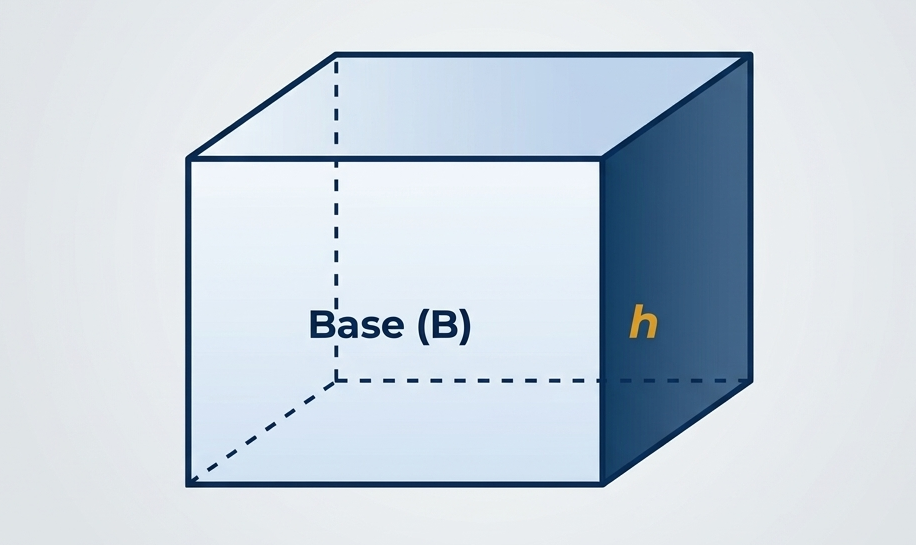
Parts of a prism: every prism has three components used in its formulas — the Base (B), the full area of one base polygon (not a side length); the Height (h), the perpendicular distance between the two bases; and the Perimeter of the base (P), used only in the surface-area formula.
Every prism uses the same two formulas regardless of base shape. The only variable is how you calculate the base area B.
B = base AREA (compute it first — not a side length) · h = perpendicular height. Rectangular: B = l×w. Triangular: B = ½ × base × triangle height.
2B = the two bases (top + bottom) · Ph = lateral area, where P = base perimeter. Open-top container → use B + Ph instead.
SAT efficiency rule: identify the base shape first — always. A "triangular prism lying on its side" still has the triangle as its base, not a rectangular face. Rotating the figure never changes the formula: V = Bh and SA = 2B + Ph apply in any orientation. Find B first, then compute.
The base polygon determines the type and how you compute B.
Base is a rectangle; six rectangular faces. The most common prism (boxes). B = l × w, so V = l × w × h.
Two triangular bases joined by three rectangular faces. B = ½ × base × triangle height — find the triangle's height first (Pythagorean theorem if only sides are given).
Two hexagonal bases and six rectangular faces. For a regular hexagon with side s, B = (3√3 / 2)s². Then V = Bh as usual.
A right prism has lateral faces perpendicular to its bases (straight up). An oblique prism is tilted — lateral faces are parallelograms. V = Bh still uses the perpendicular height for both.
Usually one volume or surface-area question per test. Students who know V = Bh and SA = 2B + Ph answer in under 90 seconds; those who confuse B with a base side length lose 3–4 minutes and still miss it.
| SAT QUESTION TYPE | HOW PRISMS APPEAR | FREQUENCY |
|---|---|---|
| Volume given dimensions | Straightforward V = Bh — identify the base, compute B, multiply by h | Most common |
| Find a missing dimension | Volume given, one dimension missing — rearrange V = Bh to solve | Common |
| Surface area | SA = 2B + Ph — needs both base area and base perimeter | Occasional |
| Density / rate | Volume × density = mass, or volume for fill rate — needs the correct volume first | Occasional |
Substituting one base side into V = Bh instead of the full base area — e.g., V = 8 × 4 instead of (8 × 5) × 4.
Fix: always compute B as a separate step. Write B = ___ first, then V = B × h.
Confusing the triangle's height (for B = ½·base·h) with the prism's length (for Ph).
Fix: label them h_triangle and h_prism explicitly — never just "h" when two heights appear.
Computing Ph correctly but omitting 2B, reporting only the lateral area as total SA.
Fix: default to SA = 2B + Ph; use B + Ph only if the problem says the prism is open at the top.
Using a tilted lateral edge as h in V = Bh.
Fix: h must be the perpendicular distance between bases — usually a labeled dashed line inside the figure, not the slant edge.
Work each one, then reveal the answer to check yourself.
Find the volume of a rectangular prism with length 12 cm, width 7 cm, height 3 cm.
A triangular prism has a right-triangle base with legs 6 cm and 8 cm. The prism is 15 cm long. Find the volume.
Find the surface area of a rectangular prism with l = 5 cm, w = 4 cm, h = 3 cm.
A rectangular prism has volume 480 cm³. The base is 8 cm by 6 cm. Find the height.
A 3D polyhedron with two congruent, parallel polygonal bases connected by rectangular lateral faces. The base shape names the type (rectangular, triangular, hexagonal). Prisms are "right" (faces perpendicular to bases) or "oblique" (tilted). Tested on the Florida Geometry EOC (MAFS.912.G-GMD) and SAT "Additional Topics in Math."
V = Bh, where B is the base AREA (the full polygon area, not a side length) and h is the perpendicular height. For a rectangular prism V = l × w × h; for a triangular prism V = (½ × base × triangle height) × prism length. The same V = Bh applies to every prism, only B changes.
SA = 2B + Ph, where B is the base area, P is the base perimeter, and h is the prism height. 2B is the two bases; Ph is the combined lateral faces. If the prism is open at the top, use B + Ph instead.
When the triangular base's height isn't given directly, only the side lengths. To find B = ½ × base × height, you need that height. For a right triangle, a leg is the height; for equilateral/isosceles with only sides given, use the Pythagorean theorem to find the height before computing B.
Yes, rectangular and triangular prism volume and surface area, the base-area vs. side-length distinction, and the oblique-prism height trap. We align every session with Florida MAFS standards and EOC formats. Most students improve on geometry within 2–3 sessions. Book a free assessment to find where points are being lost.
Book a free math assessment and get a personalized Digital SAT plan built around your gaps.