
|
Preparing for the SAT? Claim Your Personalized Math Plan →
|
Standard deviation (symbol: σ for a population, s for a sample) measures how spread out a set of data values are from their mean. A low standard deviation means values are clustered close to the average; a high standard deviation means values are widely spread. The formula is σ = √(Σ(x − μ)² / N). Standard deviation is a core concept in Florida MAFS statistics standards and is tested on the SAT Math “Problem Solving and Data Analysis” section.
Standard deviation (σ for a population, s for a sample) measures how spread out a data set is from its mean. Low σ → values cluster near the average; high σ → values are widely spread. A core Florida MAFS statistics concept and an SAT “Problem Solving & Data Analysis” staple.
Our expert math tutors are currently recording a step-by-step video breakdown for this topic. Check back soon for visual examples and SAT test-taking strategies!
Standard deviation is the typical distance of a value from the mean. There are two formulas, which one you use depends on whether your data is the whole population or just a sample.
Divide by N The full count. Use when the data IS the entire population.
SAT cue: "the entire class scored..." → use σ, divide by N.
Divide by N - 1 Bessel's correction (removes bias). Use for a sample drawn from a larger population.
SAT cue: a random sample/survey → use s, divide by N - 1. More common on the SAT.
Add all values and divide by the count N.
Compute (x - μ) for every point. Some will be negative expected.
Compute (x - μ)² . Squaring removes negative signs and emphasizes large deviations.
Sum the squared differences, then divide by N (population) or N - 1 (sample). This is the variance, σ².
√(variance) = standard deviation. This returns the answer to the original units of the data.
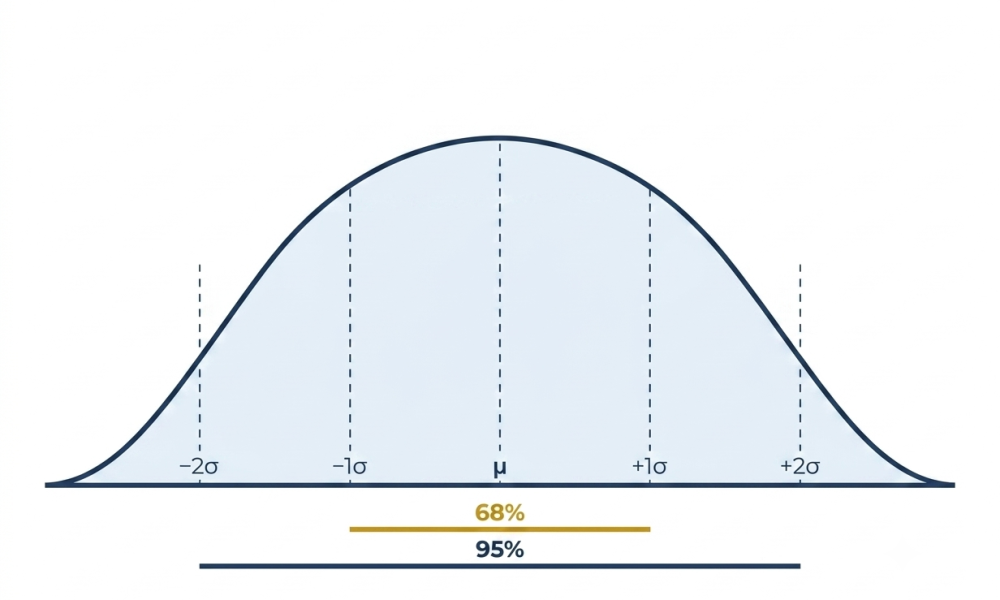
For approximately normal (bell-shaped) data, the empirical rule tells you what share of values falls within 1, 2, and 3 standard deviations of the mean.
The SAT does not ask you to calculate σ by hand. It tests whether you can interpret it, comparing two data sets, predicting the effect of adding or scaling values, and reading the spread of a histogram.
Survey or random-sample data must divide by N – 1; using N underestimates the true spread.
Fix: "sample" → N – 1; "population" → N. Read which one the problem states.
Summing (x – μ) directly always gives zero the positive and negative deviations cancel.
Fix: immediately square each difference, (x – μ)². The squaring is what prevents cancellation.
Variance = σ² (the mean of squared differences). Standard deviation = √variance.
Fix: always take the square root. If the units don't match the data, you stopped at variance.
Add 10 to every value → mean +10, but SD unchanged. Students wrongly pick "both increase."
Fix: adding shifts uniformly (SD same); only multiplying scales SD.
Work each one, then reveal the answer to check yourself.
It measures how spread out data values are from the mean. Low SD → values cluster near the average; high SD → values spread widely. Think of it as the "typical distance from the average" — the larger the number, the more variable the data.
Population σ is used when the data includes every member of the group — divide by N. Sample s is used for a random sample of a larger population — divide by N - 1 (Bessel's correction). On the SAT, sample SD (N - 1) is more common because most survey/experiment problems involve sampling.
No — it tests interpretation, not hand calculation. You'll compare which of two data sets has a greater SD, predict how adding or multiplying a constant affects it, or read the spread of a histogram. Understanding what SD means matters more than the formula here.
For normally distributed (bell-shaped) data: about 68% of values fall within 1 SD of the mean, 95% within 2 SD, and 99.7% within 3 SD. It applies when the data is approximately normal — usually stated or implied in SAT and Florida EOC problems that use it.
Yes — MAFS.912.S-ID.A.2 (use statistics appropriate to the shape of the distribution to compare center and spread) and S-ID.A.3 (interpret differences in shape, center, and spread in context). These appear in Algebra 2, Precalculus, and AP Statistics, and on Florida EOC and FSA assessments.
Book a free math assessment and get a personalized Digital SAT plan built around your gaps.