|
Preparing for the SAT? Claim Your Personalized Math Plan →
|
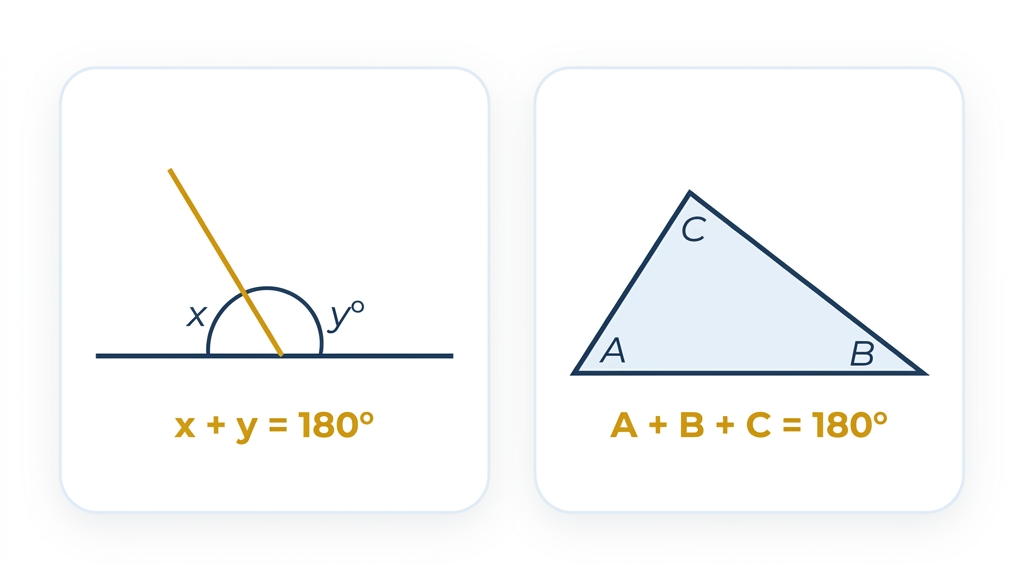
In geometry, 180 degrees is a fundamental measurement that appears in five key rules: a straight angle equals 180°; supplementary angles are any two angles that sum to 180°; the three interior angles of any triangle sum to 180°; a linear pair of adjacent angles sums to 180°; and co-interior angles formed by a transversal crossing parallel lines sum to 180°. These rules are tested throughout Florida MAFS geometry standards and the SAT Math section.
180∘
Every time a geometry problem involves angles that “add up to 180,” one of the five rules below is being applied. Knowing which rule applies to which diagram — and what conditions must be met — is the skill that separates a geometry student who guesses from one who solves with confidence on Florida assessments and the SAT.
A straight line forms a straight angle of exactly 180°.
Condition: the angle must lie entirely on a straight line – no bends, no curves.
Example: if a ray divides a straight line into two parts of x° and y°, then x + y = 180°.
A straight angle is always 180° – it is not a range. It is the definition of a straight line in degrees.
Two angles are supplementary if their measures sum to exactly 180°.
They do NOT need to be adjacent – supplementary angles can be in completely different locations on the diagram.
Example: 65° and 115° are supplementary (65 + 115 = 180).
The three interior angles of ANY triangle – equilateral, isosceles, scalene, right, obtuse – always sum to exactly 180°.
Use when: finding the missing angle in a triangle: missing angle = 180° – (sum of the other two).
Example: triangle with 55° and 70° → missing angle = 180 – 55 – 70 = 55°.
A linear pair is two adjacent angles that together form a straight line. They always sum to 180°.
Condition: the angles must share a vertex AND a side, and their non-shared sides must form a straight line.
Every linear pair is supplementary – but not every supplementary pair is a linear pair (they don't need to be adjacent).
When a transversal crosses two parallel lines, co-interior angles (also called consecutive interior angles or same-side interior angles) sum to 180°.
Condition: lines must be PARALLEL. If not parallel, co-interior angles do NOT sum to 180°.
⚡ SAT: this condition (parallel lines required) is the most common co-interior angle trap.
Angle relationships involving 180° are among the most tested geometry concepts on the SAT Math section — appearing in the Additional Topics in Math category. The SAT tests 180° rules through algebraic setups (as in Example 2 above), parallel line diagrams, and exterior angle theorem problems. Most SAT geometry questions involving 180° require students to set up an equation, solve for x, and then substitute — making algebra and geometry inseparable on the exam. InLighten’s certified SAT Math tutors in Orlando target these exact question types in every geometry prep session.
| SAT Math Category | How 180° Appears | Frequency |
|---|---|---|
| Geometry — Angle Relationships | Supplementary angles in algebraic setup; find x given angle expressions | 1–2 per test |
| Geometry — Triangles | Triangle angle sum theorem; find missing angle or solve for x | 1–2 per test |
| Geometry — Parallel Lines | Co-interior angles (sum = 180°); identify angle relationships with transversal | 1 per test |
| Geometry — Exterior Angles | Exterior angle = sum of two non-adjacent interior angles; multi-step algebra | 1 per 2 tests |
Understanding where 180° fits in the full range of angle measurements requires knowing all angle types. Each type below is defined by its degree range — and 180° sits exactly at the boundary between obtuse angles and reflex angles, as a straight angle.
| Angle Type | Definition & Degree Range | Connection to 180° |
|---|---|---|
| Acute Angle | An angle measuring between 0° and 90° (not including 0° or 90°). Example: 45°, 72°, 89°. All angles of an acute triangle are acute. Acute angles are always less than 90°. | An acute angle is always less than half of 180°. Two acute angles can be supplementary only if they each equal exactly 90° – which makes them right angles, not acute. An acute angle's supplement is always obtuse. |
| Right Angle | An angle measuring exactly 90°. Formed by two perpendicular lines. Marked with a small square in diagrams. A right angle is the supplement of another right angle (90 + 90 = 180°). | Two right angles are supplementary. A right angle is exactly half of 180°. In a right triangle, the right angle takes up 90° of the 180° triangle sum – leaving 90° split between the other two angles. |
| Obtuse Angle | An angle measuring between 90° and 180° (not including 90° or 180°). Example: 91°, 120°, 179°. A triangle can have at most one obtuse angle. | An obtuse angle's supplement is always an acute angle (because obtuse > 90°, its supplement = 180° – obtuse, which is less than 90°, making it acute). On the SAT, "find the supplement of a 130° angle" = 50° – an acute result. |
| Straight Angle | An angle measuring exactly 180°. It forms a perfectly straight line. A straight angle is the largest angle that is NOT a reflex angle. It is both its own supplement (180 + 0 = 180°) and the definition of a straight line. | This is the central angle type on this page. Every supplementary pair, linear pair, and the triangle angle sum theorem all derive from the definition of a straight angle being 180°. Understanding why 180° = straight line is understanding all five rules simultaneously. |
| Reflex Angle | An angle measuring between 180° and 360°. Example: 200°, 270°, 359°. A reflex angle "wraps around" beyond a straight line. Reflex angles do not appear in standard triangle geometry but do appear in polygon problems and circle theorems. | A reflex angle is always greater than 180° – it is the part of a rotation that exceeds a straight line. On the SAT, a reflex angle appears in problems about "the larger angle formed by two rays" – students who draw the smaller angle get the wrong answer. |
| Shape | Sides (n) | Formula | Angle Sum |
|---|---|---|---|
| Triangle | 3 | (3-2)×180 | 180° |
| Quadrilateral | 4 | (4-2)×180 | 360° |
| Pentagon | 5 | (5-2)×180 | 540° |
| Hexagon | 6 | (6-2)×180 | 720° |
| Octagon | 8 | (8-2)×180 | 1,080° |
Triangles are also the faces of many 3D shapes — prisms, pyramids, and tetrahedra. Understanding triangle angle properties is a prerequisite for calculating the surface area of these shapes. See our surface area geometry guide → for how triangle faces contribute to 3D solid surface area calculations.
Several types of angle pairs add up to 180 degrees. Supplementary angles are any two angles that sum to 180° — they do not need to be adjacent. A linear pair is two adjacent angles that form a straight line — they always sum to 180°. Co-interior angles (same-side interior angles) formed by a transversal crossing two parallel lines also sum to 180°. These rules appear in Florida MAFS geometry standards MAFS.7.G.B.5 and MAFS.8.G.A.5.
The three interior angles of any triangle sum to 180° because of the triangle angle sum theorem — a geometric proof derived from the properties of parallel lines and straight angles. If you extend one side of a triangle and draw a line through the opposite vertex parallel to the extended side, the three angles rearrange to form a straight line (180°). This works for every triangle — equilateral, isosceles, scalene, right, and obtuse — without exception. Verified by the SAT Math reference sheet, which includes this theorem.
Supplementary angles sum to 180°; complementary angles sum to 90°. The easiest mnemonic: “C comes before S in the alphabet, and 90 comes before 180” — Complementary = 90°, Supplementary = 180°. Another: “S for Supplementary, S for Straight line (180°).” On geometry tests, “find the supplement of 75°” = 105° (180 − 75); “find the complement of 75°” = 15° (90 − 75).
The interior angle sum of any polygon with n sides equals (n − 2) × 180°. This formula works because every polygon can be divided into (n − 2) triangles, and each triangle contributes 180° to the total. Triangle: (3−2)×180 = 180°. Quadrilateral: (4−2)×180 = 360°. Pentagon: 540°. Hexagon: 720°. On the SAT, polygon angle sum problems appear in the Additional Topics category and require setting up an equation using this formula.
Yes. InLighten’s certified math tutors in Orlando cover all geometry angle concepts — supplementary and complementary angles, triangle angle sum theorem, linear pairs, co-interior angle rules, and the exterior angle theorem — including the specific SAT Math question types that most students miss. Our diagnostic-first approach identifies exactly which angle rules are costing your student points before building a targeted session plan around those specific gaps. Book a free geometry assessment to start.
Knowing the 180° rules is one thing — applying the right rule to the right diagram, setting up the equation correctly, and not confusing supplementary with complementary under exam pressure is another. InLighten’s certified math tutors in Orlando diagnose exactly which geometry angle problems are costing your student points — whether it’s the co-interior angle condition, the exterior angle theorem, or a simple supplementary vs complementary mix-up — then build targeted sessions around those specific gaps. Most students see geometry grade improvement within 3 sessions. Florida Bright Futures and NCAA eligibility score requirements depend on geometry performance in exactly these areas.