
|
Preparing for the SAT? Claim Your Personalized Math Plan →
|
A circle is a closed curve where every point is the same distance from the center. That distance is the radius (r); twice the radius is the diameter (d = 2r). The area of a circle is A = πr² and the circumference is C = 2πr. Circles appear throughout Florida geometry standards (MAFS.912.G-C) and account for 5–8 questions on the SAT Math section — the highest single-topic frequency in geometry.
A circle is a closed curve where every point is the same distance from the center. That distance is the radius (r); twice the radius is the diameter (d = 2r). Area is A = πr² and circumference is C = 2πr. Circles are the highest-frequency geometry topic on the SAT, 5–8 questions per test.
Every SAT and FSA circle problem uses this vocabulary. Knowing a chord from a secant, or an arc from a sector, lets you read the diagram before you calculate.
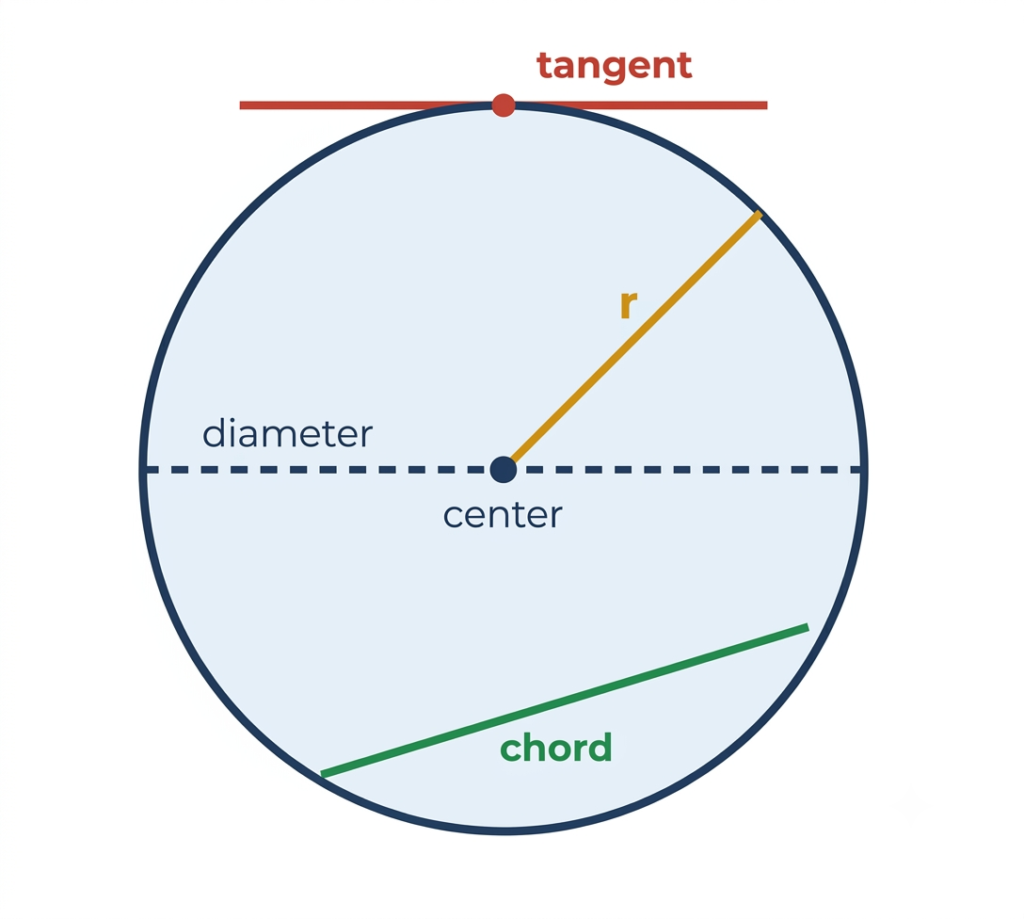
Center to circle. r = d ÷ 2 in every formula.
Across through center. d = 2r the longest chord.
Connects two points on the circle; does not pass through center.
Part of the circumference. Minor < 180° · Major > 180°.
"Pie slice": two radii + arc. (θ/360) × πr2
Between a chord and its arc. Sector area – triangle area.
Touches at exactly 1 point. Always ⊥ to radius there.
Crosses at 2 points, extends outside. SAT: Power of a Point.
Area and circumference are provided on the SAT reference sheet. Both use r, not d, always identify the radius first.
Identify r (halve d if needed), square it, multiply by π. Leave in terms of π unless asked for a decimal.
Two equivalent forms. Use C = πd when the diameter is given directly; C = 2πr when given the radius.
If answer choices contain π, leave it exact (25π). If they're decimals, use the calculator's π button not 3.14.
The SAT provides only area and circumference. These four are tested in the Medium–Hard tier and account for 3–5 of every test’s circle questions, but you must memorize them.
A fraction of the circumference: θ = 90° → ¼ of the way around. θ = central angle in degrees.
Same fraction logic, applied to the full area. Trap: using the inscribed angle (half) gives ½ the answer.
Vertex on the circle. Corollary: an inscribed angle intercepting a diameter = 90°, appears on nearly every form.
Meets the radius at 90° at the point of tangency, creating a right triangle. See our guide to the Pythagorean Theorem for the full right-triangle procedure.
Diameter given. A circle has diameter 10 cm. Find area and circumference in terms of π.
Area = 25π cm2 · Circumference = 10π cm
Arc length (word problem). A circular track has radius 60 m. A runner covers an arc subtending a 120° central angle. How long is the arc?
Arc length = 40π m ≈ 125.7 m
Inscribed angle + sector (SAT). In a circle of radius 6, an inscribed angle measures 35°. Find its intercepted arc, then the sector area for the central angle intercepting that arc.
Intercepted arc = 70° · Sector area = 7π
Circle geometry is the single most-tested geometry topic on the SAT, 5–8 questions per exam in “Additional Topics in Math.” The four un-provided formulas are where most points are lost; mastering circles can add 40–60 Math points.
| CIRCLE TOPIC | SAT FREQUENCY | ON REF SHEET? | DIFFICULTY |
|---|---|---|---|
| Area (A = πr2) | 2–3 per test | ✓ Provided | Easy Medium |
| Circumference (C = 2πr) | 1–2 per test | ✓ Provided | Easy |
| Arc Length | 1–2 per test | ✗ Not provided | Medium Hard |
| Sector Area | 1–2 per test | ✗ Not provided | Medium Hard |
| Inscribed Angle Theorem | 1 per test | ✗ Not provided | Hard |
| Tangent Line Properties | 1 per test | ✗ Not provided | Medium Hard |
The #1 circle error. Diagrams label the diameter; substituting it gives an answer 4x too large.
Fix: circle the radius on the diagram; write r = d ÷ 2 before substituting. r2 = (d/2)2, not d2.
Arc length and sector area use the central angle not the inscribed angle. Using the inscribed angle gives exactly half.
Fix: check if the angle's vertex is ON the circle (inscribed) or AT the center (central). If inscribed, double it first.
"25π" and "78.54" aren't interchangeable. A decimal won't match a π answer choice exactly.
Fix: scan the choices first. π present stay exact. Decimals use the calculator's π button, not 3.14.
A tangent meeting a radius forms a right angle and a right triangle students miss.
Fix: whenever a tangent appears, draw the radius to the contact point and mark 90°. Then use Pythagoras.
Work each one, then reveal the answer to check yourself.
A circle has a diameter of 14 inches. Find its area, in terms of π.
A wheel has a circumference of 36π cm. Find its radius, then its area.
A circle with radius 9 has a central angle of 80°. Find the arc length and sector area (in terms of π).
An inscribed angle measures 42°. Find the central angle intercepting the same arc. If r = 5, find that sector's area.
A = πr2, where r is the radius (the distance from the center to any point on the circle). If you're given the diameter, halve it first, then square and multiply by π. Leave the answer in terms of π (e.g., 25π) unless a decimal is requested. The area formula is provided on the SAT Math reference sheet.
C = 2πr (using the radius) or equivalently C = πd (using the diameter, where d = 2r). Both give the same result; use C = πd when the diameter is given directly. Circumference is provided on the SAT reference sheet. On the Florida FSA EOC, use the calculator's π button rather than 3.14.
The SAT provides only area (πr2) and circumference (2πr). Four more are tested but not provided: arc length = (θ/360)×2πr, sector area = (θ/360)×πr2, the Inscribed Angle Theorem (inscribed = ½ central), and the Tangent, Radius property (tangent ⊥ radius, forming a right triangle). These account for 3 to 5 of every test's 5 to 8 circle questions: memorize them.
An inscribed angle (vertex on the circle, sides are chords) is exactly half the central angle intercepting the same arc: inscribed = ½ × central. Special case: an inscribed angle intercepting a diameter (semicircle) always equals 90°, creating a right angle. It's in the Hard tier of SAT circle problems and in Florida MAFS.912.G-C.3.
Yes: area, circumference, arc length, sector area, the Inscribed Angle Theorem, and tangent, radius problems, at the level of the Florida FSA EOC Geometry exam and the SAT. We identify exactly which formulas and theorems your student is missing before building a targeted plan. Circle geometry (the highest frequency geometry topic on the SAT) is a priority module for students targeting competitive score thresholds. Book a free geometry assessment to start.
Book a free math assessment and get a personalized Digital SAT plan built around your gaps.