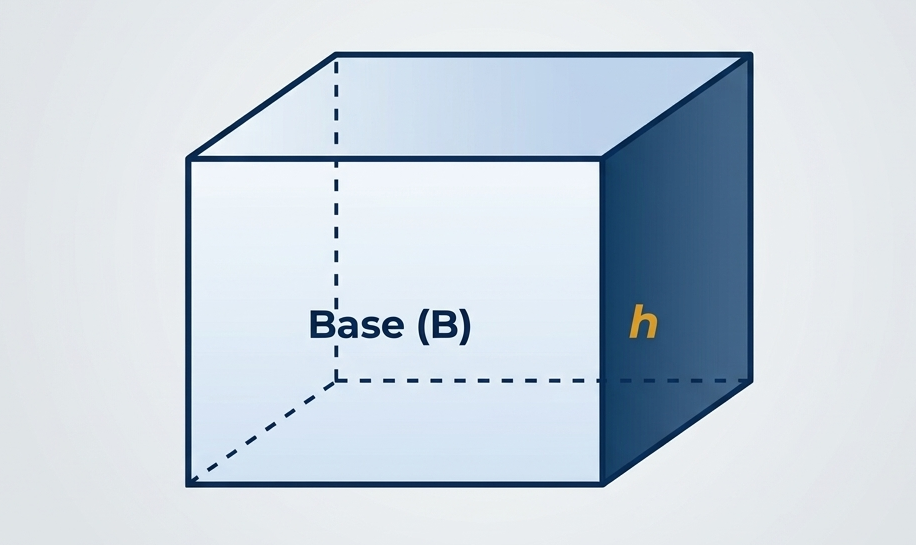
prism is a 3D solid with two identical parallel bases connected by rectangular lateral faces. The volume of a prism is V = Bh, where B is the area of the base and h is the height. The surface area of a prism is SA = 2B + Ph, where P is the perimeter of the base. Prisms are tested on the Florida Geometry EOC (MAFS.912.G-GMD) and the SAT Math “Additional Topics in Math” domain.

"Prism" Explained

A 3d shape where whatever comes before the word prism tells you the shape of the base stretched straight up with a height.
Ex. A “circular prism” is like a tube.
A circle with a straight height.

Prisms in Geometry — Volume, Surface Area & Types Explained

Formal definition: A prism is a three-dimensional geometric solid (a polyhedron) with two congruent, parallel bases connected by rectangular lateral faces. The shape of the base determines the type of prism: a rectangular base makes a rectangular prism, a triangular base makes a triangular prism, a hexagonal base makes a hexagonal prism, and so on. The lateral faces of any prism are always rectangles (or parallelograms in oblique prisms).

PRISM
Parts of a prism: Every prism has three measurable components used in its formulas: (1) the Base (B) — the area of one of the two congruent parallel faces (not a single side length, but the full area of the polygon that forms the base); (2) the Height (h) — the perpendicular distance between the two bases; and (3) the Perimeter of the base (P) — the total length of all sides of the base polygon, used only in the surface area formula.
Where you’ll see it: Prisms are tested on the Florida Geometry EOC assessment under MAFS.912.G-GMD.1 standards, on the Florida FSA, and in the SAT Math “Additional Topics in Math” domain. 3D geometry problems involving prism volume and surface area appear in every Florida Geometry course and on both the SAT and ACT.

Prism Formulas — Volume and Surface Area

Every prism uses the same two formulas regardless of the shape of its base. The volume formula requires only the base area and the height. The surface area formula requires the base area, the base perimeter, and the height. Knowing how to calculate the base area for different polygon shapes (rectangle, triangle, hexagon) is the prerequisite skill — the prism formulas themselves are always V = Bh and SA = 2B + Ph.
📐 VOLUME OF A PRISM

V = Bh

B = the AREA of the base polygon (not a side length)
h = the height of the prism (perpendicular distance between bases)

Critical note: B is the base AREA – calculate it first using the appropriate polygon area formula before multiplying by h. The most common error is substituting a single base side length for B.

📐 VOLUME BY PRISM TYPE

Rect: l × w × h  ·  Tri: (½bh_base) × h

Rectangular prism: V = length × width × height (B = l × w)

Triangular prism: V = (½ × base × height of triangle) × prism height. Note: h_base is the height of the triangular face; h is the length of the prism.

Any prism: Find the base polygon area first, then multiply by prism height.

SURFACE AREA OF A PRISM

SA = 2B + Ph

B = base area  ·  P = perimeter of the base  ·  h = prism height

2B = the two identical bases (top + bottom)
Ph = the lateral surface area (all the rectangular side faces combined)

To find SA: (1) Calculate B. (2) Calculate P. (3) Multiply P × h for lateral area. (4) Add 2B + Ph.

SAT EFFICIENCY RULE

Identify base shape first – ALWAYS

On the SAT, prism problems always start with identifying which face is the base. A "triangular prism lying on its side" has a triangular cross-section as the base – not a rectangular face.

SAT trap: rotating the prism in the diagram does not change the formula – V = Bh and SA = 2B + Ph apply in any orientation. Identify B first, then compute.

Prisms in Geometry — 3 Worked Examples

EXAMPLE 1 – RECTANGULAR PRISM VOLUME EASY

Find the volume of a rectangular prism with length 8 cm, width 5 cm, and height 4 cm.

Step 1: Identify the base shape → rectangle with l = 8 cm, w = 5 cm

Step 2: Calculate the base area B → B = l × w = 8 × 5 = 40 cm²

Step 3: Apply V = Bh → V = 40 × 4 = 160

Step 4: Include units → volume is in cubic units → cm³

Answer: V = 160 cm³  ·  Note: this equals l × w × h = 8 × 5 × 4 = 160 directly for rectangular prisms

EXAMPLE 2 – TRIANGULAR PRISM SURFACE AREA (PYTHAGOREAN REQUIRED) MEDIUM

A triangular prism has an equilateral triangular base with side length 6 cm. The prism height (length) is 10 cm. Find the total surface area.

Step 1: Base is equilateral triangle with side 6 cm. Find base area B using the equilateral triangle formula: B = (√3/4)s² = (√3/4)(36) = 9√3 ≈ 15.59 cm²

Step 2: Find perimeter of base P = 6 + 6 + 6 = 18 cm

Step 3: Prism height h = 10 cm (the length between the two triangular faces)

Step 4: Apply SA = 2B + Ph → SA = 2(9√3) + (18)(10) = 18√3 + 180 ≈ 31.18 + 180

Pythagorean link: For a non-equilateral triangle where only the slant side is given, use the Pythagorean Theorem to find the triangle's height before calculating B.

Answer: SA = 18√3 + 180 ≈ 211.18 cm²  ·  Always leave in exact form (18√3 + 180) unless decimal is requested

EXAMPLE 3 – SAT LEVEL (VOLUME GIVEN, FIND DIMENSION) HARD – SAT LEVEL

A rectangular prism has a volume of 360 cm³. Its base has a length of 9 cm and a width of 5 cm. What is the height of the prism?

Step 1: Write the volume formula → V = Bh → 360 = Bh

Step 2: Calculate the base area B → B = 9 × 5 = 45 cm²

Step 3: Solve for h → 360 = 45h → h = 360 ÷ 45 = 8

SAT Insight: SAT prism problems often give the volume and ask for a missing dimension – this reverses the formula. Rearrange V = Bh to h = V ÷ B before substituting. Students who try to guess which dimension to divide by waste 60-90 seconds and introduce arithmetic errors.

Answer: h = 8 cm  ·  SAT rule – always write the formula first, then rearrange algebraically before substituting numbers

How Prisms Appear on the SAT Math Section

Prisms appear in the SAT Math “Additional Topics in Math” domain — typically one volume or surface area question per test. These are considered “straightforward” by SAT standards: the student who knows V = Bh and SA = 2B + Ph will answer correctly in under 90 seconds. Students who have not memorized the formulas — or who confuse B (base area) with a single base side length — spend 3–4 minutes and still get it wrong.
For Florida students targeting Bright Futures GPA and SAT score requirements, geometry problems like prism volume are the most efficient SAT Math points to lock in — they require memorization, not advanced problem-solving. InLighten’s math tutors in Orlando specifically cover the SAT 3D geometry formula set with every student who scores below 600 on SAT Math.
SAT QUESTION TYPE HOW PRISMS APPEAR FREQUENCY
Volume given dimensions Straightforward V = Bh application — identify base, compute B, multiply by h Most common
Find a missing dimension Volume is given, one dimension is missing — rearrange V = Bh to solve for h or B (Example 3 above) Common
Surface area calculation SA = 2B + Ph — requires identifying both base area AND base perimeter. Rectangular prism most common subtype. Occasional
Density / rate problems Volume of prism × density = mass, or volume used to find fill rate — requires correct volume first Occasional

How Prisms Appear on the SAT Math Section

How Prisms Appear on the SAT Math Section

Confusing B (base area) with a base side length. Students substitute the length of one base side into the volume formula instead of calculating the full base area first. For a rectangular prism with l = 8, w = 5, they write V = 8 × 4 instead of V = (8 × 5) × 4 — a critical two-step process collapsed into one. This is the most common single error InLighten’s geometry tutors in Orlando see across all prism problems. Fix: always calculate B as a separate step before multiplying by h. Write B = ___ first, then write V = B × h = ___ × h. Never skip the base area calculation.
Using the wrong h in the surface area formula for triangular prisms. The surface area formula SA = 2B + Ph contains two different height values that students confuse: the height of the triangular base face (used to calculate B = ½ × base × h_triangle) and the height (length) of the prism itself (used in Ph to find lateral area). Fix: label them explicitly — call the triangle’s height “h_triangle” and the prism’s height “h_prism” on your work. Never write just “h” when two different heights are present in the same problem.
Forgetting to include both bases in the surface area formula. Students calculate Ph (lateral surface area) correctly but forget to add 2B for the two bases — reporting only the lateral surface area as the total surface area. This is especially common when a problem says “the prism is open at the top” — then only one base applies, making SA = B + Ph. Fix: check whether the problem specifies an open or closed container. Default to SA = 2B + Ph (two bases) unless told otherwise. Write the formula in full before substituting any values.
Using slant height instead of perpendicular height for oblique prisms. When a prism is drawn at an angle (oblique), students measure the slant edge length of the lateral face and use it as h in V = Bh. But h must always be the perpendicular distance between the two bases — the straight-up height, not the diagonal length. Fix: for oblique prisms, identify the perpendicular height explicitly — it will typically be given as a labeled dashed line inside the figure, not along the slant edge. If the problem gives slant height, check whether a perpendicular height is also given before using either value.

Practice Problems — Prisms in Geometry

Practice Problems — Prisms in Geometry

A prism in geometry is a three-dimensional solid (polyhedron) with two congruent, parallel polygonal bases connected by rectangular lateral faces. The shape of the base determines the prism type: rectangular, triangular, hexagonal, and so on. Prisms are classified as “right prisms” (lateral faces perpendicular to bases) or “oblique prisms” (lateral faces tilted). Prisms are tested on the Florida Geometry EOC under MAFS.912.G-GMD standards and in the SAT Math “Additional Topics in Math” domain.

The volume of a prism formula is V = Bh, where B is the area of the base (not a single base side length, but the full polygon area) and h is the perpendicular height of the prism (the distance between the two bases). For a rectangular prism, V = l × w × h because B = l × w. For a triangular prism, V = (½ × base × height of triangle) × prism height. The same formula V = Bh applies to all prism types — the only variable is how you calculate B for each base shape.

The surface area of a prism formula is SA = 2B + Ph, where B is the base area, P is the perimeter of the base, and h is the prism height. The term 2B accounts for the two identical bases (top and bottom). The term Ph accounts for all the rectangular lateral faces combined — their total area equals the base perimeter times the prism height. If a prism is open at the top (like a container), use SA = B + Ph instead of 2B + Ph. Apply this formula to any prism type by substituting the correct values of B and P.

The Pythagorean Theorem is needed for triangular prism calculations when the triangular base face’s height is not directly given — only the side lengths are provided. To find the base area B = ½ × base × h_triangle, you need the triangle’s height. If the triangle is right-angled, use one leg as the height directly. If the triangle is equilateral or isosceles with only side lengths given, apply the Pythagorean Theorem to find the height of the triangular face before calculating B. This is the most complex step in triangular prism surface area problems on the Florida Geometry EOC.

Yes. InLighten’s certified math tutors in Orlando specialize in Florida Geometry, including prism volume and surface area — covering rectangular and triangular prism calculations, the difference between base area and base side length, and the oblique prism height trap that appears on the SAT. We align every geometry session with Florida MAFS standards and Florida EOC assessment formats. Most students see measurable improvement in geometry within 2–3 sessions. Book a free assessment to identify exactly where your student is losing points on prism problems.

Struggling with Prisms in Geometry? Work with a Certified Math Tutor in Orlando.

Prism volume and surface area questions appear on the Florida Geometry EOC, the Florida FSA, and the SAT Math “Additional Topics” section. Knowing V = Bh is the easy part — correctly identifying which measurement is B (the base area, not a side length), handling the two different height values in triangular prisms, and working confidently with oblique prisms under test conditions is where students lose points. InLighten’s certified math tutors in Orlando align every geometry session with Florida MAFS.912.G-GMD standards and Florida EOC assessment formats. Most students see measurable improvement in geometry within 2–3 sessions.