Standard deviation (symbol: σ for a population, s for a sample) measures how spread out a set of data values are from their mean. A low standard deviation means values are clustered close to the average; a high standard deviation means values are widely spread. The formula is σ = √(Σ(x − μ)² / N). Standard deviation is a core concept in Florida MAFS statistics standards and is tested on the SAT Math “Problem Solving and Data Analysis” section.

"Standard Deviation" Explained

A measure of how far apart numbers are from the average.

Standard Deviation — Definition, Formula & How to Calculate It

Formal definition: Standard deviation is a statistical measure of how much individual data values in a set differ from the mean (average) of that set. It is represented by the Greek letter sigma (σ) for a population and by s for a sample. A standard deviation of zero means all values are identical; a larger standard deviation indicates greater spread or variability in the data.

Standard deviation

Where you’ll see it: Standard deviation appears in Florida MAFS statistics standards (MAFS.912.S-ID.A.2 and MAFS.912.S-ID.A.3), Florida EOC assessments for Algebra 2 and Statistics, and the SAT Math “Problem Solving and Data Analysis” domain — one of the three major SAT Math categories. It also appears in AP Statistics and data science courses.

Standard Deviation Formula — Population & Sample

There are two standard deviation formulas depending on whether your data represents an entire population or just a sample from that population. Using the wrong formula on the SAT or in a Florida statistics course is one of the most common errors — and one of the easiest to avoid once you understand the distinction.

📊 POPULATION STANDARD DEVIATION
$$\sigma = \sqrt{\frac{\sum(x - \mu)^2}{N}}$$

σ = population standard deviation · μ = population mean · x = each data value · N = number of values in the population · Σ = sum of all

Use when: your data set IS the entire population (every member included). On SAT: when a problem says "the entire class scored..." use σ and divide by N.

📈 SAMPLE STANDARD DEVIATION
$$s = \sqrt{\frac{\sum(x - \bar{x})^2}{N-1}}$$

s = sample standard deviation · = sample mean · x = each data value · N-1 = Bessel's correction (removes bias)

Use when: your data is a SAMPLE drawn from a larger population. On SAT: if a problem gives you a random sample from a survey, use s and divide by N-1. This is the more common formula on the SAT.

Standard Deviation Formula — Population & Sample

  • Find the mean (μ): Add all data values and divide by the number of values (N).
  • Subtract the mean from each value: Calculate (x − μ) for every data point. Some results will be negative — that is expected.
  • Square each difference: Calculate (x − μ)² for each data point. Squaring eliminates negative signs and emphasizes large deviations.
  • Find the mean of the squared differences (variance): Sum all (x − μ)² values, then divide by N (population) or N−1 (sample). This result is the variance (σ²).
  • Take the square root: √(variance) = standard deviation (σ or s). This returns the measure to the original unit of the data.

Standard Deviation Formula — Population & Sample

EXAMPLE 1 – FULL CALCULATION FROM RAW DATA EASY

A student recorded the following quiz scores: 6, 8, 10, 12, 14. Find the population standard deviation.

Step 1 – Find the mean: (6+8+10+12+14)/5 = 50/5 = 10
Step 2 – Subtract mean from each: (6-10)=-4, (8-10)=-2, (10-10)=0, (12-10)=2, (14-10)=4
Step 3 – Square each: 16, 4, 0, 4, 16
Step 4 – Find variance: (16+4+0+4+16)/5 = 40/5 = 8
Step 5 – Take square root: σ = √8 ≈ 2.83
Population standard deviation σ ≈ 2.83
EXAMPLE 2 – COMPARING TWO DATA SETS MEDIUM

Class A's test scores have a mean of 78 and a standard deviation of 3. Class B's scores have a mean of 78 and a standard deviation of 12. What does this tell you about each class?

Both classes have the same mean (78) – they performed equally "on average."
Class A: σ = 3 → scores are tightly clustered near 78. Most students scored between 75 and 81.
Class B: σ = 12 → scores are widely spread. Students scored anywhere from ∼54 to ∼102 (before capping at 100).
Conclusion: Mean alone does not describe a data set. Standard deviation reveals whether the mean is representative or misleading.
Same mean ≠ same distribution. Class B is far more variable than Class A.
EXAMPLE 3 – SAT-STYLE CONCEPTUAL QUESTION HARD / SAT LEVEL

A researcher measures the heights of 50 students. She then adds 5 centimeters to every measurement in the data set. Which of the following correctly describes the effect on the mean and standard deviation?

(A) Mean increases by 5; standard deviation increases by 5
(B) Mean increases by 5; standard deviation stays the same
(C) Mean stays the same; standard deviation increases by 5
(D) Both mean and standard deviation stay the same
Key insight: Adding a constant to every value shifts the entire data set up uniformly.
Effect on mean: Mean increases by 5 – every value increased by 5, so the average increases by 5.
Effect on standard deviation: Standard deviation does NOT change – the spread between values is identical. Each (x − μ) difference is unchanged because both x and μ increase by the same amount.
Answer: (B) – Mean increases by 5; standard deviation stays the same.

Standard Deviation on the SAT Math Section

The SAT does not ask you to calculate standard deviation by hand. Instead, the SAT tests whether you can interpret what standard deviation means — comparing two data sets, predicting the effect of adding or removing values, and understanding the relationship between standard deviation and the spread of a histogram. Florida students who understand the concept (not just the formula) consistently outperform students who only memorize the calculation steps.
InLighten’s certified SAT math tutors in Orlando and Lake Nona train students specifically on the interpretation-focused question types that standard deviation produces on the SAT — part of our targeted approach to Bright Futures scholarship score requirements and NCAA academic eligibility.

What Does Standard Deviation Tell You? The Empirical Rule

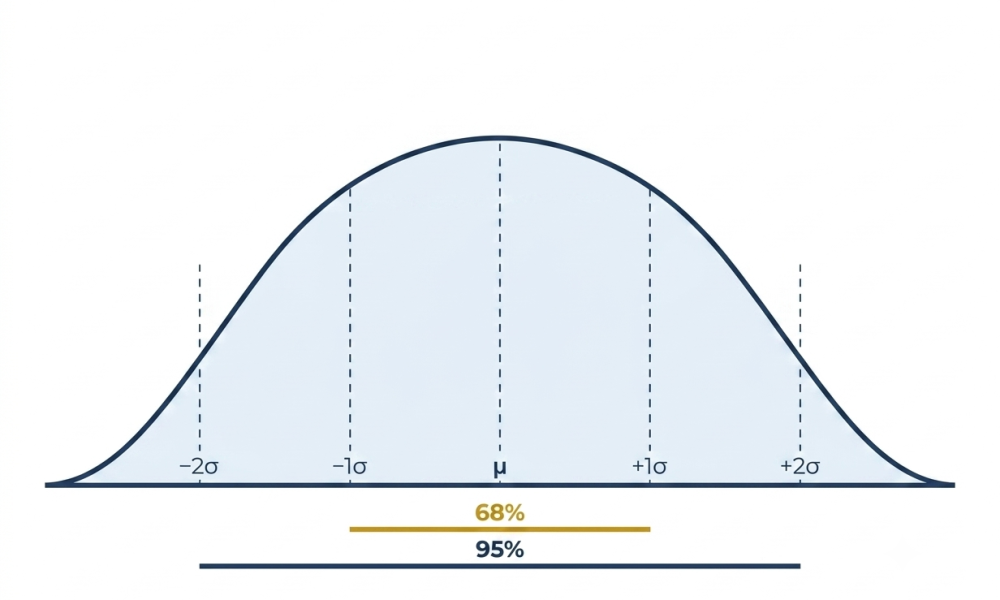
Once you have a standard deviation, the empirical rule (also called the 68-95-99.7 rule) tells you what percentage of data falls within 1, 2, or 3 standard deviations of the mean — assuming the data is approximately normally distributed (bell-shaped). This rule appears on the SAT, AP Statistics, and Florida EOC assessments.

1σ — 68% Rule

About 68% of all data values fall within 1 standard deviation of the mean — between (μ − σ) and (μ + σ). Example: if mean SAT score = 1050 and σ = 100, then 68% of students scored between 950 and 1150.

2σ — 95% Rule

About 95% of all data values fall within 2 standard deviations of the mean — between (μ − 2σ) and (μ + 2σ). Example: with the same data, 95% of students scored between 850 and 1250. Any score outside this range is unusual.

3σ — 99.7% Rule

About 99.7% of all data values fall within 3 standard deviations of the mean. Only 0.3% of data falls outside this range — these are statistical outliers. Example: only 0.3% of students scored below 750 or above 1350.

Common Standard Deviation Mistakes — and How to Fix Them

Using N instead of N−1 for a sample. If the problem gives you data from a survey or random sample, you must divide by N−1, not N. Dividing by N underestimates the true population spread. Fix: Read the problem carefully — “sample” → N−1 (“sample standard deviation”). “Population” → N (“population standard deviation”).
Forgetting to square the differences in Step 3. Students subtract the mean correctly but skip squaring — summing (x−μ) directly gives zero every time (the positive and negative deviations cancel). Fix: After subtracting the mean, immediately square each result: (x−μ)². The squaring step is what makes standard deviation work — it prevents cancellation.
Confusing standard deviation with variance. Variance = σ² (the mean of squared differences). Standard deviation = σ = √(variance). Many students stop at Step 4 and report variance as their answer. Fix: Standard deviation is always the square root of variance. If your answer doesn’t have the same units as the original data, you’ve reported variance — not standard deviation.
Thinking adding a constant changes standard deviation (SAT trap). On the SAT, if you add 10 to every data value, the mean increases by 10 — but the standard deviation stays the same. Students incorrectly choose the answer “both mean and SD increase.” Fix: Adding a constant shifts the whole data set uniformly — every (x−μ) difference is unchanged because both x and μ increase by the same amount. Only scaling (multiplying) changes SD.

Common Standard Deviation Mistakes — and How to Fix Them

PRACTICE 1 — EASY — CALCULATION EASY

The data set {2, 4, 4, 4, 5, 5, 7, 9} has a mean of 5. What is the population standard deviation? Round to two decimal places.

PRACTICE 2 — MEDIUM — INTERPRETATION MEDIUM

A school reports that the average GPA is 3.2 with a standard deviation of 0.1, while another school reports a GPA of 3.2 with a standard deviation of 0.8. At which school is the GPA more consistent across students? Explain why.

PRACTICE 3 — HARD — SAT-STYLE HARD

A data set has mean 50 and standard deviation 8. Every value in the set is multiplied by 3. What are the new mean and standard deviation?

Standard Deviation — Frequently Asked Questions

Standard deviation measures how spread out data values are from the average (mean) of a data set. A low standard deviation means most values are close to the mean; a high standard deviation means values are spread widely. Think of it as a “typical distance from the average” — the larger the number, the more variable the data.

Population standard deviation (σ) is used when your data set includes every member of the group you’re studying — you divide by N. Sample standard deviation (s) is used when your data is a random sample drawn from a larger population — you divide by N−1 (Bessel’s correction). On the SAT, sample standard deviation (N−1) is more common because most survey and experiment problems involve sampling.

No. The SAT does not require hand calculation of standard deviation. Instead, the SAT tests your ability to interpret standard deviation — for example, comparing which of two data sets has a greater standard deviation, predicting how adding or multiplying a constant affects the SD, or reading the spread of a histogram. Florida students who understand what SD means (not just the formula) are significantly better prepared for SAT Data Analysis questions.

The empirical rule states that in a normally distributed (bell-shaped) data set: approximately 68% of values fall within 1 standard deviation of the mean, 95% within 2 standard deviations, and 99.7% within 3 standard deviations. It applies when data is approximately normal — which is stated or implied in SAT and Florida EOC problems that use this rule.

Yes. Standard deviation is covered in Florida MAFS.912.S-ID.A.2 (use statistics appropriate to the shape of the distribution to compare center and spread) and MAFS.912.S-ID.A.3 (interpret differences in shape, center, and spread in the context of the data sets). These standards appear in Algebra 2, Precalculus, and AP Statistics courses, as well as Florida EOC and FSA assessments for high school students in Orlando, Winter Park, and Lake Nona.

Statistics Clicking — or Still Confusing?

Standard deviation is one of those concepts that makes sense the moment it’s explained the right way — and stays confusing until it is. InLighten’s certified math tutors in Orlando, Winter Park, and Lake Nona work one-on-one with high school students and student-athletes to close the gap between understanding the formula and performing on exam day.
Whether your student is working toward Bright Futures scholarship score thresholds, NCAA academic eligibility requirements, or simply needs to pass the Florida EOC — InLighten’s SAT Math and statistics programs are built around exactly these outcomes. Flexible scheduling works around practice, training, and game days.