
|
Preparing for the SAT? Claim Your Personalized Math Plan →
|
An arc in math is a portion of a circle’s circumference between two points. Every arc has two measurements: arc measure — the central angle in degrees (arc measure = central angle°); and arc length — the actual distance along the curve: arc length = (central angle° ÷ 360°) × 2πr, where r is the radius. Arcs appear in SAT Math circle geometry problems and Florida geometry EOC assessments.
An arc is a portion of a circle’s circumference between two points. Every arc has two measurements: arc measure (the central angle in degrees) and arc length (the actual distance along the curve), L = (central angle° ÷ 360°) × 2πr.
We're building a short video breaking down arc length and central angles step by step. Check back soon, or keep working through the examples above in the meantime.
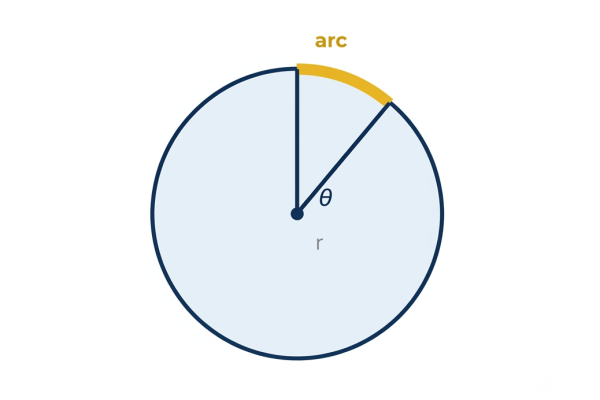
A connected portion of a circle’s circumference, the curved path between any two points on the circle. Every arc is measured two ways: by its arc measure (the central angle in degrees that intercepts the arc) and by its arc length (the actual linear distance along the curve, in the same units as the radius). A semicircle is an arc of exactly 180°.
They look similar but measure completely different things, in completely different units. Most arc problems need one of these three.
Units: degrees only — no length. If the central angle is 60°, the arc measures 60°. Arc measure is an angle, not a distance.
(θ/360) is the fraction of the circle; 2πr is the full circumference. Linear units (cm, m, in).
Only when θ is in radians. Convert: θ(rad) = θ(deg) × π ÷ 180. E.g. 60° = π/3. Appears in advanced SAT & pre-calc.
Arc length from a central angle. Radius 6 cm, central angle 90°.
Given diameter, find arc length. Diameter 20 m, central angle 144°.
Radian measure. Radius 5 in, central angle π/3 radians.
Arc questions live in “Additional Topics in Math.” Most give one missing variable in L = (θ/360°) × 2πr; the radian variant appears in advanced problems. Circle geometry is 10–12% of SAT Math points.
| SAT MATH SETUP | WHAT'S GIVEN | WHAT YOU SOLVE FOR |
|---|---|---|
| Standard arc length | Central angle (degrees) + radius | Arc length — use L = (θ/360°) × 2πr |
| Fraction-of-circle | Fraction of circle (e.g. ¼) + radius | Arc length — multiply fraction × 2πr directly |
| Reverse — find radius | Arc length + central angle | Radius — rearrange: r = L ÷ [(θ/360°) × 2π] |
| Radian arc length | Central angle (radians) + radius | Arc length — use L = rθ (no conversion) |
| Sector proportion | Central angle + circle area | Sector area — A = (θ/360°) × πr² |
Three related circle concepts that students confuse, each with its own formula.
A curved portion of the circumference. Minor arc < 180°, major arc > 180°; a semicircle is exactly 180°. Measured in degrees or linear units.
The "pie slice" region enclosed by two radii and the arc. Has area (square units). Same (θ/360) structure as arc length — the arc is just its curved edge.
A straight segment joining two points on the circle — not a curve. The diameter is the longest chord. A chord splits the circle into a minor and major arc.
Arc measure is an angle (degrees, no distance); arc length is the curved distance (cm, m, in). Different quantities, different formulas.
Fix: write the units as your first check. A degree symbol on an arc-length answer means the wrong formula.
L = (θ/360°) × 2πr needs the radius. Using diameter gives an answer exactly 2× too large.
Fix: if a diameter is given, write r = d ÷ 2 as Step 1 before touching the arc formula.
L = rθ works only in radians. 90° is not 90 radians (it's π/2 ≈ 1.57).
Fix: confirm the angle unit first. Degrees → convert, or use the (θ/360°) × 2πr formula instead.
Skipping the (θ/360°) fraction computes the whole circle, not the arc.
Fix: arc length = (fraction of circle) × circumference, and the fraction is always θ ÷ 360°.
Struggling with arc problems like these? InLighten's certified math tutors in Orlando build a targeted plan around exactly these gaps.
Work each one, then reveal the answer to check yourself.
A circle has radius 9 cm and a central angle of 120°. Find the arc length (leave in terms of π).
An arc has length 5π m and the central angle is 90°. Find the radius.
A central angle of 2π/3 radians intercepts an arc on a circle of radius 12 in. Find the arc length.
A sector has central angle 45° and radius 8 cm. Find (a) the arc length and (b) the sector area.
A curved portion of a circle's circumference between two points. Arcs are measured two ways: arc measure (the central angle in degrees) and arc length (the actual linear distance along the curve, in cm/m/in). A semicircle is an arc of exactly 180°.
Arc Length = (central angle° ÷ 360°) × 2πr, where r is the radius — the arc as a fraction of the full circumference. When the angle is in radians, it simplifies to L = rθ. Always check whether the angle is in degrees or radians before choosing.
Arc measure is the central angle in degrees (e.g. 60°) — no distance units. Arc length is the actual curved distance (e.g. 6π cm), in the same units as the radius. Two arcs can share an arc measure but have different arc lengths if their radii differ. Confusing them is the #1 arc error on the SAT.
An arc is the curved boundary between two points — one-dimensional, measured in linear units. A sector is the "pie slice" region enclosed by two radii and the arc — two-dimensional, measured in square units. Arc: L = (θ/360°) × 2πr. Sector: A = (θ/360°) × πr².
In "Additional Topics in Math" (circle geometry). Problems give a central angle and radius and ask for arc length, or give arc length and angle and ask for the radius (rearrange). Advanced problems use radians (L = rθ). The most common error is using diameter instead of radius. See MAFS.912.G-C.2 on CPALMS for Florida alignment.
SAT® is a registered trademark belonging to the College Board. The College Board is not involved with or affiliated with Inlighten Tutoring, nor does the College Board endorse or sponsor any of the products or services offered by Inlighten Tutoring. ACT® is a registered trademark belonging to ACT, Inc. ACT, Inc. is not involved with or affiliated with Inlighten Tutoring, nor does ACT, Inc. endorse or sponsor any of the products or services offered by Inlighten Tutoring.
2026 Inlighten Tutoring. All Rights Reserved